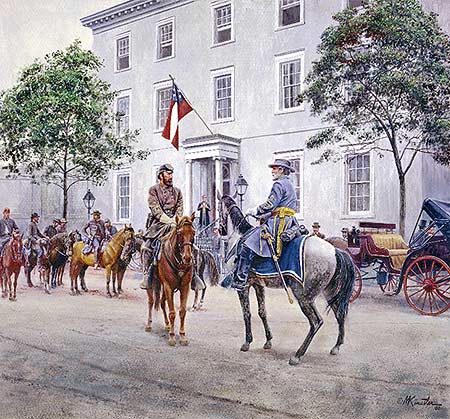
Let's continue with Private Carlton McCarthy's account of life in the Army of Northern Virginia.
It is amusing to think of the follies of the early part of the war, as illustrated by the outfits of the volunteers. They were so heavily clad, and so burdened with all manners of things, that a march was torture, and the wagon trains were so immense in proportion to the number of troops, that it would have been impossible to guard them in an enemy's country. Subordinate officers thought themselves entitled to transportation for trunks, mattresses, and folding bedsteads, and the privates were ridiculous in their demands.
Thus much by way of introduction. The change came rapidly, and stayed not until the transformation was complete. Nor was this change attributable alone to the orders of the general officers. The men soon learned the inconvenience and danger of so much luggage, and, as they be came more experienced, they vied with each other in reducing themselves to light-marching trim.
Experience soon demonstrated that boots were not agreeable on a long march. They were heavy and irksome, and when the heels were won a little one-sided, the wearer would find his ankle twisted nearly out of joint by every unevenness of the road. When thoroughly wet, it was a laborious undertaking to get the off; and worse to get them on in time to answer the morning roll-call. And so, good, strong brogues, or brogans, with broad bottoms and big, fat heels, succeeded the boots, and were found more more comfortable and agreeable, easier on and off, and altogether the more sensible.
A short-waisted and single-breasted jacket usurped the place of the longtailed coat, and became universal. The enemy noticed this peculiarity, and called the Confederates gray jackets which name was immediately transferred to those lively creatures which were the constant admirers and inseparable companions of the Boys in Gray and Blue.
Caps were destined to hold out longer than some other uncomfortable things, but they finally yielded to the demands of comfort and common sense, and a good soft felt hat was worn instead. A man who has never been a soldier does not know, nor indeed can know, the amount of comfort there is in a good soft hat in camp, and how utterly useless is a "soldier hat" as they are generally made. Why the Prussians with all their experience, wear they heavy, unyielding helmets, and the French their little caps, is a mystery to a Confederate who has enjoyed the comfort of an old slouch.
Overcoats an inexperienced man would think an absolute necessity for men exposed to the rigors of a northern Virginia winter, but they grew scarcer and scarcer; they were found to be a great inconvenience. The men came to the conclusion that the trouble of carrying them on hot days outweighed the comfort of having them when the cold day arrived. Besides they found that life in the open air hardened them to such an extent that changes in the temperatures were not felt to any degree. Some clung to the overcoats to the last, but the majority got tired of lugging them around and either discarded them altogether, or trusted to capturing one about the time it would needed. Nearly every overcoat in the army in the later years was one of Uncle Sam's captured from his boys.
The knapsack vanished early in the struggle. It was inconvenient to "change" the underwear too often, and the disposition not to change grew, as the knapsack was found to gall the back and soldiers, and weary the man before half the march was accomplished. The better way was to dress out and out, and wear the outfit until the enemy's knapsacks, or the folks at home supplied a change. Certainly it did not pay to carry around clear clothes while waiting for the time to use them.
Wednesday, July 30, 2008
Tuesday, July 29, 2008
Minutia of Soldier Life in The Army of Northern Virginia - Part One
Private Carlton McCarthy of the Richmond Howitzers writes in detail what it was like to be a soldier in the Army of Northern Virginia.
The volunteer of 1861 made extensive preparations for the field. Boots, he though, were an absolute necessity, and the heavier the soles and longer the tops the better. His pants were stuffed inside the top of his boots, of course. A double-breasted coat, heavily wadded, with two rows of big brass buttons and a long skirt, was considered comfortable. A small stiff cap, with a narrow brim, took the place of the comfortable "felt," or the shining and towering tile worn in civil life.
Then over all was a huge overcoat, long and heavy, with a cape reaching nearly to the waist. on his back he strapped a knapsack containing a full stock of underwear, soap, towels, comb, brush, looking-glass, tooth-brush, paper and envelopes, pens, ink, pencils, blacking, pipes, twine string, and cotton strips for wounds and other emergencies, needles and thread, but tones, knife, fork, and spoon, and many other things as each man's idea of what he was to encounter varied. On the outside of the knapsack, solidly folded, were two great blankets and a rubber or oil-cloth. This knapsack, etc. weighed from 15 to 25 pounds, sometimes more. All seemed to think it was impossible to have on too heavy clothes, or to have too many conveniences, and each had an idea that to be a good soldier he must be provided against every emergency.
In addition to the knapsack, each man had a haversack, more or less costly, some of cloth and some of fine morocco, and stored with provisions always, as though he expected any moment to receive orders to march across the Great Desert, and supply his own wants on the way. A canteen was considered indispensable, and at the outset it was thought prudent to keep it full of water. Many, expecting terrific hand-to-hand encounters, carried revolvers, and even bowie knives. Merino shirts (and flannel) were thought to be the right thing, but experience demonstrated the contrary. Gloves were also thought to be very necessary and good things to have in winter time, the favorite style being buck gauntlets with long cuffs.
In addition to each man's private luggage, each mess, generally composed of from five to ten men, drawn together by similar tastes and associations, had its outfit, consisting of a large camp chest containing skillet, frying pan, coffee boiler, bucket for lard, coffee box, salt box, meal box, your box, knives, forks, spoons, plates, cups, etc., etc., These chests were so large that 8 to 10 filled up an army wagon, and were so heavy that two strong men had all they could do to get one of them into the wagon. In addition to the chest, each mess owned an axe, water bucket, and bread tray. Then the tents of each company, and little sheet iron stoves and stoves pipes, and the trucks and valises of the company officers, made an immense pile of stuff, so that each company had a small wagon train of its own.
All thought money to be absolutely necessary, and for a while rations were disdained and the mess supplied with the best that could be bought with the mess fund. Quite a large number had a "boy" along to do the cooking and washing. Think of it! A Confederate soldier with a body servant all his own, to bring him a drink of water, black his boots, dust his clothes, cook his corn bread and bacon, and put wood on his fire. Never was there fonder admiration than these darkies displayed for their masters. Their chief delight and glory was to praise the courage and good looks of "Mahse Tom," and prophesy great things about his future. Many a ringing laugh and shout of fun originated in the queer remarks, shining countenances, and glistening teeth of this now forever departed character.
The volunteer of 1861 made extensive preparations for the field. Boots, he though, were an absolute necessity, and the heavier the soles and longer the tops the better. His pants were stuffed inside the top of his boots, of course. A double-breasted coat, heavily wadded, with two rows of big brass buttons and a long skirt, was considered comfortable. A small stiff cap, with a narrow brim, took the place of the comfortable "felt," or the shining and towering tile worn in civil life.
Then over all was a huge overcoat, long and heavy, with a cape reaching nearly to the waist. on his back he strapped a knapsack containing a full stock of underwear, soap, towels, comb, brush, looking-glass, tooth-brush, paper and envelopes, pens, ink, pencils, blacking, pipes, twine string, and cotton strips for wounds and other emergencies, needles and thread, but tones, knife, fork, and spoon, and many other things as each man's idea of what he was to encounter varied. On the outside of the knapsack, solidly folded, were two great blankets and a rubber or oil-cloth. This knapsack, etc. weighed from 15 to 25 pounds, sometimes more. All seemed to think it was impossible to have on too heavy clothes, or to have too many conveniences, and each had an idea that to be a good soldier he must be provided against every emergency.
In addition to the knapsack, each man had a haversack, more or less costly, some of cloth and some of fine morocco, and stored with provisions always, as though he expected any moment to receive orders to march across the Great Desert, and supply his own wants on the way. A canteen was considered indispensable, and at the outset it was thought prudent to keep it full of water. Many, expecting terrific hand-to-hand encounters, carried revolvers, and even bowie knives. Merino shirts (and flannel) were thought to be the right thing, but experience demonstrated the contrary. Gloves were also thought to be very necessary and good things to have in winter time, the favorite style being buck gauntlets with long cuffs.
In addition to each man's private luggage, each mess, generally composed of from five to ten men, drawn together by similar tastes and associations, had its outfit, consisting of a large camp chest containing skillet, frying pan, coffee boiler, bucket for lard, coffee box, salt box, meal box, your box, knives, forks, spoons, plates, cups, etc., etc., These chests were so large that 8 to 10 filled up an army wagon, and were so heavy that two strong men had all they could do to get one of them into the wagon. In addition to the chest, each mess owned an axe, water bucket, and bread tray. Then the tents of each company, and little sheet iron stoves and stoves pipes, and the trucks and valises of the company officers, made an immense pile of stuff, so that each company had a small wagon train of its own.
All thought money to be absolutely necessary, and for a while rations were disdained and the mess supplied with the best that could be bought with the mess fund. Quite a large number had a "boy" along to do the cooking and washing. Think of it! A Confederate soldier with a body servant all his own, to bring him a drink of water, black his boots, dust his clothes, cook his corn bread and bacon, and put wood on his fire. Never was there fonder admiration than these darkies displayed for their masters. Their chief delight and glory was to praise the courage and good looks of "Mahse Tom," and prophesy great things about his future. Many a ringing laugh and shout of fun originated in the queer remarks, shining countenances, and glistening teeth of this now forever departed character.

Saturday, July 26, 2008
General Imboden's Report of General Lee after Pickett's Charge
When night closed the struggle, Lee's army was repulsed. We all knew that the day had gone against us, but the full extent of the disaster was only known in high quarters. The carnage of the day was generally understood to have been frightful, yet our army was not in retreat, and it was surmised in the camp that with tomorrow's dawn would come a renewal of the struggle. All felt and appreciated the momentous consequences to the cause of Southern independence of final defeat or victory on that great field.
It was a warm summer's night; there were few campfires and the weary soldiers were lying in groups on the luxuriant grass of the beautiful meadows, discussing the events of the day, speculating on the morrow, or watching that our horses did not straggle off while browsing. About 11 o'clock a horseman came to summon me to General Lee. I promptly mounted and, accompanied by Lieutenant George W. McPhail, an aide on my staff, and guided by the courier who brought the message, rode bout two miles toward Gettysburg to where half a dozen small tents were pointed out, a little way from the roadside to our left, as General Lee's headquarters for the night. On inquiry I found that he was not there, but had gone to the headquarters of General A.P. Hill, about a half a mile nearer to Gettysburg. When we reached the place indicated, a single flickering candle, visible from the road through the open front of the common wall tent, exposed to view Generals Lee and Hill seated on camp stools with a map spread upon their knees. Dismounting, I approached on foot. After exchanging the ordinary salutation, General Lee directed me to go back to his headquarters and wait for him. I did so, but he did not make his appearance until about 1 o'clock, when he came riding alone, at a slow walk, and evidently wrapped in profound thought.
When he arrived there was not even a sentinel on duty at his tent, and no one of his staff was awake. The moon was high in the clear sky and the silent scene was unusually vivid. As he approached and saw us lying on the grass under a tree, he spoke, reined in his jaded horse, and essayed to dismount. The effort to do so betrayed so much physical exhaustion that I hurriedly rose and stepped forward to assist him, but before I reached his side he had succeeded in alighting and threw his arm across the saddle to rest, and fixing his eyes upon the ground leaned in silence and almost motionless upon his equally weary horse, -- the two forming a striking and never-to-be-forgotten group. The moon shone full upon his massive features and revealed an expression of sadness that I have never before seen upon his face. Awed by his appearance, I waited for him to speak until the silence became embarrassing, when, to break it and change the silent current of his thoughts, I ventured to remark, in a sympathetic tone, and in allusion to his great fatigue: "General this day has been a hard day on you."
He looked up and replied mournfully: "Yes, it has been a sad day to us;" and immediately relapsed into his thoughtful mood and attitude.
Being uwilling again to intrude upon his reflections, I said no more. After perhaps a minute or two, he suddenly straightened up to his full height, and turning to me with more animation and excitement of manner than I had even seen in him before, for he was a man of wonderful equanimity, he said in a voice tremulous with emotion: "I never saw troops behave more magnificently than Pickett's division of Virginians did today in that grand charge upon the enemy. And if they had been supported as they were to have been -- but, for some reason not yet fully explained to me, were not, -- we would have held the position and the day would have been ours." After a moment's pause, he added in a loud voice, in a tone almost of agony, "Too bad! Too bad! OH! TOO BAD!"
I shall never forget his language, his manner, and his appearance of mental suffering. In a few moments all emotion was suppressed, and he spoke feelingly of several of his fallen and trusted officers; among others Brigadier Generals Armistead, Garnett, and Kemper of Picket's division.
It was a warm summer's night; there were few campfires and the weary soldiers were lying in groups on the luxuriant grass of the beautiful meadows, discussing the events of the day, speculating on the morrow, or watching that our horses did not straggle off while browsing. About 11 o'clock a horseman came to summon me to General Lee. I promptly mounted and, accompanied by Lieutenant George W. McPhail, an aide on my staff, and guided by the courier who brought the message, rode bout two miles toward Gettysburg to where half a dozen small tents were pointed out, a little way from the roadside to our left, as General Lee's headquarters for the night. On inquiry I found that he was not there, but had gone to the headquarters of General A.P. Hill, about a half a mile nearer to Gettysburg. When we reached the place indicated, a single flickering candle, visible from the road through the open front of the common wall tent, exposed to view Generals Lee and Hill seated on camp stools with a map spread upon their knees. Dismounting, I approached on foot. After exchanging the ordinary salutation, General Lee directed me to go back to his headquarters and wait for him. I did so, but he did not make his appearance until about 1 o'clock, when he came riding alone, at a slow walk, and evidently wrapped in profound thought.
When he arrived there was not even a sentinel on duty at his tent, and no one of his staff was awake. The moon was high in the clear sky and the silent scene was unusually vivid. As he approached and saw us lying on the grass under a tree, he spoke, reined in his jaded horse, and essayed to dismount. The effort to do so betrayed so much physical exhaustion that I hurriedly rose and stepped forward to assist him, but before I reached his side he had succeeded in alighting and threw his arm across the saddle to rest, and fixing his eyes upon the ground leaned in silence and almost motionless upon his equally weary horse, -- the two forming a striking and never-to-be-forgotten group. The moon shone full upon his massive features and revealed an expression of sadness that I have never before seen upon his face. Awed by his appearance, I waited for him to speak until the silence became embarrassing, when, to break it and change the silent current of his thoughts, I ventured to remark, in a sympathetic tone, and in allusion to his great fatigue: "General this day has been a hard day on you."
He looked up and replied mournfully: "Yes, it has been a sad day to us;" and immediately relapsed into his thoughtful mood and attitude.
Being uwilling again to intrude upon his reflections, I said no more. After perhaps a minute or two, he suddenly straightened up to his full height, and turning to me with more animation and excitement of manner than I had even seen in him before, for he was a man of wonderful equanimity, he said in a voice tremulous with emotion: "I never saw troops behave more magnificently than Pickett's division of Virginians did today in that grand charge upon the enemy. And if they had been supported as they were to have been -- but, for some reason not yet fully explained to me, were not, -- we would have held the position and the day would have been ours." After a moment's pause, he added in a loud voice, in a tone almost of agony, "Too bad! Too bad! OH! TOO BAD!"
I shall never forget his language, his manner, and his appearance of mental suffering. In a few moments all emotion was suppressed, and he spoke feelingly of several of his fallen and trusted officers; among others Brigadier Generals Armistead, Garnett, and Kemper of Picket's division.
Friday, July 25, 2008
Lee Reviews the Third Corps in Summer 1863
Lee's youngest son, Captain Robert E. Lee, Jr., writes about Lee's review of A.P. Hill's Third Corps in August, 1863. I enjoyed the story and hope you do to.
During this period of rest, so unusual to the Army of Northern Virginia, several reviews were held before the commanding general. I remember being present when that of the Third Army Corps, General A.P. Hill commanding, took place. Some of us young cavalrymen, then stationed near the Rappahannock, rode over to Orange Court House to see this grant military pageant. From all parts of the army, officers and men, who could get leave came to look on, and from all the surrounding country the people, old and young, ladies and children, came in every pattern of vehicle and on horse back, to see twenty thousand of that "incomparable infantry" of the Army of Northern Virginia pass in review before their great commander.
The General was mounted on Traveller, looking very proud of his master, who had on sash and sword, which he very rarely wore, a pair-of new cavalry gauntlets, and, I think, a new hat. At any rate, he looked unusually fine, and sat his horse like a perfect picture of grace and power. The infantry was drawn up in column by divisions, with their great muskets all glittering in the sun, their battle-flags standing straight out before the breeze, and their bands playing, awaiting the inspection of the General, before they broke into column by companies and marched past him in review.
When all was ready, General Hill and staff rode up to General Lee, and the two generals, with their respective staffs, galloped around front and rear of each of the three divisions standing motionless on the plain. As the cavalcade reached the head of each division, its commanding officer joined in and followed as far as the new division, so that there was a continual infusion of fresh groups into the original one all along the lines.
Traveller started with a long lope, and never changed his stride. His rider sat erect and calm, not noticing anything but the gray lines of men whom he knew so well. The pace was very fast, as there were nine good miles to go, and the escort began to become less and less, dropping out one by one from different causes as Traveller raced along without a check.
When the General drew up, after this nine-mile gallop, under the standard at the reviewing stand, flushed with the exercise as well as with pride in his brave men, he raised his hat and saluted. Then arose a shout of applause and admiration from the entire assemblage, the memory of which to this day moistens the eye of every old soldier.
During this period of rest, so unusual to the Army of Northern Virginia, several reviews were held before the commanding general. I remember being present when that of the Third Army Corps, General A.P. Hill commanding, took place. Some of us young cavalrymen, then stationed near the Rappahannock, rode over to Orange Court House to see this grant military pageant. From all parts of the army, officers and men, who could get leave came to look on, and from all the surrounding country the people, old and young, ladies and children, came in every pattern of vehicle and on horse back, to see twenty thousand of that "incomparable infantry" of the Army of Northern Virginia pass in review before their great commander.
The General was mounted on Traveller, looking very proud of his master, who had on sash and sword, which he very rarely wore, a pair-of new cavalry gauntlets, and, I think, a new hat. At any rate, he looked unusually fine, and sat his horse like a perfect picture of grace and power. The infantry was drawn up in column by divisions, with their great muskets all glittering in the sun, their battle-flags standing straight out before the breeze, and their bands playing, awaiting the inspection of the General, before they broke into column by companies and marched past him in review.
When all was ready, General Hill and staff rode up to General Lee, and the two generals, with their respective staffs, galloped around front and rear of each of the three divisions standing motionless on the plain. As the cavalcade reached the head of each division, its commanding officer joined in and followed as far as the new division, so that there was a continual infusion of fresh groups into the original one all along the lines.
Traveller started with a long lope, and never changed his stride. His rider sat erect and calm, not noticing anything but the gray lines of men whom he knew so well. The pace was very fast, as there were nine good miles to go, and the escort began to become less and less, dropping out one by one from different causes as Traveller raced along without a check.
When the General drew up, after this nine-mile gallop, under the standard at the reviewing stand, flushed with the exercise as well as with pride in his brave men, he raised his hat and saluted. Then arose a shout of applause and admiration from the entire assemblage, the memory of which to this day moistens the eye of every old soldier.
Wednesday, July 23, 2008
Henry Kyd Douglas Relates a Comic Scene
Here is a rather funny account by Henry Kyd Douglas that reveals the relationship between Jackson and Stuart. It comes from Douglas’ autobiography, I Rode With Stonewall.
One night, after the middle of it, General Stuart came riding into our Headquarters accompanied by his artillery pet, Captain John Pelham, the “boy Major,” as he was afterwards called, or the “the gallant Pelham,” as General Lee named him at Fredericksburg… Everyone had gone to rest. Stuart went directly to General Jackson’s tent; Pelham came into mine. The General was asleep and the cavalry chief threw himself down by his side, taking off nothing but his saber. As the night became chilly, so did he, and unconsciously he began to take possession of blankets and got between the sheets. There he discovered himself in the early morn in the full panoply of war, and he got out of it. After a while, when a lot of us were standing by a blazing log-fire before the General’s tent, he came out for us ablutions.
“Good morning, General Jackson,” said Stuart, “how are you?”
Old Jack passed his hands through his thin and uncombed hair and then in tones as nearly comic as he could muster, he said, “General Stuart, I’m always glad to see you here. You might select better hours sometimes, but I’m always glad to have you. But, General” – as he stooped and rubbed himself along the legs – “you must not get into my bed with your boots and spurs on and ride me around like a cavalry horse all night!”
One night, after the middle of it, General Stuart came riding into our Headquarters accompanied by his artillery pet, Captain John Pelham, the “boy Major,” as he was afterwards called, or the “the gallant Pelham,” as General Lee named him at Fredericksburg… Everyone had gone to rest. Stuart went directly to General Jackson’s tent; Pelham came into mine. The General was asleep and the cavalry chief threw himself down by his side, taking off nothing but his saber. As the night became chilly, so did he, and unconsciously he began to take possession of blankets and got between the sheets. There he discovered himself in the early morn in the full panoply of war, and he got out of it. After a while, when a lot of us were standing by a blazing log-fire before the General’s tent, he came out for us ablutions.
“Good morning, General Jackson,” said Stuart, “how are you?”
Old Jack passed his hands through his thin and uncombed hair and then in tones as nearly comic as he could muster, he said, “General Stuart, I’m always glad to see you here. You might select better hours sometimes, but I’m always glad to have you. But, General” – as he stooped and rubbed himself along the legs – “you must not get into my bed with your boots and spurs on and ride me around like a cavalry horse all night!”
Saturday, July 19, 2008
Personal Recollections of General Lee by General Pendleton
This account by General William Pendleton (father of Jackson's adjutant Sandie Pendleton) is from the Battle of Fredericksburg. General Pendleton attended West Point but resigned from the army to pursue the ministry. When the war broke out, he was the rector of Grace Church in Lexington, Virginia. At the time of Fredericksburg, he was the Chief of Artillery in the Army of Northern Virginia.
From the prominent points in our line almost the entire scene could be taken in by the eye. And at one of these, the most commanding, where we had a few powerful guns, General Lee remained much of the day, observing the field; only too indifferent, as was his wont, to danger from the large, numerous, and well-aimed missles hurled especially thither from the enemy's heavy batteries across the Rappahannock. Seldom, in all the wars of the world, has a spectacle been presented like that which, from this central elevation, we looked upon. More than 100,000 blue-coated men in the open plain, with every military appliance, in battle order, and moving in their respective subdivisions to attack our line. Although our numbers were certainly not half those of the enemy, there was misgiving, probably, in no officer or man as to the result.
Events in one quarter of the field, as it lay before us, attracted peculiar interest, and gave occasion to one of those characteristics remarks of General Lee which told at once of his capacity for enjoying the excitements of action, and of the good feeling and strong principle that kept it under control. A large force advanced rapidly to charge our right. Stonewall Jackson was there, and that he would promptly hurl them back little doubt was entertained. Still no such assault can be witnessed without earnest interest, if not concern. Nor was the shock arrived on our side without loss. There fell the heroic General Gregg, of the gallant and now vengeance-suffering State of South Carolina. Presently, however, as was anticipated, the spirited charge was reversed, and the blue figures by thousands were seen recrossing, "double quick," with faces to the rear, the space they had traversed, and hundreds of gray pursuers hastening their speed. while younger spectators near us gave expression of their feelings by shouts, clapping of hands, &c., the gratified yet considerate andamiable commander turned to myself, and with beaming countenance said, "It is well war is so terrible, or we should get too fond of it."
Not long after that an incident occurred, which made us shudder for our beloved chief. One of the large guns on that eminence, having to be plied continuously against another portion of the enemy's line, which was advancing to charge the part of our defenses held by the good and gallant Georgian, General Tom Cobb, and being, like much hastily-cast Sotuhern ordinance, of insufficient tenacity, finally burst with prodigious violence. None, wonderfully and happily, was struck by its fragments. And, remarkably, those who stood nearest, of whom the individual relating to you was one, within a little over arm's length, although considerably jarred by the shock, proved to be really in less danger than others further off. General Lee was standing perhaps fifty feet in the rear, and a large piece of the cannon, weighing, we estimated, about a third of a ton, fell just beyond him. He thus very narrowly escaped death. Like himself, however, he only looked upon the mass calmly for a moment, and then, without a syllable expressive of surprise or concern, continued the business occupying him at the time.
From the prominent points in our line almost the entire scene could be taken in by the eye. And at one of these, the most commanding, where we had a few powerful guns, General Lee remained much of the day, observing the field; only too indifferent, as was his wont, to danger from the large, numerous, and well-aimed missles hurled especially thither from the enemy's heavy batteries across the Rappahannock. Seldom, in all the wars of the world, has a spectacle been presented like that which, from this central elevation, we looked upon. More than 100,000 blue-coated men in the open plain, with every military appliance, in battle order, and moving in their respective subdivisions to attack our line. Although our numbers were certainly not half those of the enemy, there was misgiving, probably, in no officer or man as to the result.
Events in one quarter of the field, as it lay before us, attracted peculiar interest, and gave occasion to one of those characteristics remarks of General Lee which told at once of his capacity for enjoying the excitements of action, and of the good feeling and strong principle that kept it under control. A large force advanced rapidly to charge our right. Stonewall Jackson was there, and that he would promptly hurl them back little doubt was entertained. Still no such assault can be witnessed without earnest interest, if not concern. Nor was the shock arrived on our side without loss. There fell the heroic General Gregg, of the gallant and now vengeance-suffering State of South Carolina. Presently, however, as was anticipated, the spirited charge was reversed, and the blue figures by thousands were seen recrossing, "double quick," with faces to the rear, the space they had traversed, and hundreds of gray pursuers hastening their speed. while younger spectators near us gave expression of their feelings by shouts, clapping of hands, &c., the gratified yet considerate andamiable commander turned to myself, and with beaming countenance said, "It is well war is so terrible, or we should get too fond of it."
Not long after that an incident occurred, which made us shudder for our beloved chief. One of the large guns on that eminence, having to be plied continuously against another portion of the enemy's line, which was advancing to charge the part of our defenses held by the good and gallant Georgian, General Tom Cobb, and being, like much hastily-cast Sotuhern ordinance, of insufficient tenacity, finally burst with prodigious violence. None, wonderfully and happily, was struck by its fragments. And, remarkably, those who stood nearest, of whom the individual relating to you was one, within a little over arm's length, although considerably jarred by the shock, proved to be really in less danger than others further off. General Lee was standing perhaps fifty feet in the rear, and a large piece of the cannon, weighing, we estimated, about a third of a ton, fell just beyond him. He thus very narrowly escaped death. Like himself, however, he only looked upon the mass calmly for a moment, and then, without a syllable expressive of surprise or concern, continued the business occupying him at the time.
Friday, July 18, 2008
Who Could Not Conquer With Such Troops as These? - Part Two
Below is the conclusion to Dabney's article.
On the morning of the 26th, he (Jackson) turned eastward, and passing through the Bull Run Mountains, at Thoroughfare Gap, proceeded to Bristoe Station, on the Orange Railroad, by another equally arduous march. At Gainesville, he was joined by Stuart, with his cavalry, who now assumed the duty of guarding his right flank and watching the main army of Pope about Warrenton. As the Confederates approached Bristoe Station, about sunset, the roar of a railroad train proceeding eastward was heard and dispositions were made to arrest it by placing the brigade of Hays, under Colonel Forno, across the track. The first train broke through the obstructions placed before it and escaped. Two others which followed it were captured but were found to contain nothing.
The corps of Jackson had now marched fifty miles in two days. The whole army of Pope was interposed between it and its friends. They had no supplies whatever, save those which the might capture from the enemy. But they were between the enemy and his capital and were cheered by the hope of inflicting a vital blow upon him before he escaped. This movement would be pronounced wrong if judged by a formal and common-place application of the maxims of the military art. But it is the very prerogative of true genius to know how to modify the application of those rules according to circumstances. It might have been objected that such a division of the Confederate Army into two parts; subjected to the risk of being beaten in detail; that while the Federal commander detained and amused one by a detachment, he would turn upon the other with the chief weight of his forces and crush it into fragments. Had Pope been a Jackson this danger would have been real; but because Pope was but Pope and General Lee had a Jackson to execute the bold conception and a Stuart to mask his movements during its progress, the risk was too small to forbid the attempt. The promptitude of General Stuart in seizing the only signal station whence the line of march could possibly be perceived and the secrecy and rapidity of General Jackson in pursuing it. with the energy of his action when he had reached his goal, ensured the success of the movement.
On the morning of the 26th, he (Jackson) turned eastward, and passing through the Bull Run Mountains, at Thoroughfare Gap, proceeded to Bristoe Station, on the Orange Railroad, by another equally arduous march. At Gainesville, he was joined by Stuart, with his cavalry, who now assumed the duty of guarding his right flank and watching the main army of Pope about Warrenton. As the Confederates approached Bristoe Station, about sunset, the roar of a railroad train proceeding eastward was heard and dispositions were made to arrest it by placing the brigade of Hays, under Colonel Forno, across the track. The first train broke through the obstructions placed before it and escaped. Two others which followed it were captured but were found to contain nothing.
The corps of Jackson had now marched fifty miles in two days. The whole army of Pope was interposed between it and its friends. They had no supplies whatever, save those which the might capture from the enemy. But they were between the enemy and his capital and were cheered by the hope of inflicting a vital blow upon him before he escaped. This movement would be pronounced wrong if judged by a formal and common-place application of the maxims of the military art. But it is the very prerogative of true genius to know how to modify the application of those rules according to circumstances. It might have been objected that such a division of the Confederate Army into two parts; subjected to the risk of being beaten in detail; that while the Federal commander detained and amused one by a detachment, he would turn upon the other with the chief weight of his forces and crush it into fragments. Had Pope been a Jackson this danger would have been real; but because Pope was but Pope and General Lee had a Jackson to execute the bold conception and a Stuart to mask his movements during its progress, the risk was too small to forbid the attempt. The promptitude of General Stuart in seizing the only signal station whence the line of march could possibly be perceived and the secrecy and rapidity of General Jackson in pursuing it. with the energy of his action when he had reached his goal, ensured the success of the movement.
Subscribe to:
Posts (Atom)