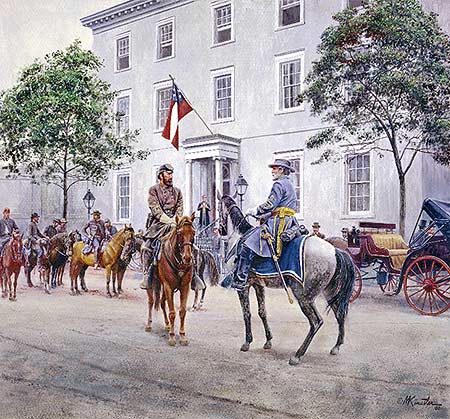
When night closed the struggle, Lee's army was repulsed. We all knew that the day had gone against us, but the full extent of the disaster was only known in high quarters. The carnage of the day was generally understood to have been frightful, yet our army was not in retreat, and it was surmised in the camp that with tomorrow's dawn would come a renewal of the struggle. All felt and appreciated the momentous consequences to the cause of Southern independence of final defeat or victory on that great field.
It was a warm summer's night; there were few campfires and the weary soldiers were lying in groups on the luxuriant grass of the beautiful meadows, discussing the events of the day, speculating on the morrow, or watching that our horses did not straggle off while browsing. About 11 o'clock a horseman came to summon me to General Lee. I promptly mounted and, accompanied by Lieutenant George W. McPhail, an aide on my staff, and guided by the courier who brought the message, rode bout two miles toward Gettysburg to where half a dozen small tents were pointed out, a little way from the roadside to our left, as General Lee's headquarters for the night. On inquiry I found that he was not there, but had gone to the headquarters of General A.P. Hill, about a half a mile nearer to Gettysburg. When we reached the place indicated, a single flickering candle, visible from the road through the open front of the common wall tent, exposed to view Generals Lee and Hill seated on camp stools with a map spread upon their knees. Dismounting, I approached on foot. After exchanging the ordinary salutation, General Lee directed me to go back to his headquarters and wait for him. I did so, but he did not make his appearance until about 1 o'clock, when he came riding alone, at a slow walk, and evidently wrapped in profound thought.
When he arrived there was not even a sentinel on duty at his tent, and no one of his staff was awake. The moon was high in the clear sky and the silent scene was unusually vivid. As he approached and saw us lying on the grass under a tree, he spoke, reined in his jaded horse, and essayed to dismount. The effort to do so betrayed so much physical exhaustion that I hurriedly rose and stepped forward to assist him, but before I reached his side he had succeeded in alighting and threw his arm across the saddle to rest, and fixing his eyes upon the ground leaned in silence and almost motionless upon his equally weary horse, -- the two forming a striking and never-to-be-forgotten group. The moon shone full upon his massive features and revealed an expression of sadness that I have never before seen upon his face. Awed by his appearance, I waited for him to speak until the silence became embarrassing, when, to break it and change the silent current of his thoughts, I ventured to remark, in a sympathetic tone, and in allusion to his great fatigue: "General this day has been a hard day on you."
He looked up and replied mournfully: "Yes, it has been a sad day to us;" and immediately relapsed into his thoughtful mood and attitude.
Being uwilling again to intrude upon his reflections, I said no more. After perhaps a minute or two, he suddenly straightened up to his full height, and turning to me with more animation and excitement of manner than I had even seen in him before, for he was a man of wonderful equanimity, he said in a voice tremulous with emotion: "I never saw troops behave more magnificently than Pickett's division of Virginians did today in that grand charge upon the enemy. And if they had been supported as they were to have been -- but, for some reason not yet fully explained to me, were not, -- we would have held the position and the day would have been ours." After a moment's pause, he added in a loud voice, in a tone almost of agony, "Too bad! Too bad! OH! TOO BAD!"
I shall never forget his language, his manner, and his appearance of mental suffering. In a few moments all emotion was suppressed, and he spoke feelingly of several of his fallen and trusted officers; among others Brigadier Generals Armistead, Garnett, and Kemper of Picket's division.
Showing posts with label Gettysburg. Show all posts
Showing posts with label Gettysburg. Show all posts
Saturday, July 26, 2008
Thursday, July 10, 2008
President Davis' Reply to Lee's Resignation
Yesterday, I posted Lee's resignation letter. Today, I post Davis' reply.
Richmond, Virginia, August 11, 1863
General R.E. Lee,
Commanding Army of Northern Virginia
Yours of 8th instant has been received. I am glad that you concur so entirely with me as to the want of our country in this trying hour, and am happy to add that after the first depression consequent upon our disaster in the west, indications have appeared that our people will exhibit that fortitude which we agree in believing is alone needful to secure ultimate success.
It well became Sidney Johnston, when overwhelmed by a senseless clamor, to admit the rule that success is the test of merit; and yet there has been nothing which I have found to require a greater effort of patience than to bear the criticisms of the ignorant, who pronounce everything a failure which does not equal their expectations or desires, and can see no good result which is not in the line of their own imaginings. I admit the propriety of your conclusions, than an officer who loses the confidence of his troops should have his position changed, whatever may be his ability, but when I read the sentence I was not at all prepared for the application you were about to make. Expressions of discontent in the public journals furnish but little evidence of the sentiment of the army. I wish it were otherwise, even though all the abuse of myself should be accepted as the results of honest observation. I say I wish I could feel that the public journals were not generally partisan or venal.
Were you capable of stooping to it, you could easily surround yourself with those who would fill the press with your laudations, and seek to exalt you for what you had not done, rather than detract from the achievements which will make you and your army the subject of history and object of the world's admiration for generations to come.
I am truly sorry to know that you still feel the effects of the illness you suffered last spring and can readily understand the embarrassments you experience in using the eyes of others, having been so much accustomed to make your own reconnaissances. Practice, will, however, do much to relieve the embarrassment, and the minute knowledge of the country which you have acquired will render you less dependent for topographical information.
But suppose, my dear friend, that I were to admit, with all their implications, the points which you present, where am I to find that new commander who is to possess the greater ability which you believe to be required? I do not doubt the readiness with which you would give way to one who could accomplish all that you have wished, and you will do me the justice to believe that if Providence would kindly offer such a person for our use, I would not hesitate to avail of his services.
My sight is not sufficiently penetrating to discover such hidden merit, if it exists, and I have but used to you the language of sober earnestness when I have pressed upon you the propriety of avoiding all unnecessary exposure to danger, because I felt our country could not bear to lose you. To ask me to substitute you by some one in my judgment more fit to command, or who would possess more of the confidence of the army, or of the reflecting men of country, is to demand an impossibility.
It only remains for me to hope that you will take all possible care of yourself, that your health and strength may be entirely restored, and that the Lord will preserve you for the important duties devolved upon you in the struggle of our suffering country for the independence which we have engaged in war to maintain.
As ever, very respectfully and truly, yours
Jefferson Davis
Richmond, Virginia, August 11, 1863
General R.E. Lee,
Commanding Army of Northern Virginia
Yours of 8th instant has been received. I am glad that you concur so entirely with me as to the want of our country in this trying hour, and am happy to add that after the first depression consequent upon our disaster in the west, indications have appeared that our people will exhibit that fortitude which we agree in believing is alone needful to secure ultimate success.
It well became Sidney Johnston, when overwhelmed by a senseless clamor, to admit the rule that success is the test of merit; and yet there has been nothing which I have found to require a greater effort of patience than to bear the criticisms of the ignorant, who pronounce everything a failure which does not equal their expectations or desires, and can see no good result which is not in the line of their own imaginings. I admit the propriety of your conclusions, than an officer who loses the confidence of his troops should have his position changed, whatever may be his ability, but when I read the sentence I was not at all prepared for the application you were about to make. Expressions of discontent in the public journals furnish but little evidence of the sentiment of the army. I wish it were otherwise, even though all the abuse of myself should be accepted as the results of honest observation. I say I wish I could feel that the public journals were not generally partisan or venal.
Were you capable of stooping to it, you could easily surround yourself with those who would fill the press with your laudations, and seek to exalt you for what you had not done, rather than detract from the achievements which will make you and your army the subject of history and object of the world's admiration for generations to come.
I am truly sorry to know that you still feel the effects of the illness you suffered last spring and can readily understand the embarrassments you experience in using the eyes of others, having been so much accustomed to make your own reconnaissances. Practice, will, however, do much to relieve the embarrassment, and the minute knowledge of the country which you have acquired will render you less dependent for topographical information.
But suppose, my dear friend, that I were to admit, with all their implications, the points which you present, where am I to find that new commander who is to possess the greater ability which you believe to be required? I do not doubt the readiness with which you would give way to one who could accomplish all that you have wished, and you will do me the justice to believe that if Providence would kindly offer such a person for our use, I would not hesitate to avail of his services.
My sight is not sufficiently penetrating to discover such hidden merit, if it exists, and I have but used to you the language of sober earnestness when I have pressed upon you the propriety of avoiding all unnecessary exposure to danger, because I felt our country could not bear to lose you. To ask me to substitute you by some one in my judgment more fit to command, or who would possess more of the confidence of the army, or of the reflecting men of country, is to demand an impossibility.
It only remains for me to hope that you will take all possible care of yourself, that your health and strength may be entirely restored, and that the Lord will preserve you for the important duties devolved upon you in the struggle of our suffering country for the independence which we have engaged in war to maintain.
As ever, very respectfully and truly, yours
Jefferson Davis

Wednesday, July 9, 2008
General Lee's Letter of Resignation
After the failed July 3rd charge, Lee met his returning veterans and exclaimed, "it is all my fault." On August 8, he sent President Jefferson Davis his offer to resign.
Camp Orange, August 8, 1863
His Excellency Jefferson Davis,
President of the Confederate States
Mr. President,
Your letters of July 28 and August 2 have been received, and I have waited for a leisure hour to reply, but I fear that will never come. I am extremely obliged to you for the attention given to the wants of this army, and the efforts made to supply them. Our absentees are returning, and I hope the earnest and beautiful appeal may stir up the virtue of the whole people; and that they may see their duty and perform it. Nothing is wanted but their fortitude should equal their bravery to insure the success of our cause. We must expect reverses, even defeats. They are sent to teach us wisdom and prudence, to call forth greater energies and to prevent our falling into greater disasters. Our people have only to be true and united, to bear manfully the misfortunes incident to war, and all will come right in the end.
I know how prone we are to censure and how ready to blame others for the non-fulfillment of our expectations. This is unbecoming in a generous people, and I grieve to see its expression. The general remedy for the want of success in a military commander is his removal. This is natural, and in many instances, proper. For, no matter what may be the ability of the officer, if he loses the confidence of his troops disaster must sooner or later ensue.
I have been prompted by these reflections more than once since my return from Pennsylvania to propose to Your Excellency the propriety of selecting another commander for this army. I have seen and heard of expression of discontent in the public journals at the result of the expedition. I do not know how far this feeling exends in the army. My brother officers have been too kind to report it, and so far the troops have been too generous to exhibit it. It is fair, however, to suppose that it it does exist, and success is so necessary to us that nothing should be risked to secure it. I therefore, in all sincerity, request Your Excellency to take measures to supply my place. I do this with the more earnestness because no one is more aware than myself of my inability for the duties of my position. I cannot even accomplish what I myself desire. How can I fulfill the expectations of others? In addition I sensibly feel the growing failure of my bodily strength. I have not yet recovered from the attack I experienced the past spring. I am becoming more and more incapable of exertion, and am thus prevented from making the personal examinations and giving the personal supervision to the operations of the field which I feel to be necessary. I am so dull that in making use of the eyes of others I am frequently misled. Everything, therefore, points to the advantages to be derived from a new commander, and I the more anxiously urge the matter upon Your Excellency from my belief that a younger and abler man than myself can readily be attained. I know that he will have as gallant and brave an army as ever existed to second his efforts, and it would be the happiest day of my life to see at its head a worthy leader -- one that would accomplish more than I could perform and all that I have wished. I hope Your Excellency will attribute my request to the true reason, the desire to serve my country, and to do all in my power to insure the success of her righteous cause.
I have no complaints to make of any one but myself. I have received nothing but kindness from those above me, and the most considerate attention from my comrades and companions in arms. To Your Excellency I am specially indebted for uniform kindness and consideration. You have done everything in your power to aid me in the work committed to my charge, without omitting anything to promote the general welfare. I pray that your efforts may at length be crowned with success, and that you may long live to enjoy the thanks of grateful people.
With sentiments of great esteem, I am, very respectfully and truly, yours,
R.E. Lee,
General
Camp Orange, August 8, 1863
His Excellency Jefferson Davis,
President of the Confederate States
Mr. President,
Your letters of July 28 and August 2 have been received, and I have waited for a leisure hour to reply, but I fear that will never come. I am extremely obliged to you for the attention given to the wants of this army, and the efforts made to supply them. Our absentees are returning, and I hope the earnest and beautiful appeal may stir up the virtue of the whole people; and that they may see their duty and perform it. Nothing is wanted but their fortitude should equal their bravery to insure the success of our cause. We must expect reverses, even defeats. They are sent to teach us wisdom and prudence, to call forth greater energies and to prevent our falling into greater disasters. Our people have only to be true and united, to bear manfully the misfortunes incident to war, and all will come right in the end.
I know how prone we are to censure and how ready to blame others for the non-fulfillment of our expectations. This is unbecoming in a generous people, and I grieve to see its expression. The general remedy for the want of success in a military commander is his removal. This is natural, and in many instances, proper. For, no matter what may be the ability of the officer, if he loses the confidence of his troops disaster must sooner or later ensue.
I have been prompted by these reflections more than once since my return from Pennsylvania to propose to Your Excellency the propriety of selecting another commander for this army. I have seen and heard of expression of discontent in the public journals at the result of the expedition. I do not know how far this feeling exends in the army. My brother officers have been too kind to report it, and so far the troops have been too generous to exhibit it. It is fair, however, to suppose that it it does exist, and success is so necessary to us that nothing should be risked to secure it. I therefore, in all sincerity, request Your Excellency to take measures to supply my place. I do this with the more earnestness because no one is more aware than myself of my inability for the duties of my position. I cannot even accomplish what I myself desire. How can I fulfill the expectations of others? In addition I sensibly feel the growing failure of my bodily strength. I have not yet recovered from the attack I experienced the past spring. I am becoming more and more incapable of exertion, and am thus prevented from making the personal examinations and giving the personal supervision to the operations of the field which I feel to be necessary. I am so dull that in making use of the eyes of others I am frequently misled. Everything, therefore, points to the advantages to be derived from a new commander, and I the more anxiously urge the matter upon Your Excellency from my belief that a younger and abler man than myself can readily be attained. I know that he will have as gallant and brave an army as ever existed to second his efforts, and it would be the happiest day of my life to see at its head a worthy leader -- one that would accomplish more than I could perform and all that I have wished. I hope Your Excellency will attribute my request to the true reason, the desire to serve my country, and to do all in my power to insure the success of her righteous cause.
I have no complaints to make of any one but myself. I have received nothing but kindness from those above me, and the most considerate attention from my comrades and companions in arms. To Your Excellency I am specially indebted for uniform kindness and consideration. You have done everything in your power to aid me in the work committed to my charge, without omitting anything to promote the general welfare. I pray that your efforts may at length be crowned with success, and that you may long live to enjoy the thanks of grateful people.
With sentiments of great esteem, I am, very respectfully and truly, yours,
R.E. Lee,
General
Thursday, July 3, 2008
Stuart in the Gettysburg Campaign
On the anniversary of the 3rd day at Gettysburg, I offer another article by Mosby in his brilliant defense of the much maligned Stuart during that campaign.
(Source: Southern Historical Society Papers, Vol. 38, pages 197-210)
[From Richmond, Va., Times-Dispatch, January 30,1910.]
(Source: Southern Historical Society Papers, Vol. 38, pages 197-210)
[From Richmond, Va., Times-Dispatch, January 30,1910.]
STUART IN THE GETTYSBURG CAMPAIGN.
___________
A Defense of the Cavalry Commander.
___________
By Col. JOHN S. MOSBY.
___________
Below is printed Colonel John S. Mosby's answer to Colonel T. M. R. Talcott's criticism of his work on "Stuart's Cavalry in the Gettysburg Campaign." Colonel Talcott's article appeared in this column several weeks ago and consisted largely of direct citations from the "Official Records of the War of the Rebellion," showing General Lee's plan of campaign and elucidating his orders to his subordinates. Since Colonel Mosby's article was received Rev. Randolph McKim, D. D., of Washington, D. C., late aid to General Edward Johnson, delivered an address on the same subject before R. E. Lee Camp, No. 1, Confederate Veterans, in which he vigorously defended General Lee. We hope soon to print this address.-Editor's note.
Three letters have lately appeared in the Times-Dispatch from Colonel T. M. R. Talcott, in which he attempts to answer my objections to General Lee's two reports of the Gettysburg campaign in my book, "Stuart's Cavalry in the Gettysburg Campaign," which was published nearly two years ago. The ground of my objection is the injustice they do to the commander of the cavalry.
As his name is not mentioned in any of the official reports of the campaign, I do not know what were Colonel Talcott's relations with the army at that time, or what opportunity he had for observing its operations. He does not even profess to have discovered any new evidences to support the old and exploded charge against Stuart of disobedience of orders, and all the documentary evidence he produces is quoted or referred to in my book. It is true that he publishes a letter to himself from Colonel Walter H. Taylor, Assistant Adjutant-General to General Lee, but as Taylor is already a discredited witness, his testimony is entitled to little weight in this controversy.
Three letters have lately appeared in the Times-Dispatch from Colonel T. M. R. Talcott, in which he attempts to answer my objections to General Lee's two reports of the Gettysburg campaign in my book, "Stuart's Cavalry in the Gettysburg Campaign," which was published nearly two years ago. The ground of my objection is the injustice they do to the commander of the cavalry.
As his name is not mentioned in any of the official reports of the campaign, I do not know what were Colonel Talcott's relations with the army at that time, or what opportunity he had for observing its operations. He does not even profess to have discovered any new evidences to support the old and exploded charge against Stuart of disobedience of orders, and all the documentary evidence he produces is quoted or referred to in my book. It is true that he publishes a letter to himself from Colonel Walter H. Taylor, Assistant Adjutant-General to General Lee, but as Taylor is already a discredited witness, his testimony is entitled to little weight in this controversy.
The statements in his letter to Colonel Talcott are contradicted by a letter from General Lee to Stuart, dated 5 P. M., June 23, 1863. A copy of this letter appears in General Lee's letter-book in Colonel Taylor's handwriting. Colonel Taylor says Stuart "was admonished all the while to keep in touch with our main army and to keep General Lee informed as to the movements of the enemy."
Colonel Taylor depends on his imagination for his facts. I defy him to point out one word in General Lee's letter to Stuart about keeping "in touch with the main army," or keeping General Lee "informed of the movements of the enemy."
"It was in reference to this oblivion which has come over General Lee's staff officers that I said the Homeric legend of the Lotus-Eaters, who lost their memory, is no longer a romance, but a reality.
LEE'S ORDERS OF JUNE 22.
On June 22d, General Lee had written Stuart to leave two brigades of cavalry with him, and to cross into Maryland with three brigades, "and take position on General Ewell's right, place yourself in communication with him, guard his flank, keep him informed of the enemy's movements, and collect all the supplies you can for the use of the army. One column of General Ewell's army will probably move towards the Susquehanna by the Emmittsburg route, another by Chambersburg." This letter is in Colonel Charles Marshall's handwriting. General Lee was then in the Shenandoah Valley with the corps of Longstreet and A. P. Hill; Ewell was about Hagerstown, Md., and had been ordered to the Susquehanna.
According to Colonel Taylor, General Lee issued an absurd order requiring Stuart to cross the Potomac and put himself on Ewell's right flank on his march to the Susquehanna, and at the same time keep in touch with the other two corps; and in addition to watch and report to him the movements of Hooker's army on the Potomac. If Stuart could have performed all those things he would have surpassed anything in the enchanting tales of the Arabian Nights.
Colonel Taylor does not say what General Lee expected to do with the two brigades of cavalry he kept with him in Virginia.
The letter of June 22d was sent to Longstreet, to be forwarded if he thought Stuart "can be spared from my (his) front." Longstreet did forward the instructions, and, referring to General Lee, said: "He speaks of your leaving via Hopewell Gap [the Bull Run Mountain] and passing by the rear of the enemy." At the same time Longstreet, who was at Millwood, wrote to General Lee, "Yours of 4 o'clock this afternoon received. I have forwarded your letter to General Stuart with the suggestion that he pass by the enemy's rear if he thinks he may get through." This was notice to Lee of the route Stuart would go. So the cavalry movement around Hooker's rear had the approval in advance of both General Lee and General Longstreet.
Hooker was then in Fairfax; General Lee was in his front. General Lee could not have expected Stuart to pass around Hooker's rear to cross the Potomac, and at the same time keep in touch with the main army and in communication with him unless he had a machine that could fly over Hooker's head and navigate the air. Yet his report complains that "by the route he pursued the Federal Army was interposed between his command and our main body--preventing any communication with him until he arrived at Carlisle."
REPORT IS CONFUSING.
Nobody would suspect from reading his first report that General Lee kept two cavalry brigades with him to watch the enemy, or that he ever authorized Stuart to cross the river in rear of the enemy; or that Ewell had gone into Pennsylvania a week in advance of the main army.
The first report is dated July 31, 1863, and was immediately published in the newspapers. It is the origin of all the criticisms of Stuart. It says: "In the meantime a part of General Ewell's corps had entered Maryland and the rest was about to follow.* * * * General Stuart was left to guard the passes of the mountains and observe the movements of the enemy, whom he was instructed to harass and impede as much as possible should he attempt to cross the Potomac.
"In that event General Stuart was directed to move into Maryland, crossing the Potomac east or west of the Blue Ridge, as in his judgment should be best, and take position on the right of our column as it advanced."
The statement that Stuart was authorized to cross the Potomac east or west of the Ridge is true; but it is not the whole truth, for, taken in connection with the complaint of Hooker's army being interposed between Stuart and our army, persons who read the report naturally inferred it meant that Stuart had authority to cross at some of the fords east of Harper's Ferry, but in front of Hooker's army. The report did not say a word about Ewell's corps having been detached and sent on several days in advance to the Susquehanna, and that Stuart was ordered to join Ewell. It speaks only of Ewell being in Maryland.
On the contrary, and one reading the report would conclude that the corps of Longstreet, Ewell and A. P. Hill united at Hagerstown, in Maryland, and that Stuart was ordered to put himself "on the right of our column as it advanced" into Pennsylvania. Now, as Ewell was at Hagerstown when he received General Lee's order of the 22d to move to the Susquehanna, and as he crossed the State line that day while Stuart was still in Fauquier County, Virginia, it could hardly have been expected that Stuart would overtake Ewell before he reached the Susquehanna, or that General Lee would rely on Stuart to watch and report Hooker's movements on the Potomac, especially as he had kept two brigades of cavalry with him.
Yet Colonel Taylor says that General Lee expected Stuart to perform that miracle.
GENERAL LEE'S FINAL INSTRUCTIONS.
Again, General Lee's final instructions to Stuart were written from Berryville at 5 P. M., June 23d. As I have said, they were copied by Colonel Taylor in General Lee's letter-book. They were substantially a repetition of those sent through Longstreet the day before, but more explicit about crossing the Potomac. They gave Stuart the alternative of coming over the Ridge the next day, crossing the Potomac at Shepherdstown and then moving on over the South Mountain to Fredericktown; or he could pass around Hooker's rear, "doing them all the damage you can, and cross the river east of the mountain. In either case, after crossing the river, you must move on and feel the right of Ewell's troops, collecting information, provisions, etc."
Clearly, when General Lee told Stuart that if he crossed at Shepherdstown he must move on over to Frederickstown, he did not mean for Stuart to stop there, but merely to indicate the best route to join Ewell, as he had written Stuart that one of Ewell's columns would move to the Susquehanna by Emmittsburg. In this second letter he said: "The movements of Ewell's corps are as stated in my former letter" (22d). On that day he had written Ewell from Berryville:* * * * "Mine of to-day authorizing you to move towards the Susquehanna, I hope has reached you.* * *
I also directed General Stuart, should the enemy have so far retired from his front as to permit of the departure of a portion of the cavalry, to march with three brigades across the Potomac and place himself on your right and communicate with you, keep you advised of the movements of the enemy and assist in collecting supplies for the army." There is not a word in the instructions to Stuart, although the report says so, about his being left to guard the passes of the mountain or harass and impede the enemy, "should he attempt to cross the Potomac"; for the plain reason that he was expected to cross in advance of the enemy and move on into Pennsylvania with Ewell.
STUART'S ALTERNATIVES.
Nobody can reconcile the statements about the cavalry in General Lee's two reports with his orders to both Ewell and Stuart on June 22d, and his letter of 5 P. M., June 23d, to Stuart, which is, as I have said, in Colonel Taylor's handwriting. No discretion was given to Stuart to remain with the army in Virginia or join Ewell in Pennsylvania; but discretion was given him to go by Shepherdstown, or cross in Hooker's rear at Seneca. No matter which route he went he would be equally out of sight of the enemy and out of communication with General Lee. Stuart would have been where General Lee put him. In his last letter to Stuart General Lee speaks of the movements of troops in the Valley the next day.
If General Lee had anticipated that it would break up Stuart's plan of passing to the Potomac not around Hooker's rear, through Fairfax, but through the middle of Hooker's army, cutting it in two and destroying his transportation, he would have delayed the movement in the Valley, as there was no necessity for it that day. A. P. Hill was at Charlestown, about nine miles from Shepherdstown; he should have stood still to give Stuart time to cross the river.
Stuart would then have been so far ahead that Pleasanton's cavalry could never have overtaken him. From the day General Lee crossed the Rappahannock Hooker had always moved so as to keep in touch with Lee, and between Lee and Washington.
It could not be expected that after the whole Southern Army had crossed the Potomac, Hooker would halt in Virginia and uncover Washington.
HOOKER'S PROMPT MOVEMENT.
On the 24th A. P. Hill's corps moved from Charlestown to the Potomac, in sight of the signal station on Maryland Heights. The news was telegraphed to Hooker, and he set his army in motion for the Potomac the next day. Stuart found Hooker's army marching on the roads which he had expected to travel, hence he had to change his route and make a detour through Fairfax around Hooker's rear. Instead of crossing the river on the evening of the 25th, he did not get over until the night of the 27th. Pleasanton's Cavalry Corps had been kept behind as the rear guard of the army, and crossed the Potomac some miles above on the same night. It was kept behind and neutralized by Stuart being in their rear, and gave no trouble to Genera Lee.
Colonel Talcott quotes from my book what is said about the premature movements in the Shenandoah Valley, making the Gettysburg campaign the Iliad of the South, and claims that this is an admission that the disaster was due to the absence of the cavalry.
His conclusions are illogical--a non sequitur --no such meaning can be given to any language. No matter where Stuart crossed the Potomac--east or west of the Ridge--he would not have been with General Lee or anywhere near Gettysburg, but away off on the Susquehanna. I never said it was the cause of the loss of the battle, but of the failure of the campaign as originally planned.
HILL'S RESPONSIBILITY.
It was this movement of A. P. Hill on the 24th from Charlestown that disclosed our plan to the enemy and caused it to miscarry. There never would have been a battle at Gettysburg if Stuart had crossed the Potomac on the evening of the 25th, as he had expected. With his transportation destroyed, the canal on the Potomac, which had become his line of supply, broken, and all communications cut between Washington and the North, Hooker's attention would have been drawn from Lee to the Capital, and Stuart would have marched leisurely on to the Susquehanna. Longstreet was at Millwood on the 24th, and marched out of view of the signal station by Bunker Hill and Martinsburg to Williamsport. As he had to march about three times the distance that A. P. Hill had to march from Charlestown to cross at Shepherdstown, Hill might have waited a day and then he, Longstreet and Stuart would all have crossed the Potomac on the same day and would have left Hooker behind in Virginia.
Of course, General Lee did not anticipate that Hooker would follow so promptly and defeat the operation that was originally planned. Still Stuart did cross in the enemy's rear.
Colonel Talcott says it was necessary for the two corps to move on the 24th to support Ewell. But Ewell's, Early's and Rodes's reports show just the reverse. A few militia met them at two or three places, but scattered without firing a shot. When Early got to York he sent Gordon to secure the bridge across the Susquehanna, but the militia set fire to the bridge and ran over the river. Hooker had detached no forces to follow Ewell. General Lee held him in Virginia, while Ewell foraged in Pennsylvania. Jenkins' cavalry was skirmishing with some militia in the suburbs of Harrisburg when Ewell, who was at Carlisle, recalled him.
STUART'S CONDUCT ON JUNE 25TH.
Colonel Talcott also says that when, on the 25th, Stuart found out that he could not pass through Hooker's army he ought to have turned back, gone over the Blue Ridge and crossed the river at Shepherdstown. But it was easier then to go on than to turn back. He simply obeyed General Lee's order, kept on and passed around Hooker's rear. He could not possibly have reached Shepherdstown before the night of the 27th, which was the time he crossed at Seneca. General Lee had then been two days at Chambersburg.
If Stuart had gone back to Shepherdstown he would have rested for a night, and then have moved on through some pass in the South Mountain to join Early at York. He would have reached there about the time Early was leaving to join Ewell.
Stuart's crossing at Seneca, so near Washington, cutting the canal, intercepting communications and capturing supply trains seriously impeded the operations of the Northern army. Meade's attention was directed from Lee; he sent two-thirds of his cavalry and three army corps off to the east to intercept Stuart, save Baltimore, and open his communications, which Stuart had cut. But the fruit of these operations was lost by A. P. Hill's and Heth's Quixotic adventures in going off without orders to Gettysburg.
Yet nobody would suspect from reading General Lee's two reports, or what his staff officers have written, that A. P. Hill and Heth broke up his plan of campaign. And here I will notice a statement in Colonel Taylor's book-- "Four Years With Lee"--that does great injustice to his chief. He says that at Cashtown, on the morning of July 1st, Lee stopped and had a talk with A. P. Hill before he started to Gettysburg. If true, it makes General Lee responsible for the blunder of that movement. Fortunately for General Lee's reputation, this statement is contradicted by the report of General Pendleton, who rode that day with General Lee.
On the morning of July 1st his headquarters were at Greenwood, about ten miles west of Cashtown. From there he wrote Imboden that his headquarters for the next few days would be at Cashtown. It must have been long after noon when General Lee reached Cashtown, as Pendleton says he did not stop there, but rode rapidly forward to the sound of the guns. He reached the field, about eight miles off, near the close of the fight. Heth's report says he left Cashtown about 5 o'clock in the morning.
HILL AND HETH KNEW CONDITIONS.
Colonel Talcott also says that Hill and Heth did not know that the enemy held Gettysburg. If he will read their reports he will see that they say they knew it; and A. P. Hill says that on the day before he sent a courier to General Lee informing him of it. I admit that Colonel Talcott, in making this statement about ignorance of the enemy, follows General Lee's first report, which is contradicted by his second report. The first report says that "finding ourselves unexpectedly confronted by the Federal army it became a matter of difficulty to withdraw through the mountains with our large trains." The fine Italian hand of a lawyer is manifest here. Both Hill and Heth say they knew the enemy held Gettysburg; if so, the meeting could not have been unexpected. Nor does the report explain why General Lee could not save his trains without a battle, when he saved them with small loss after losing a battle.
Nor does this report explain why Ewell, with Rodes' and Early's Divisions, was marching away from Gettysburg on the morning of July 1st, if the army had been ordered, as it says, to concentrate at Gettysburg. Colonel Taylor's book says the order was for the concentration at Cashtown. He contradicts the first report, which says Gettysburg. It is clear the absence of three brigades of cavalry with Stuart had nothing to do with bringing on or losing the battle. Ewell and Early had at least 2,000 cavalry with them, and General Lee had kept two brigades of cavalry with him. Nobody can show that General Lee did, or omitted to do, anything on account of his ignorance of the situation of the Northern army. As General Lee says that he had not intended to fight a battle unless attacked, it made no difference to him if the enemy were at Gettysburg, if they were not interrupting him; all he had to do was to be ready when they came. Lee's whole army would have been concentrated at Cashtown, or in supporting distance, that evening if Hill and Heth had not gone off on an excursion and dispersed it. It is not credible that General Lee should have stayed two days in Maryland, on the Potomac, and in the shadow of South Mountain, with Hooker's army on the other side and in the gaps, with their signal stations on the peaks, without discovering their presence. Such bucolic simplicity is inconsistent with the character of the Confederate commander. Every private in his army knew where Hooker was.
GENERAL LEE READS REPORT.
No doubt he left when he was sure that Hooker's army was over the river. Nor could he have been surprised to hear it was at Gettysburg, unless he expected Hooker to stand still. At Williamsport he wrote Mr. Davis that he thought he could throw Hooker's army over the river; and yet his report says he was surprised when he heard he had done it. For this reason I expressed the opinion that he must have signed without reading the report. Colonel Taylor says he read it. I am sorry to hear it.
It is strange that the biographers and staff officers who have charged the Gettysburg disaster to General Lee's ignorance of the enemy's movements have ignored the letter from General Lee at Chambersburg to Ewell at Carlisle, dated 7:30 A. M., June 28, 1863, which refutes all they say, and proves that General Lee knew perfectly well where Hooker was. This letter is published in my book, on page 117.
General Lee's report says: "It was expected that as soon as the Federal army should cross the Potomac, General Stuart would give notice of its movements, and nothing having been heard from him since our entrance into Maryland, it was inferred that the enemy had not yet left Virginia.
"Orders were therefore issued to move on to Harrisburg. * * * The advance against Harrisburg was arrested by intelligence received from a scout [spy] on the night of the 28th to the effect that the army of General Hooker had crossed the Potomac and was approaching the South Mountain." If General Lee had thought that Hooker was still in Virginia he would have marched directly to Washington and Baltimore. At least he ought to have done it.
ALL KNEW HOOKER'S MOVEMENTS.
I have proved in my book that the spy was only a ghost that somebody saw, and that no order was issued to move on to Harrisburg. Ewell was then over thirty miles north, at Carlisle; he had been a week in Pennsylvania and had detached Early's Division to go east to the Susquehanna; Jenkins' Cavalry was about Harrisburg; General Lee, with Hill and Longstreet, had crossed the Potomac several days before. Now I say that any private or teamster would have told General Lee that Hooker would not stay in Virginia when he was in Pennsylvania.. That was something that any man of ordinary sense would have known without being told.
According to Colonel Marshall, General Lee was thrown almost into a panic when he heard the news that Hooker was over the river and was following him.
"As I can't believe it, I said in my book, and I repeat, that in my opinion, when General Lee signed a paper containing such an absurdity he had never read it. If he had thought, when he crossed the Potomac, that Hooker's army was still in Virginia, then instead of marching north he would have turned east. The Chambersburg letter shows that General Lee knew that Hooker was still keeping between him and Washington. It told Ewell that he had written him "last night" (27th) that Hooker had crossed the Potomac and was moving towards South Mountain, and that he had directed Ewell to move back to Chambersburg; but if he had not already progressed on that road he wanted him to move east of the mountain in the direction of Cashtown or Gettysburg. So on the night of the 27th General Lee wrote Ewell what his report says he had first heard from a spy on the night of the 28th. Neither Colonel Talcott nor Colonel Taylor tries to explain this letter or make it consistent with the statement of the report.
DATE OF LETTER ESTABLISHED.
I anticipated in my book (pages 117-121) that some one would insist that the date was a mistake, and should have been the 29th. But, if the letter in the Records should have been dated the 29th, then "last night's" letter would have been dated the 28th. Now, Early says that he received at York a copy of this letter on the evening of the 29th, and he started early the next morning, expecting to join Ewell west of the mountain. It is about seventy miles, via Carlisle, from Chambersburg to York.
The letter could not possibly have reached Early on the 29th if it had left Chambersburg later than the 27th. Again, Edward Johnson's division left Carlisle on the morning of the 29th on the Chambersburg pike, and before the second order arrived for Ewell to move east of the mountain, and Ewell's trains were passing through Chambersburg at midnight on the 29th, which shows that they must have left Carlisle probably on the evening of the 28th.
Again, Ewell says he arrived at Carlisle on the 27th, and was starting for Harrisburg on the 29th, but the movement was arrested by an order from General Lee to return. It is clear that Johnson left Carlisle and Early left York in obedience to the first order (27th).
But Ewell remained at Carlisle with Rodes' division, after receiving the second order, to give Jenkins time to return from Harrisburg and to unite with Early, marching west, at Heidlersburg. If the letter in the Records had been written on the 29th, then neither letter could have reached Ewell before he got to Harrisburg. His march north was arrested by the first letter. Of course all presumptions are in favor of the correctness of the date of the letter published in the Records. The burden of proof is on those who impeach it. But Ewell's, Early's and Johnson's reports verify the latter in every particular.
It would have been far better for General Lee's military reputation if he had written his own report of events of the campaign just as they occurred, instead of having an active lawyer to write a brief for him; this
"Had been an act of purer fame,
Than gathers round Marengo's name."
I am aware that in Virginia there is a sentiment that tolerates only one side of a question that concerns General Lee.
LEE'S LAST ORDER TO MOSBY.
After General Stuart was killed, in May, 1864, 1 reported directly to General Lee. The following is the last order I ever received from him:
Headquarters, March 27, 1865.
"Rec'd 8-20.
"Col. J. S. Mosby,
"Care Major Boyle, Gordonsville:
"Collect your command and watch the country from front of Gordonsville to Blue Ridge, and also Valley. Your command is now all in that section, and the General will rely on you to watch and protect the country. If any of your command is in the Northern Neck, call it to you.
"W. H. Taylor,
"Assistant Adjutant-General."
It was forwarded from Gordonsville by courier to me in Loudoun.
A few days afterwards we heard from Appomattox. My battalion was then on the line of the Potomac, where the war had begun. For General Lee I have always had a deep affection, but, to my mind, the fashionable cult that exalts him above mortality and makes him incapable of error is as irrational as the mystic faith of the Hindu in Buddha.
And now, in conclusion, I will say that some may think that Stuart needed no defense; and will apply to my effort to rescue his memory from undeserved blame the words of Milton on a monument to Shakespeake--
"Dear Son of Memory, great heir of fame,
What needs't thou such weak witness of thy name."
John S. Mosby.
Washington, D. C., January, 1910.
Wednesday, July 2, 2008
Longstreet And Stuart
I offer another article by John Mosby on the role of Stuart at Gettysburg. This article, printed in the Southern Historical Society Papers, answers Longstreet's charges that Stuart disobeyed his orders.
(Source: Southern Historical Society Papers, Vol. 23, pages 205-229)
[From the Richmond (Va.) Times, Feb 2, 1896.]
LONGSTREET AND STUART.
__________
Highly Interesting Review by Colonel John S. Mosby.
__________
CAUSE OF THE LOSS OF GETTYSBURG.
__________
Many of Longstreet's Statements in His Book Combated by Colonel
Mosby--The Want of Cavalry Had Nothing to Do
with the Result of the Battle.
__________
[From the Richmond (Va.) Times, Feb 2, 1896.]
LONGSTREET AND STUART.
__________
Highly Interesting Review by Colonel John S. Mosby.
__________
CAUSE OF THE LOSS OF GETTYSBURG.
__________
Many of Longstreet's Statements in His Book Combated by Colonel
Mosby--The Want of Cavalry Had Nothing to Do
with the Result of the Battle.
__________
General Longstreet, having acted a great part as a soldier, now appears as the historian of the war. His book will soon be buried in the dust of oblivion, but, fortunately for him, his fame does not rest upon what he has written, but what he has done. No doubt he has had to endure much, as he says, for the sake of his opinions, as every man must who goes in advance of his age, and he has had strong provocation to speak with bitterness of some of his contemporaries, if he spoke of them at all. But his better angel would have told him that much that he has written about his brothers-in-arms would injure his own reputation more than theirs, and that if he had suffered injustice in defending the right, he had the consolation of knowing that:
"Only those are crowned and sainted,
Who with grief have been acquainted."
He will not be able to persuade anyone but himself that he was ever the rival of General Lee and Stonewall Jackson, or that Jackson's fame is factitious and due to his being a Virginian. It is not because he was a Virginian that his monument stands on the bank of the "father of waters," and that a great people beyond the sea gave his statue, in bronze, to the State that will cherish his fame as a possession forever.
THE CAVALRY.
I only propose, however, to review that portion of his book that relates to the management of the cavalry in the Gettysburg campaign. He says that on June 19th, "under the impression that the cavalry was to operate with the first corps (Longstreet's) in the general plan, the commander (Stuart) was ordered to follow its withdrawal west of the Blue Ridge and cross the Potomac on its right at Shepherdstown and make his ride towards Baltimore. He claimed that General Lee had given him authority to cross east of the Blue Ridge. The point at which the cavalry force should cross the river was not determined between the Confederate commander and his chief of cavalry, there being doubt whether the crossing could be made at Point of Rocks between the Union army and Blue Ridge, or between that army and Washington city. That question was left open, and I was ordered to choose between the points named at the moment that my command took up its line of march. So our plans, adopted after deep study, were suddenly given over to gratify the youthful cavalryman's wish for a romantic ride." General Longstreet does not pretend to have any written record or evidence to, support his assertion; on the contrary, the record shows that at that time no such plan could have been entertained, or even discussed.
He writes history on the a priori principle of the ancient philosophers, who never went outside of their own consciousness to enquire about facts. It is an exercise of imagination, not of memory; if he runs up against a fact then, like a battery or a line of battle that got in his way--so much the worse for the fact. Not that I would insinuate that he has consciously been guilty of invention; but seeing, as he supposes, in the light of events, that certain things ought to have been done, he persuades himself that they were done. At the above date (June 19th) General Lee had not determined on sending any of his army north of the Potomac, except Ewell's Corps that was in the advance. Only Rodes' and Johnson's Divisions, with Jenkins' Cavalry, had then crossed the river. A. P. Hill's Corps, that had been left at Fredericksburg, had not then reached the Shenandoah Valley. General Lee, with Longstreet's Corps, was about Berryville; Stuart, with the cavalry, was east of the Blue Ridge, guarding the approaches to the gaps; Longstreet on the west, was supporting him. Longstreet was facing east; Hooker in his front, was, of course, facing west.
GENERAL LEE'S PLANS.
Now, on June 19th, the day that Longstreet says that all their plans of invasion were matured, and Stuart was ordered to follow his corps and cross the Potomac at Shepherdstown, General Lee wrote to Ewell, who, with two of his divisions, was about Hagerstown, Md., Early not having then crossed the river. General Lee says: "I very much regret that you have not the benefit of your whole corps, for with that north of the Potomac you would accomplish as much unmolested as the whole army could perform with General Hooker in its front. * * * If your advance causes Hooker to cross the Potomac, or separate his army in any way, Longstreet can follow you." So on June 19th it was uncertain whether Longstreet would cross the river or not. On the 22d Hill arrived near Charlestown. Ewell was then ordered to enter Pennsylvania with his whole corps; Jenkins' Cavalry was with him. That day (22d) in a letter to Ewell, General Lee says: "If you are ready to move you can do so. I think your best course will be toward the Susquehanna, taking the routes by Emmettsburg, Chambersburg, and McConnellsburg. It will depend upon the quantity of supplies obtained in that country whether the rest of the army can follow. If Harrisburg comes within your means, capture it." So on the morning of June 22d it had not been settled that Longstreet and Hill should follow Ewell.
Later in the day (3:30 P. M.) he again writes Ewell: "I also directed General Stuart, should the enemy have so far retired from his front as to permit of the departure of a portion of the cavalry, to march with three brigades across the Potomac, and place himself on your right, and in communication with you, &c. I also directed Imboden, if opportunity offered, to cross the Potomac, and perform the same offices on your left." Ewell marched with two divisions down the Cumberland Valley to Chambersburg: thence to Carlisle, where he halted. Early was detached and sent east through the Cashtown pass in the South mountain, to York.
WHAT THE LETTERS SHOW.
These letters of General Lee's show that Stuart could not have been ordered to march on Longstreet's flank, because (1) Ewell was then in Pennsylvania and Longstreet in Virginia, and (2) Longstreet and Hill had received no orders to march. The next day General Lee wrote to Mr. Davis: "Reports of movements of the enemy cast of the Blue Ridge cause me to believe that he is preparing to cross the Potomac. A pontoon bridge is said to be laid at Harper's Ferry; his army corps, that he has advanced to Leesburg and the foot of the mountains, appear to be withdrawing. Their attempt to penetrate the mountains has been successfully repelled by General Stuart with the cavalry. General Ewell's corps is in motion toward the Susquehanna. General A.P. Hill is moving toward the Potomac; his leading division will reach Shepherdstown to-day. I have withdrawn Longstreet west of the Shenandoah, and if nothing prevents he will follow to-morrow." General Lee was then satisfied of Hooker's purpose to cross the Potomac. During the time that Stuart was defending the gaps on account of the presence of Longstreet's corps, Stuart was, to some extent, brought under his authority; for convenience, and to preserve concert of action, all of his correspondence with General Lee passed through Longstreet. In this way Lee and Longstreet were both kept informed of the movements of the enemy. On the day that Ewell left Hagerstown (22d), General Lee sent unsealed through Longstreet the following letter of instructions:
"Headquarters, June 22, 1863.
"Major-General J. E. B. Stuart, Commanding Cavalry, &c.:
"General,--I have just received your note of 7:45 this morning to General Longstreet. I judge the efforts of the enemy yesterday were to arrest our progress and ascertain our whereabouts. I fear he will steal a march on us, and get across the Potomac before we are aware. If you find that he is moving northward, and that two brigades can guard the Blue Ridge and take care of your rear, you can move the other three into Maryland, and take position on Ewell's right, place yourself in communication with him, guard his flank, and keep him informed of the enemy's movements, and collect all the supplies you can for the use of the army. One column of General Ewell's army will probably move towards the Susquehanna by the Emmettsburg route, another by Chambersburg."
Stuart is here given discretion as to the route he should go; but the orders to leave Longstreet and go to Ewell are peremptory. Stuart's headquarters were then at Rector's Cross Roads, about twelve miles east of the Ridge. These letters demonstrate how erroneous are the statements of Generals Longstreet and Heth, and of Long, in the romance he published and called the Memoirs of General Lee, that Stuart was ordered to march on the flank of the column with which General Lee was present. He couldn't be on Ewell's flank on the Susquehanna and Longstreet's flank on the Potomac at the same time. Neither would Longstreet have ordered Stuart to remain with him, knowing that General Lee had ordered him to Ewell. All of Stuart's critics have ignored the fact that General Lee ordered Stuart to leave him and go to Ewell. General Longstreet wrote as follows to General Lee :
"June 22, 1863--7:30 P. M.
"General R. E. Lee, Commanding, &c.:
"General,--Yours of 4 o'clock this afternoon is received. I have forwarded your letter to General Stuart, with the suggestion that he pass by the enemy's rear if he thinks he may get through. We have nothing of the enemy to-day.
"Most respectfully,
"James Longstreet,
"Lieutenant-General, Commanding."
LONGSTREET TO STUART.
In the correspondence during this period between Lee, Longstreet, and Stuart this is the first intimation about taking the route in the rear of the enemy, and it seems that General Longstreet suggested it. This is his letter to Stuart:
"Millwood, June 22, 1863-7 P. M.
"Major-General. J. E. B. Stuart, Commanding Cavalry.-
"General,--General Lee has enclosed to me this letter for you, to be forwarded to you, provided you can be spared from my front, and provided I think that you can move across the Potomac without disclosing our plans. He speaks of your leaving via Hopewell Gap, and passing by the rear of the enemy. If you can get through by that route, I think that you will be less likely to indicate what our plans are than if you should cross by passing to our rear. I forward the letter of instructions with these suggestions. Please advise me of the condition of affairs before you leave and order General Hampton, whom I suppose you will leave here in command, to report to me at Millwood, either by letter or in person, as may be the most agreeable to him.
"Most respectfully,
"James Longstreet,
"Lieutenant-General."
N.B. I think that your passage of the Potomac by our rear (Shepherdstown), at the present moment, will in a measure disclose our plans. You had better not leave us, therefore, unless you can take the proposed route in rear of the enemy."
In his book General Longstreet says: "The extent of authority with me, therefore, was to decide whether the crossing should be made at the Point of Rocks, or around Hopewell Gap, east of the Union Army." The Point of Rocks is nowhere mentioned in the correspondence, and General Longstreet's own letter is proof that it was not considered as a place for Stuart's crossing. He tells Stuart that it is better to go by the rear of the enemy than by "our rear." Now at that time Longstreet and Hill were in the valley fronting east; the Point of Rocks is twelve miles east of the Blue Ridge; their rear way, then, of course, toward the west. In crossing at Point of Rocks Stuart would not have been in rear of either army, but in front of both. If, on the contrary, Stuart had come over the Blue Ridge and crossed the Potomac at Shepherdstown, he would have passed in our rear. General Longstreet says: "In the postscript three points are indicated: First, the move along my rear to the crossing at Point of Rocks." As Longstreet was west of the Blue Ridge facing east, and Stuart was east of the Ridge, it is hard to see how he would pass Longstreet's rear in moving to the Point of Rocks. The Point of Rocks is not mentioned in the letter. "Second, my preferred march on my flank to the Shepherdstown crossing." There is no such preference shown in the letter; just the reverse, as Longstreet urges Stuart not to cross in "our rear," which would have been at Shepherdstown. "Third, the route indicated by General Lee." But in his letter of the 22d, to Stuart, General Lee indicated no route--he merely ordered Stuart (if General Longstreet could spare him from his front) to join Ewell. Of course he couldn't join Ewell--stay with Longstreet, as they were seventy-five miles apart, and the distance widening. He further says: "Especially did he (Stuart) know that my orders were that he should ride on the right of my column, as originally designed, to the Shepherdstown crossing." Stuart didn't know anything of the kind--neither did General Longstreet. The record is against him. The very letter that Longstreet forwarded to Stuart from General Lee told him to leave Longstreet and go to Ewell.
LEE'S FINAL INSTRUCTION.
But General Lee's final instructions to Stuart, dated June 23d, 5 P. M., shows what choice of routes was given to Stuart. General Lee says: "If General Hooker's army remains inactive, you can leave two brigades to watch him. and withdraw with the three others; but should he not appear to be moving northward, I think you had better withdraw this side of the mountain to-morrow night, cross at Shepherdstown next day, and move over to Fredericktown. You will, however, be able to judge whether you can pass around their army without hindrance, doing them all the damage you can, and cross the river east of the mountains. In either case, after crossing the river, you must move on, and feel the right of Ewell's troops, collecting information, provisions," &C. * * * * The movements of Ewell's Corps are as stated in my former letter. Hill's first division will reach the Potomac to-day (23d), and Longstreet will follow to-morrow." This letter proves that the choice of routes lay between Shepherdstown, and west of the Blue Ridge, or crossing the river in rear of the enemy to the east. It also shows that Stuart was not to march on the flank of the column with General Lee even if he crossed at Shepherdstown, but to move on through Boonsboro Gap, and put himself on Ewell's right. Stuart took the shortest and most direct route to join Early's Division that was then marching east toward York. General Longstreet gives himself away when he says: "The first corps was to draw back from the Blue Ridge, and cross the Potomac at Williamsport, to be followed by the cavalry, which was to cross at Shepherdstown, and ride severely towards Baltimore, to force the enemy to eastern concentration." Now Stuart did ride "severely toward Baltimore," and near to the gates of the city. But if he had gone the other way, and crossed at Shepherdstown, and then ridden through Boonsboro Gap to Baltimore, he would have been as far from Longstreet's flank as he was by the route he took in rear of Hooker. He did not, as he says, order Stuart to put Hampton in command of the two brigades that were left behind, for he had no such authority; neither is it true that Robertson was assigned to this command "without orders to report," at his headquarters.
SHOULD READ.
Stuart's instructions to Robertson, which, through abundant caution, he repeated to Jones, and all the correspondence to which I have referred, has been published. It may be that he hasn't read it. If he has not, then he ought to stop writing, and go to reading history. The instructions to Robertson says: * * * * "you will instruct General Jones, from time to time, as the movements progress or events may require, and report anything of importance to Lieutenant-General Longstreet, with whose position you will communicate by relays through Charlestown. I send instructions for General Jones, which please read." Jones was one of the best outpost officers in the army. Stuart's main reliance was on him. His brigade was at that time much nearer the Potomac than Robertson's. Jones in accordance with Stuart's order places the Twelfth Virginia Cavalry at Charlestown. Longstreet was responsible for the use made of these two brigades, as they were under his orders. It would have been much easier to send a courier back for them from Hagerstown, if the cavalry was needed, than from Chambersburg. He knew that Hooker's army had crossed the river, and was holding the South Mountain passes when he was at Hagerstown. So his spy only told General Lee what he already knew. It could not have been a surprise to hear at Chambersburg that the Northern army was moving north. There was nothing else for it to do. If when General Lee was at Hagerstown he had supposed that Hooker was still south of the Potomac he would not have moved north, but due east, toward Baltimore and Washington. There is not the slightest evidence to show that in this campaign any injury resulted to the army from want of cavalry. Our communications were never interrupted. General Longstreet speaks of Stuart's movement toward Ewell's right flank as a raid. As I have shown, it was nothing of the kind, but a part of a combined movement of the whole army. The criticisms of Stuart are all predicated on the idea that Gettysburg was General Lee's objective point; and as Stuart was absent from the first day's battle he must, therefore, have been in default. But General Lee was not present in the battle; he arrived just at the close. On this assumption a plausible theory was invented that the battle was precipitated for want of cavalry. In Belford's Magazine (October and November, 1891), in an article on Gettysburg, based on a study of the records, I demonstrated the error; and showed that General Lee never intended to go to Gettysburg, but that Cashtown was his expected point of concentration. General Heth, General Longstreet, Long and others, had represented Gettysburg to be the strategic point on which General Lee was maneuvering. They forgot that we had held and then abandoned it. Of course, when the base was knocked from under it, the theory fell.
WHO WAS RESPONSIBLE.
General Longstreet now says that Cashtown was the place where General Lee ordered the concentration. He did not say so in the Century. He fails to show the genesis of the battle, and who was responsible for the defeat of General Lee's plans. I will first say that in my opinion General Longstreet was not. Hill, with Heth's and Pender's Divisions, was at Cashtown on the evening of June 30th. General Lee, with Longstreet, was still some distance west of the mountain. Every division of his army--infantry, cavalry, and artillery--was on the march, and converging on Cashtown on the morning of July 1st. They could all have reached there by night, or in supporting distance. On the evening before (30th), Hill and Heth heard that a body of the enemy had just occupied Gettysburg. Early on the morning of July 1st, Hill, with Heth's and Pender's Divisions, started down without orders to attack them. Before reaching Gettysburg they met Buford's Cavalry on the pike. Buford held them in check until Reynolds, who had camped some six miles off with two corps, hearing the firing, came to his support. Heth first put two brigades into the fight that were soon knocked to pieces; Archer and most of his brigade were captured. Heth says: "Archer and Davis were now directed to. advance, the object being to feel the enemy and to determine in what force the enemy were--whether or not he was massing his forces on Gettysburg. Heavy columns of the enemy were soon encountered. General Davis was unable to hold the position he had gained. The enemy concentrated on his front and flanks in overwhelming force. The 'enemy had now been felt, and found to be in heavy force.'" Hill states substantially the same thing. He put in Heth's other two brigades, and then Pender's Division. He would have been badly beaten, but Ewell, on the march to Cashtown, received a note from Hill, and hearing the firing, came to his rescue. Hill and Heth called the fight, which lasted from about 8 o'clock A.M. to 4 P.M., and in which over 20,000 men were engaged on a side, and five or six thousand killed and wounded on each side, a reconnaissance. If this was a reconnaissance, then what is a battle? General Lee had not ordered any reconnaissance, and there was no necessity for it. was west of the mountain when he heard the firing, and did not understand its significance.
IT WAS A RAID.
The object of a reconnaissance is to get information, not to fight. Only sufficient force is applied to compel an enemy to develop his strength and display his position. The attacking force then. retires. After two of Heth's Brigades had been shattered and heavy columns of the enemy deployed in his front, he knew the enemy was in force, and ought to have retired, and gone back to Cashtown. The trouble was, Hill had found out too much. It is plain that this expedition was not a reconnaissance, but a raid. A high military authority says: "When once the object of a reconnaissance has been gained, a retreat must be sounded even in the middle of a combat." General Lee was in a state of duress when he arrived on the field at the close of the fight. He was compelled to order up the remainder of the army and deliver battle on ground he had not chosen, or fall back to Cashtown, leaving his dead and wounded on the field, and giving the enemy the prestige of victory. It is clear that the want of cavalry had nothing to do either with precipitating the battle or losing it. Stuart was absent on the day it began for the same reason that General Lee was.
This has been written more in sorrow than in anger. It is no pleasure to me to expose the mistakes of others; my motive is to defend the dead, and that arm of the service to which I belonged. It is a sacred duty I owe to the memory of a friend,
"To whom the shadows of far years extend."
Jno. S. Mosby.
San Francisco, Cal., January 23, 1896.
Tuesday, July 1, 2008
Stuart and Gettysburg
As a Stuart fan, the anniversary of Gettysburg is hard to take. The old chestnut that Stuart was out "joy-riding" around the Yankees, disobeying Lee's order, seeking personal glory, and causing the Army of Northern Virginia to lose the battle are on full display.
I have already posted a 9 part paper (I think it is 9 parts) on this topic. What I want to post now is one of John Mosby's articles in the Southern Historical Society Papers. Mosby's spirited defense of Stuart should be must reading for all scholars, historians, or enthusiasts who continue to advance the argument that Stuart was derelict in his duties. So should Stuart's orders as recorded in the Original Records.
(Source: Southern Historical Society Papers, Vol. 23, pages 238-247)
I have just read in the Post the report of Colonel Charles Marshall's speech at the celebration of the anniversary of General Lee's birthday. It is the argument of an astute advocate and sophist, and utterly destitute of judicial candor. I shall briefly notice and answer the charge he makes that General Stuart, the Chief of Cavalry, violated General Lee's order in the Gettysburg campaign. Fortunately, in this case, the truth does not lie at the bottom of a well:
1. General Lee expressly says in his report that he gave Stuart authority to cross the Potomac in the rear of the enemy, which is the route he took. Colonel Marshall was a staff-officer of General Lee's, and, of course, knew this fact; yet he did not mention it.
2. He states that Stuart was ordered to place himself on Ewell's right flank, and did not do it. Any one reading the speech would infer that at the date of the instruction Ewell was with General Lee in the Shenandoah Valley, and that Stuart was in default in this respect. He ignores the important fact that Ewell was then several days' march in advance of General Lee, in Pennsylvania. Of course, Stuart could not be at the same time with General Lee in Virginia and with Ewell in Pennsylvania. He says that Stuart's instructions were to cover the Confederate right as the enemy moved northward. No such instructions were given, but just the reverse. At 5 P. M. June 23d, General Lee wrote to Stuart, who was then east of the Blue Ridge, in Loudoun county:
"If General Hooker's army remains inactive, you can leave two brigades to watch him, and withdraw with the three others; but should he not appear to be moving northward I think you had better withdraw this side of the mountain to-morrow night, cross at Shepherdstown next day (25th), and move over to Frederickstown. You will, however, be able to judge whether you can pass around their army without hindrance, doing them all the damage you can, and cross the river east of the mountains. In either case, after crossing the river you must move on and feel the right of Ewell's troops, collecting information, provisions," etc.
At that time Longstreet's Corps was the rear guard of the army, and Lee's instructions to Stuart were sent through him. On the day before Longstreet had forwarded a similar letter from General Lee, and urged Stuart to go to Ewell by the route around the rear of the enemy. So far from Stuart having been ordered to wait until the enemy moved northward, he was told to go immediately, if they were not moving northward. At that time Hooker was waiting quietly on General Lee; all of his movements had been subordinate to Lee's. He had moved in a circle pari passu with Lee from the Rappahannock to the Potomac so as to cover Washington. When Lee crossed the river, of course Hooker would cross and maintain the same relative position. General Lee knew that it was physically impossible for Stuart to pass the enemy's rear and keep up communication with him; he knew that it would be equally impossible if he crossed the river west of the Blue Ridge at Shepherdstown, and then (in accordance with his orders) moved on over the South Mountain and joined the right of Ewell's column. How could Stuart be on the Susquehanna and at the same time watch and report Hooker's movements on the Potomac?
MARCHED DAY AND NIGHT.
On June 22d General Lee had written Stuart, "One column of Ewell's army (under Early) will probably move toward the Susquehanna by the Emmetsburg route--another by Chambersburg." So it was immaterial so far as giving information of Hooker's movements was concerned whether Stuart crossed the Potomac east or west of the Ridge. In either event after crossing he was required to go out of sight of Hooker, and to sever communication with General Lee. Stuart took the most direct route to join the right of Ewell's column, marching continuously day and night to do so. When he reached York he found that Early had been ordered back to Cashtown, the appointed rendezvous of the army. About all this Colonel Marshall says nothing.
3. Colonel Marshall leaves the impression on the reader that Stuart took the whole cavalry corps with him. He knew that Stuart left two brigades of cavalry with Longstreet.
4. Colonel Marshall says that General Lee, at Chambersburg, not having heard from Stuart since he left Virginia, thought that Hooker was still south of the Potomac, until on the night of the 28th he learned through a spy that Hooker was moving northward. This is equivalent to saying that General Lee had lost his head, for no rational being could have supposed that Hooker would remain on the south bank of the Potomac while the Confederates were foraging in Pennsylvania. He might as well have disbanded his army. When General Lee passed Hagerstown on the 26th he knew that the bulk of Hooker's army was north of the river and holding the South Mountain passes. If Hooker had still been in Virginia there would have been nothing to prevent General Lee from marching direct to Baltimore and Washington. If General Lee had supposed (as Colonel Marshall says he did) that the way was open to capture those cities, he would have marched east, and not north to Chambersburg. General Lee never committed any such military blunder. The spy, therefore, only told General Lee what he knew before.
On the morning of June 28th, at Frederick, Hooker was superseded by Meade. His army remained there that day. Instead of threatening General Lee's communications, as Colonel Marshall says, Meade withdrew the two corps that were holding the mountain passes when General Lee passed through Maryland, and moved his army the next day to the east so as to cover Washington and Baltimore. There was never any interruption of Lee's communications.
5. Colonel Marshall says that General Lee took his army to Gettysburg simply to keep Meade east of the mountain and prevent a threatened movement against his communications. This statement is contradicted by the record. General Lee attached no such importance to his communications--if he had any. The road was open to the Potomac, but it was not a line of supply; his army lived off the country, and took with it all the ammunition it expected to use. On June 25th, after crossing the river, he wrote Mr. Davis: "I have not sufficient troops to maintain my communications, and therefore have to abandon them."
According to Colonel Marshall he broke up his whole campaign trying to save them. The fact was they were not even threatened, and General Lee knew it. There was continued passing between the army and the river.
6. I deny that General Lee ever ordered his army to Gettysburg, as Colonel Marshall says, or had any intention of going there before the battle began. In an article published in Belford's Magazine (October and November, 1891) I demonstrated this fact from the records. Colonel Marshall ought to study them before he makes another speech.
GENERAL HETH QUOTED.
On the morning of June 29th General Lee ordered a concentration of the army at Cashtown, a village at the eastern base of the mountain, Hill's Corps was in advance; he reached Cashtown June 30th. That night Hill and Heth heard that there was a force of the enemy at Gettysburg; early the next morning Hill, without orders, with Heth's and Pender's Divisions, started down the Gettysburg pike. General Lee was then west of the mountain with Longstreet. Buford's Cavalry was holding Gettysburg as an outpost. Heth was in advance, and soon ran against Buford. There was a pretty stiff fight with the cavalry until Reynolds, who was camped some six miles back, came to his support. Heth says:
"Archer and Davis were now directed to advance, the object being to feel the enemy; to make a forced reconnoissance, and determine in what force the enemy were--whether or not he was moving his forces on Gettysburg. Heavy columns of the enemy were soon encountered."
Davis's and Archer's Brigades were soon smashed, and Archer, with a good many of his men, made prisoners. "The enemy," says General Heth, "had now been felt and found to be in heavy force. The division was now formed in line of battle," etc.
The object of a reconnaissance is to get information; after getting the information the attacking force retires. It seems that General Heth ought now to have been satisfied that the enemy was in force, and should have returned to Cashtown--i.e., if he only went to make a reconnaissance. Hill now put in Pender's and Heth's divisions, and says they drove the enemy until they came upon the First and Eleventh corps that Reynolds had brought up. He says that he went to Gettysburg "to find out what was in my front." He had now found it. Hill would have been driven back to Cashtown if Ewell had not come to his support. With Rodes's and Early's divisions, he had camped the night before a few miles north of Gettysburg, and had started to Cashtown when he received a note from Hill telling him he was moving to Gettysburg. The battle had then begun. Ewell, not understanding Hill's object in going to Gettysburg, bearing the sound of battle, and no doubt supposing the army was assembling there, turned the head of his column and marched toward Gettysburg. He came up just in time to save Hill.
AT FULL SPEED.
General Lee was still west of the mountain when he heard the firing. He did not understand it, and rode forward at full speed to the battle. He arrived on the field just at the close. The battle had been brought on without his knowledge, and without his orders, and lasted from early in the morning until 4 o'clock in the evening. It is clear that Hill took the two divisions to Gettysburg just for an adventure. When General Lee arrived on the field he found about half of his army there. He had been so compromised that he was compelled to accept battle on those conditions, and ordered up the rest of his forces. That morning every division of his army was on the march, and converging on Cashtown. That night the whole army--infantry, cavalry, and artillery--would have been concentrated at Cashtown, or in supporting distance, if this rash movement on Gettysburg had not precipitated a battle. A British officer--Colonel Freemantle-- was present as a spectator, and spent the night of July 1st at General Longstreet's headquarters. In his diary he says:
"I have the best reason for supposing that the fight came off prematurely, and that neither Lee nor Longstreet intended that it should have begun that day. I also think that their plans were deranged by the events of the 1st."
The record shows who is responsible for the loss of the campaign, and that it was not Stuart. There were no orders to make a reconnoissance on July 1st, and no necessity for making one.
The success of the first day, due to the accident of Ewell's arrival on the field when he was not expected, was a misfortune to the Southern army. It would have been far better if Ewell had let Hill and Heth be beaten. They had put the Confederates in the condition of a fish that has swallowed a bait with a hook to it.
John S. Mosby.
I have already posted a 9 part paper (I think it is 9 parts) on this topic. What I want to post now is one of John Mosby's articles in the Southern Historical Society Papers. Mosby's spirited defense of Stuart should be must reading for all scholars, historians, or enthusiasts who continue to advance the argument that Stuart was derelict in his duties. So should Stuart's orders as recorded in the Original Records.
(Source: Southern Historical Society Papers, Vol. 23, pages 238-247)
STUART AND GETTYSBURG.
__________
Col. John S. Mosby's Defense of the Great Cavalry Leader.
__________
San Francisco, Cal., January 28, 1896.
__________
Col. John S. Mosby's Defense of the Great Cavalry Leader.
__________
San Francisco, Cal., January 28, 1896.
To the Editor of the Dispatch:
I have just read in the Post the report of Colonel Charles Marshall's speech at the celebration of the anniversary of General Lee's birthday. It is the argument of an astute advocate and sophist, and utterly destitute of judicial candor. I shall briefly notice and answer the charge he makes that General Stuart, the Chief of Cavalry, violated General Lee's order in the Gettysburg campaign. Fortunately, in this case, the truth does not lie at the bottom of a well:
1. General Lee expressly says in his report that he gave Stuart authority to cross the Potomac in the rear of the enemy, which is the route he took. Colonel Marshall was a staff-officer of General Lee's, and, of course, knew this fact; yet he did not mention it.
2. He states that Stuart was ordered to place himself on Ewell's right flank, and did not do it. Any one reading the speech would infer that at the date of the instruction Ewell was with General Lee in the Shenandoah Valley, and that Stuart was in default in this respect. He ignores the important fact that Ewell was then several days' march in advance of General Lee, in Pennsylvania. Of course, Stuart could not be at the same time with General Lee in Virginia and with Ewell in Pennsylvania. He says that Stuart's instructions were to cover the Confederate right as the enemy moved northward. No such instructions were given, but just the reverse. At 5 P. M. June 23d, General Lee wrote to Stuart, who was then east of the Blue Ridge, in Loudoun county:
"If General Hooker's army remains inactive, you can leave two brigades to watch him, and withdraw with the three others; but should he not appear to be moving northward I think you had better withdraw this side of the mountain to-morrow night, cross at Shepherdstown next day (25th), and move over to Frederickstown. You will, however, be able to judge whether you can pass around their army without hindrance, doing them all the damage you can, and cross the river east of the mountains. In either case, after crossing the river you must move on and feel the right of Ewell's troops, collecting information, provisions," etc.
At that time Longstreet's Corps was the rear guard of the army, and Lee's instructions to Stuart were sent through him. On the day before Longstreet had forwarded a similar letter from General Lee, and urged Stuart to go to Ewell by the route around the rear of the enemy. So far from Stuart having been ordered to wait until the enemy moved northward, he was told to go immediately, if they were not moving northward. At that time Hooker was waiting quietly on General Lee; all of his movements had been subordinate to Lee's. He had moved in a circle pari passu with Lee from the Rappahannock to the Potomac so as to cover Washington. When Lee crossed the river, of course Hooker would cross and maintain the same relative position. General Lee knew that it was physically impossible for Stuart to pass the enemy's rear and keep up communication with him; he knew that it would be equally impossible if he crossed the river west of the Blue Ridge at Shepherdstown, and then (in accordance with his orders) moved on over the South Mountain and joined the right of Ewell's column. How could Stuart be on the Susquehanna and at the same time watch and report Hooker's movements on the Potomac?
MARCHED DAY AND NIGHT.
On June 22d General Lee had written Stuart, "One column of Ewell's army (under Early) will probably move toward the Susquehanna by the Emmetsburg route--another by Chambersburg." So it was immaterial so far as giving information of Hooker's movements was concerned whether Stuart crossed the Potomac east or west of the Ridge. In either event after crossing he was required to go out of sight of Hooker, and to sever communication with General Lee. Stuart took the most direct route to join the right of Ewell's column, marching continuously day and night to do so. When he reached York he found that Early had been ordered back to Cashtown, the appointed rendezvous of the army. About all this Colonel Marshall says nothing.
3. Colonel Marshall leaves the impression on the reader that Stuart took the whole cavalry corps with him. He knew that Stuart left two brigades of cavalry with Longstreet.
4. Colonel Marshall says that General Lee, at Chambersburg, not having heard from Stuart since he left Virginia, thought that Hooker was still south of the Potomac, until on the night of the 28th he learned through a spy that Hooker was moving northward. This is equivalent to saying that General Lee had lost his head, for no rational being could have supposed that Hooker would remain on the south bank of the Potomac while the Confederates were foraging in Pennsylvania. He might as well have disbanded his army. When General Lee passed Hagerstown on the 26th he knew that the bulk of Hooker's army was north of the river and holding the South Mountain passes. If Hooker had still been in Virginia there would have been nothing to prevent General Lee from marching direct to Baltimore and Washington. If General Lee had supposed (as Colonel Marshall says he did) that the way was open to capture those cities, he would have marched east, and not north to Chambersburg. General Lee never committed any such military blunder. The spy, therefore, only told General Lee what he knew before.
On the morning of June 28th, at Frederick, Hooker was superseded by Meade. His army remained there that day. Instead of threatening General Lee's communications, as Colonel Marshall says, Meade withdrew the two corps that were holding the mountain passes when General Lee passed through Maryland, and moved his army the next day to the east so as to cover Washington and Baltimore. There was never any interruption of Lee's communications.
5. Colonel Marshall says that General Lee took his army to Gettysburg simply to keep Meade east of the mountain and prevent a threatened movement against his communications. This statement is contradicted by the record. General Lee attached no such importance to his communications--if he had any. The road was open to the Potomac, but it was not a line of supply; his army lived off the country, and took with it all the ammunition it expected to use. On June 25th, after crossing the river, he wrote Mr. Davis: "I have not sufficient troops to maintain my communications, and therefore have to abandon them."
According to Colonel Marshall he broke up his whole campaign trying to save them. The fact was they were not even threatened, and General Lee knew it. There was continued passing between the army and the river.
6. I deny that General Lee ever ordered his army to Gettysburg, as Colonel Marshall says, or had any intention of going there before the battle began. In an article published in Belford's Magazine (October and November, 1891) I demonstrated this fact from the records. Colonel Marshall ought to study them before he makes another speech.
GENERAL HETH QUOTED.
On the morning of June 29th General Lee ordered a concentration of the army at Cashtown, a village at the eastern base of the mountain, Hill's Corps was in advance; he reached Cashtown June 30th. That night Hill and Heth heard that there was a force of the enemy at Gettysburg; early the next morning Hill, without orders, with Heth's and Pender's Divisions, started down the Gettysburg pike. General Lee was then west of the mountain with Longstreet. Buford's Cavalry was holding Gettysburg as an outpost. Heth was in advance, and soon ran against Buford. There was a pretty stiff fight with the cavalry until Reynolds, who was camped some six miles back, came to his support. Heth says:
"Archer and Davis were now directed to advance, the object being to feel the enemy; to make a forced reconnoissance, and determine in what force the enemy were--whether or not he was moving his forces on Gettysburg. Heavy columns of the enemy were soon encountered."
Davis's and Archer's Brigades were soon smashed, and Archer, with a good many of his men, made prisoners. "The enemy," says General Heth, "had now been felt and found to be in heavy force. The division was now formed in line of battle," etc.
The object of a reconnaissance is to get information; after getting the information the attacking force retires. It seems that General Heth ought now to have been satisfied that the enemy was in force, and should have returned to Cashtown--i.e., if he only went to make a reconnaissance. Hill now put in Pender's and Heth's divisions, and says they drove the enemy until they came upon the First and Eleventh corps that Reynolds had brought up. He says that he went to Gettysburg "to find out what was in my front." He had now found it. Hill would have been driven back to Cashtown if Ewell had not come to his support. With Rodes's and Early's divisions, he had camped the night before a few miles north of Gettysburg, and had started to Cashtown when he received a note from Hill telling him he was moving to Gettysburg. The battle had then begun. Ewell, not understanding Hill's object in going to Gettysburg, bearing the sound of battle, and no doubt supposing the army was assembling there, turned the head of his column and marched toward Gettysburg. He came up just in time to save Hill.
AT FULL SPEED.
General Lee was still west of the mountain when he heard the firing. He did not understand it, and rode forward at full speed to the battle. He arrived on the field just at the close. The battle had been brought on without his knowledge, and without his orders, and lasted from early in the morning until 4 o'clock in the evening. It is clear that Hill took the two divisions to Gettysburg just for an adventure. When General Lee arrived on the field he found about half of his army there. He had been so compromised that he was compelled to accept battle on those conditions, and ordered up the rest of his forces. That morning every division of his army was on the march, and converging on Cashtown. That night the whole army--infantry, cavalry, and artillery--would have been concentrated at Cashtown, or in supporting distance, if this rash movement on Gettysburg had not precipitated a battle. A British officer--Colonel Freemantle-- was present as a spectator, and spent the night of July 1st at General Longstreet's headquarters. In his diary he says:
"I have the best reason for supposing that the fight came off prematurely, and that neither Lee nor Longstreet intended that it should have begun that day. I also think that their plans were deranged by the events of the 1st."
The record shows who is responsible for the loss of the campaign, and that it was not Stuart. There were no orders to make a reconnoissance on July 1st, and no necessity for making one.
The success of the first day, due to the accident of Ewell's arrival on the field when he was not expected, was a misfortune to the Southern army. It would have been far better if Ewell had let Hill and Heth be beaten. They had put the Confederates in the condition of a fish that has swallowed a bait with a hook to it.
John S. Mosby.
Friday, June 20, 2008
Address Delivered at the Unveiling of the Statue of General J.E.B. Stuart - Part 4
GETTYSBURG
The campaign of Gettysburg commenced with a series of cavalry fights in Loudoun and Faquier. For five days Stuart was a constantly engaged with Pleasanton's whole corps, who, supported by the infantry, assumed the offensive and displayed an energy and audacity which would otherwise never have been exhibited. The resulting losses were severe, and when we commenced the long march to the enemy's rear, threatening Washington City, our men and horses were already worn and jaded.
The fact that it took Stuart one day longer than he expected to fight his way to Carlisle, Pennsylvania, arriving on the field of Gettysburg on the second day of the battle, has been used to account for the failure of the Army of Northern Virginia to keep up its unbroken score of victories.
To say that the battle would have been won if Stuart had arrived a day earlier is to tribute to him greater than his most ardent admirers could claim. General Lee believed that if Stonewall Jackson had been there the victory would have been assured. But Stuart was blameless for his march to Carlisle as Jackson was for his absence in another and better world. The charge that Stuart's march from the Potomac to the Susquehanna was not warranted by his orders or by the best military judgment at the time, has been completely refuted by the masterly pens of Colonel John S. Mosby and Major H.B. McClellan, based on the official records.
General Lee's letters to Stuart on the 22nd and 23rd of June, 1863, establish the fact that General Lee authorized Stuart to use his discretion as to crossing the Potomac by the way of the enemy's rear, and General Longstreet, who communicated to him those instructions, distinctly advised General Stuart to choose that route. Two brigades of cavalry were left on the Blue Ridge to watch Hooker's army, while Stuart with his other three brigades moved on through Maryland. A cavalry fight at Hanover took place on June 30th with Kilpatrick's division. It caused a wide detour, in the course of which we cross the trail of Early's division. General Early heard our guns at Hanover and rightly conjectured that they were Stuart's Horse Artillery. Strangely and unhappily he failed to communicate with Stuart or leave any intimation that he was on the march for Cashtown.
Napoleon's guns at Waterloo were heard by Grouchy on the road to Wavre, and if he had crossed over to the Emperor's assistance the story of Waterloo would have been differently told. But no sound of Ewell's battle on the 1st of July at Gettysburg reached Stuart's ears as he pressed on to Carlisle, where he expected to find the right wing of General Lee's army. Therefore if happened that the cavalry attacked Carlisle, and there, near midnight, by the glare of the burning Barracks, Stuart read the dispatch announcing the victory of Ewell and Hill over the Federal forces. Instantly the attack on Carlisle was abandoned, and by a hard night march we pressed south to Gettysburg, arriving just as Ewell was beginning his assault upon Culp's Hill on the evening of the second day's battle.
It is needless to tell you of the severe cavalry fight on July 3rd between Stuart and Gregg on our extreme left--a position which we held as the battle closed, and which was of critical value if the charge of Pickett and Pettigrew had resulted as General Lee expected.
To those who know General Stuart's character as we knew it, the bare suggestion that he was capable of of disobeying any order of General Lee, either in letter or in spirit, is not only incredible, but absolutely untrue. General Lee himself, in his official report, makes not the slightest intimation of such a monstrous impossibility.
Colonel Mosby, in righteous indignation, has exclaimed: How could Stuart join Ewell on the Susquehanna, guard the gaps of the Blue Ridge in Virginia, watch and impede Hooker's crossing of the Potomac; and then place himself on the right of our column, as it advanced into Pennsylvania, unless he was inspired with ubiquity? Even Hercules could not perform all of his twelve labors at the same time.
The last word has not yet been said about Gettysburg. It will be discussed long after Waterloo has been forgotten, but history will not permit the fame of Stuart to be tarnished by the false claim that he disobeyed any order ever received by him from General Lee.
His conduct in reaching the battlefield as soon as he did is as praiseworthy of his invaluable service on the retreat to the Potomac. Of this service the author of the "Crisis of the Confederacy," a trained military critic, says: That Lee brought his forces out of this dilemma, not only without serious loss but with an air of reluctantly relinquishing the theatre, was due to the skill of his dispositions and to the admirable coordination of the movements of his lieutenants; but the march was only possible, thanks to the bold and skillful handling of his cavalry by Stuart, who excelled himself in these dark days of misfortune.
And the same excellent authority says: Stuart's indefatigable horsemen could be counted on to render valuable help in delaying the enemy's advance and guarding the left which was the exposed flank, if the enemy should venture to attack. All day on July 8th, while the cavalry was fighting, the Confederate army rested after the feat of marching which had brought it from Gettysburg to the Potomac.
Bear in mind that in this retreat Stuart was suffering from the loss of many of his best officers, and among the severely wounded was the gallant Hampton, whose services for many days were lost to the cavalry.
Tuesday, April 15, 2008
General Orders Number Thirteen
I recently joined an on-line society that has been all abuzz with the opening of the new visitors center at Gettysburg. From all the emails bombarding my inbox, the visitors center is really something. An issue was raised, though, about the display citing slavery as the cause of the war. Some in the society were afraid that this could upset the Lost Causers, but the overwhelming sentiment was "too bad," because... well, you know those Lost Causers.
Congress passed a law that makes it mandatory for all national parks to emphasize slavery as the sole cause of the war. The new visitors center at Gettysburg has complied. A new generation of children will grow up believing that the South started the war to protect their "peculiar institution" from the meddling Yankees. Judging by the society's emails, the majority doesn't have a problem with that explanation. And if someone does protest... well, what do you expect from a Lost Causer.
Now, I keep throwing that term around "Lost Causer." Those employing it in their emails do so as an insult. We Lost Causers are living in denial about why our great-great-great-great (I hope that is enough greats) grandfathers picked up their guns and started the war. I don't see it as an insult, but as a compliment. Why? Glad you asked.
As a Lost Causer, my argument is that slavery was not the sole reason for the war. This argument is sound. Thumbing through Earth's history, just how many wars had only one singular cause? Just one that historians can confidentally point to and say, "this right here is why the war was fought." I don't know of any. (But I don't claim to know all causes of all the wars fought) Life and politics are much more complicated than that. There were many issues tearing the country apart during the first half of the 19th century and not just slavery.
Now, to be honest, I have heard some of my friends say that slavery had nothing to do with the war. That is as false a statement as slavery was the only cause. You don't have to read too far into the historical record to see that slavery and all that slavery represented to the Southern economy was a powerful reason for the split in the nation. So, I want to go on record and say that yes slavery played a significant part but it was not the sole reason for the war.
Here's my problem with Congress' demand that the war be reduced to slavery, and the Gettysburg visitor centers' compliance with that edict. First of all, it's not true. It represents one side as all good (the Union) and the other side as all bad (the South). It reduces all arguments to the contrary as the ravings of the lunatic Lost Causer. And it paints all those who fought and died as fighting and dying for one goal. The Confederates to keep their slaves, and the Union to set all men free. And sorry, it's just not that simple.
What do you do with the Union soldier, who, upon hearing of the Emancipation Proclamation, was furious and wrote home that he felt like he had been betrayed. He didn't take up arms to free the slave but to preserve the Union. Or the Confederate soldier who didn't own any slaves but took up arms to defend his home. These real motives have been swept aside as unimportant. No, Congress, in its infinite wisdom, has decided to give all the participants one motive - slavery!
The purpose of the visitors center is to teach the history of the battle. By reducing the cause of the war to a such a simplistic reason, the visitors center doesn't seem to care what history it teaches or the damage it causes: to the soldiers or those who come to the center to learn about the battle. And that probably makes me the angriest of all.
Congress passed a law that makes it mandatory for all national parks to emphasize slavery as the sole cause of the war. The new visitors center at Gettysburg has complied. A new generation of children will grow up believing that the South started the war to protect their "peculiar institution" from the meddling Yankees. Judging by the society's emails, the majority doesn't have a problem with that explanation. And if someone does protest... well, what do you expect from a Lost Causer.
Now, I keep throwing that term around "Lost Causer." Those employing it in their emails do so as an insult. We Lost Causers are living in denial about why our great-great-great-great (I hope that is enough greats) grandfathers picked up their guns and started the war. I don't see it as an insult, but as a compliment. Why? Glad you asked.
As a Lost Causer, my argument is that slavery was not the sole reason for the war. This argument is sound. Thumbing through Earth's history, just how many wars had only one singular cause? Just one that historians can confidentally point to and say, "this right here is why the war was fought." I don't know of any. (But I don't claim to know all causes of all the wars fought) Life and politics are much more complicated than that. There were many issues tearing the country apart during the first half of the 19th century and not just slavery.
Now, to be honest, I have heard some of my friends say that slavery had nothing to do with the war. That is as false a statement as slavery was the only cause. You don't have to read too far into the historical record to see that slavery and all that slavery represented to the Southern economy was a powerful reason for the split in the nation. So, I want to go on record and say that yes slavery played a significant part but it was not the sole reason for the war.
Here's my problem with Congress' demand that the war be reduced to slavery, and the Gettysburg visitor centers' compliance with that edict. First of all, it's not true. It represents one side as all good (the Union) and the other side as all bad (the South). It reduces all arguments to the contrary as the ravings of the lunatic Lost Causer. And it paints all those who fought and died as fighting and dying for one goal. The Confederates to keep their slaves, and the Union to set all men free. And sorry, it's just not that simple.
What do you do with the Union soldier, who, upon hearing of the Emancipation Proclamation, was furious and wrote home that he felt like he had been betrayed. He didn't take up arms to free the slave but to preserve the Union. Or the Confederate soldier who didn't own any slaves but took up arms to defend his home. These real motives have been swept aside as unimportant. No, Congress, in its infinite wisdom, has decided to give all the participants one motive - slavery!
The purpose of the visitors center is to teach the history of the battle. By reducing the cause of the war to a such a simplistic reason, the visitors center doesn't seem to care what history it teaches or the damage it causes: to the soldiers or those who come to the center to learn about the battle. And that probably makes me the angriest of all.
Sunday, March 23, 2008
General Orders Number Eight
I had a friend buy me a copy of The Killer Angels on a recent visit to the States. As someone who is trying to write her own novel about the Civil War, I wanted to reread this book and study the choices Michael Shaara makes in describing the characters, landscape, and military actions.
The Killer Angels was the first Civil War book I read after I watched the movie made from its pages. It is a fantastic book, deserving of its Pulitzer Prize. As most know, its Southern narrative comes from Longstreet's memoirs and was responsible for the revival of the forgotten general, who was victimized by Lee's aides and some generals of the ANV in their attempt to shield Lee from any culpability for the loss at Gettysburg. A loss that Lee did not hesitate in accepting responsibility for. He tried to resign afterwards, citing his health as a major cause for the loss.
I was ignorant of any of Civil War history when I read this book. Well, except for what I remembered from high school and gleaned from my many readings of Gone With the Wind. I saw the movie and read the book and knew that I wanted to learn more about this time in our history. That is a debt I owe to Michael Shaara's stunning prose.
But, Michael Shaara, whether intended or not has done some of the men he writes about a grave injustice. But I wonder if that is his fault or ours as Civil War enthusiasts.
In the pages of The Killer Angels, Longstreet is advanced at the expense of Lee. Longstreet is credited with understanding that Pickett's Charge was foolish and suicidal. It is not his fault that the attack failed. No that falls on Lee, who stubbornly refused to listen to Longstreet's sage advice. That conversation never happened because Pickett didn't charge across the field as the movie portrays. Instead, Pickett's advance was a huge flanking movement "up the Emmitsburg Road" designed to push Hancock's Second Corps into Ewell and Hill. Hancock acknowledges this in his testimony before Congress, when he says that he thought Lee was intending to go through him... that Lee was looking to roll up his line. If one has walked the Southern position at Gettysburg, one finds that Pickett's brigades were not in front of the Second Corps but to the right of Hancock's position.
But the absolute thing that Shaara's book did was ruin Stuart. The Stuart presented in those pages and in the film is one that bares little resemblance to the Stuart of history. Shaara's Stuart was an irresponsible publicity hound, who on purpose, disobeyed his orders and went riding around the Union army to avenge his loss at Brandy Station (a battle he did not lose) and restore his good name. This Stuart has to be lectured to by an angry Lee like he was a child. If this Stuart actually existed, he would have been cashiered and sent back to Virginia.
Now all that makes good drama. But in the hands of lazy historians it is a slur that Stuart can never recover from. I have argued with many enthusiasts, who read books and love the history as much, if not more than me. But they can't get past what they saw on their television screens. An angry Martin Sheen berating a contrite Stuart close to tears.
But to all of us who claim to love the history, on both sides, it should matter greatly. It should matter that Stuart's orders never tell him to communicate with Lee, but with Ewell. It should matter that Stuart was ordered to the right of Ewell on the Susquehanna and not to Lee's flank on the Potomac. It should matter greatly that Stuart was told to look for Early at York, where the army would be consolidated. And finally, it should matter that right after Lee's death, his aides and some of the generals of the ANV systematically destroyed both Longstreet's and Stuart's reputation in order to salvage Lee's.
I have to wonder if there is any book I can write that could do for Stuart what The Killer Angels did for Longstreet. Since the movie Gettysburg premiered, isn't it true that Longstreet has become the hero of the battle? Reading online societies, online forums, and participating in debates, I find this to be the case. But we are basing his role during the battle on a myth he created in order to protect himself from the unfounded charges made by Walter Taylor, Charles Marshall, Jubal Early, and W.N. Pendleton after Lee's death that he was responsible for the loss.
The reason I ask these questions is that I recently had a conversation with a Civil War enthusiast, who did not care what Stuart was ordered to do. It simply did not matter. He argued that Stuart was a randy cavalier, sleeping around (don't even get me started) and so upset over the negative publicity he received after Brandy Station that he disobeyed his orders and cost Lee the victory. The only thing that saved him from his mistake was Lee's affection for him. This narrative does exist in the historiography, but just because it exists, does not mean it is correct. We, as Civil War enthusiasts, have access to the Original Records of the War. We can look up the orders ourselves. We can read what Stuart was ordered to do. We can compare those orders with the accusations against Stuart that he disobeyed his orders and see that he did as both Lee and Longstreet ordered him to do.
So, I don't fault Michael Shaara for writing a book based on a forgotten memoir of a disgraced general. I do fault all those who take fiction, no matter how well done, and turn it into history. How bad is it? I argued with a professor during a Civil War class in college over this very issue. He didn't like being challenged. He thundered at me: "Did you not see Gettysburg?" My response was a stunned: "That's a movie, it's not history." No matter. He came in the next week and read from a historian's book that upheld the scape goating of Stuart. The class laughed, but I did not care. Stuart deserves better.
I will close this rant with a quote from Longstreet regarding Stuart's role at Gettysburg. He was writing to Major McClellan, Stuart's adjutant, after McClellan wrote an article quoting Stuart's orders. "Your paper, as it was intended, is a complete vindication of General Stuart. It shows General Lee's authority for the movement of his cavalry, and those movements were well conducted, rapidly and vigorously executed, (This is very disingenuous of Longstreet, who, not only knew what Lee's orders said, but endorsed them in a letter that is included in the Official Records) that Stuart left more cavalry with us than we actually used - a fact not known to me heretofore -, and that therefore it was peculiarly unjust, not to say cruel, in all who assailed Stuart, as the cause of the failure of the Campaign." August 3, 1878.
In his memoirs almost twenty years later, Longstreet writes: “Our plans, adopted after deep study, were suddenly given over to gratify the youthful cavalryman's wish for a romantic ride.”
And thanks to The Killer Angels, Gettysburg, and finally our own lack of curiosity into the actual facts, that is the story that remains. To the utter ruin of James Ewell Brown Stuart.
The Killer Angels was the first Civil War book I read after I watched the movie made from its pages. It is a fantastic book, deserving of its Pulitzer Prize. As most know, its Southern narrative comes from Longstreet's memoirs and was responsible for the revival of the forgotten general, who was victimized by Lee's aides and some generals of the ANV in their attempt to shield Lee from any culpability for the loss at Gettysburg. A loss that Lee did not hesitate in accepting responsibility for. He tried to resign afterwards, citing his health as a major cause for the loss.
I was ignorant of any of Civil War history when I read this book. Well, except for what I remembered from high school and gleaned from my many readings of Gone With the Wind. I saw the movie and read the book and knew that I wanted to learn more about this time in our history. That is a debt I owe to Michael Shaara's stunning prose.
But, Michael Shaara, whether intended or not has done some of the men he writes about a grave injustice. But I wonder if that is his fault or ours as Civil War enthusiasts.
In the pages of The Killer Angels, Longstreet is advanced at the expense of Lee. Longstreet is credited with understanding that Pickett's Charge was foolish and suicidal. It is not his fault that the attack failed. No that falls on Lee, who stubbornly refused to listen to Longstreet's sage advice. That conversation never happened because Pickett didn't charge across the field as the movie portrays. Instead, Pickett's advance was a huge flanking movement "up the Emmitsburg Road" designed to push Hancock's Second Corps into Ewell and Hill. Hancock acknowledges this in his testimony before Congress, when he says that he thought Lee was intending to go through him... that Lee was looking to roll up his line. If one has walked the Southern position at Gettysburg, one finds that Pickett's brigades were not in front of the Second Corps but to the right of Hancock's position.
But the absolute thing that Shaara's book did was ruin Stuart. The Stuart presented in those pages and in the film is one that bares little resemblance to the Stuart of history. Shaara's Stuart was an irresponsible publicity hound, who on purpose, disobeyed his orders and went riding around the Union army to avenge his loss at Brandy Station (a battle he did not lose) and restore his good name. This Stuart has to be lectured to by an angry Lee like he was a child. If this Stuart actually existed, he would have been cashiered and sent back to Virginia.
Now all that makes good drama. But in the hands of lazy historians it is a slur that Stuart can never recover from. I have argued with many enthusiasts, who read books and love the history as much, if not more than me. But they can't get past what they saw on their television screens. An angry Martin Sheen berating a contrite Stuart close to tears.
But to all of us who claim to love the history, on both sides, it should matter greatly. It should matter that Stuart's orders never tell him to communicate with Lee, but with Ewell. It should matter that Stuart was ordered to the right of Ewell on the Susquehanna and not to Lee's flank on the Potomac. It should matter greatly that Stuart was told to look for Early at York, where the army would be consolidated. And finally, it should matter that right after Lee's death, his aides and some of the generals of the ANV systematically destroyed both Longstreet's and Stuart's reputation in order to salvage Lee's.
I have to wonder if there is any book I can write that could do for Stuart what The Killer Angels did for Longstreet. Since the movie Gettysburg premiered, isn't it true that Longstreet has become the hero of the battle? Reading online societies, online forums, and participating in debates, I find this to be the case. But we are basing his role during the battle on a myth he created in order to protect himself from the unfounded charges made by Walter Taylor, Charles Marshall, Jubal Early, and W.N. Pendleton after Lee's death that he was responsible for the loss.
The reason I ask these questions is that I recently had a conversation with a Civil War enthusiast, who did not care what Stuart was ordered to do. It simply did not matter. He argued that Stuart was a randy cavalier, sleeping around (don't even get me started) and so upset over the negative publicity he received after Brandy Station that he disobeyed his orders and cost Lee the victory. The only thing that saved him from his mistake was Lee's affection for him. This narrative does exist in the historiography, but just because it exists, does not mean it is correct. We, as Civil War enthusiasts, have access to the Original Records of the War. We can look up the orders ourselves. We can read what Stuart was ordered to do. We can compare those orders with the accusations against Stuart that he disobeyed his orders and see that he did as both Lee and Longstreet ordered him to do.
So, I don't fault Michael Shaara for writing a book based on a forgotten memoir of a disgraced general. I do fault all those who take fiction, no matter how well done, and turn it into history. How bad is it? I argued with a professor during a Civil War class in college over this very issue. He didn't like being challenged. He thundered at me: "Did you not see Gettysburg?" My response was a stunned: "That's a movie, it's not history." No matter. He came in the next week and read from a historian's book that upheld the scape goating of Stuart. The class laughed, but I did not care. Stuart deserves better.
I will close this rant with a quote from Longstreet regarding Stuart's role at Gettysburg. He was writing to Major McClellan, Stuart's adjutant, after McClellan wrote an article quoting Stuart's orders. "Your paper, as it was intended, is a complete vindication of General Stuart. It shows General Lee's authority for the movement of his cavalry, and those movements were well conducted, rapidly and vigorously executed, (This is very disingenuous of Longstreet, who, not only knew what Lee's orders said, but endorsed them in a letter that is included in the Official Records) that Stuart left more cavalry with us than we actually used - a fact not known to me heretofore -, and that therefore it was peculiarly unjust, not to say cruel, in all who assailed Stuart, as the cause of the failure of the Campaign." August 3, 1878.
In his memoirs almost twenty years later, Longstreet writes: “Our plans, adopted after deep study, were suddenly given over to gratify the youthful cavalryman's wish for a romantic ride.”
And thanks to The Killer Angels, Gettysburg, and finally our own lack of curiosity into the actual facts, that is the story that remains. To the utter ruin of James Ewell Brown Stuart.
Sunday, March 9, 2008
Part Nine - Conclusion
The public debate after Lee’s death was waged with one goal: to exonerate Lee of all guilt in the loss at Gettysburg, now seen, in perfect hindsight, as the high-water mark of the Confederacy. Much of the battle’s historiography published during this time was written by men who quite freely admitted they had an agenda. They desired to deflect blame for the loss away from Lee and unto others. When the finger of blame was pointed at him, Longstreet battled back vigorously. Stuart was unable to defend himself, (55) and until John Mosby returned from Hong Kong, no one else did either.
Mosby’s passionate defense shined the light on the agenda. The question of how Stuart could be on the Potomac and the Susquehanna challenged their revisionist history. In response to Mosby’s challenge, Taylor wrote in 1909, “What I have claimed is simply this: Although certain discretion was allowed General Stuart as to his movements, he was admonished all the while to keep in touch with our main army and to keep General Lee informed as to the movements of the enemy.” (56) No, he was told to communicate with Ewell. The orders are very clear on that matter. Yet, the narration of Lee stumbling blind toward Gettysburg, created and maintained by his aides, has become the accepted narration. Mosby’s influence on the historiography proved inconsequential when compared to the authority of Lee’s aides due to the positions they held during the war and after.
Longstreet, the other scapegoat, suffered as well. He was the war’s forgotten general until the release of Gettysburg when interest in his memoirs and his legacy was revived. Stuart has paid for this Longstreet restoration in dramatic scenes that have Lee scolding him like a naughty schoolboy for joyriding around the Yankees instead of being on the right flank of the army as ordered.
Freeman relied on the memoirs of Lee’s staff when writing his biography, which is considered the definitive work on Lee’s life. He puts his own opinions and judgments in Lee’s voice and then uses them to censure Stuart for disobeying his orders. He also substitutes Taylor’s, Marshall’s, and Long’s opinions of what Stuart was supposed to do instead of relying on what Stuart was ordered to do. He carries this thesis into his other two books as well. These works are heavily referenced in the Gettysburg historiography. Dowdey, another prominent Civil War historian, is equally condemning of Stuart.
Perhaps the final verdict on whether Stuart obeyed his orders should be left to Robert E. Lee. In the years following the surrender, he was loath to talk about the war but his eyes would always light up whenever Stuart was mentioned. He met with General Wade Hampton, who succeeded Stuart as cavalry commander, and left this lasting tribute to Stuart. “General Stuart was my ideal of a solider,” he told Hampton. “He was always cheerful under all circumstances, and always ready for any work, and he was always reliable.” (57)
(55) Stuart was killed in action at Yellow Taverns, Virginia on May 11, 1864.
(56)Walter Taylor, Colonel. “A Review of Stuart’s Cavalry in the Gettysburg Campaign by Colonel John Mosby.” (Source: Southern Historical Society Papers, Vol. 37, 1909. pages 21-37)
(57)Mark Nesbitt. Saber and Scapegoat., Mechanicsburg: Stackpole Books. 1994, 107.
Mosby’s passionate defense shined the light on the agenda. The question of how Stuart could be on the Potomac and the Susquehanna challenged their revisionist history. In response to Mosby’s challenge, Taylor wrote in 1909, “What I have claimed is simply this: Although certain discretion was allowed General Stuart as to his movements, he was admonished all the while to keep in touch with our main army and to keep General Lee informed as to the movements of the enemy.” (56) No, he was told to communicate with Ewell. The orders are very clear on that matter. Yet, the narration of Lee stumbling blind toward Gettysburg, created and maintained by his aides, has become the accepted narration. Mosby’s influence on the historiography proved inconsequential when compared to the authority of Lee’s aides due to the positions they held during the war and after.
Longstreet, the other scapegoat, suffered as well. He was the war’s forgotten general until the release of Gettysburg when interest in his memoirs and his legacy was revived. Stuart has paid for this Longstreet restoration in dramatic scenes that have Lee scolding him like a naughty schoolboy for joyriding around the Yankees instead of being on the right flank of the army as ordered.
Freeman relied on the memoirs of Lee’s staff when writing his biography, which is considered the definitive work on Lee’s life. He puts his own opinions and judgments in Lee’s voice and then uses them to censure Stuart for disobeying his orders. He also substitutes Taylor’s, Marshall’s, and Long’s opinions of what Stuart was supposed to do instead of relying on what Stuart was ordered to do. He carries this thesis into his other two books as well. These works are heavily referenced in the Gettysburg historiography. Dowdey, another prominent Civil War historian, is equally condemning of Stuart.
Perhaps the final verdict on whether Stuart obeyed his orders should be left to Robert E. Lee. In the years following the surrender, he was loath to talk about the war but his eyes would always light up whenever Stuart was mentioned. He met with General Wade Hampton, who succeeded Stuart as cavalry commander, and left this lasting tribute to Stuart. “General Stuart was my ideal of a solider,” he told Hampton. “He was always cheerful under all circumstances, and always ready for any work, and he was always reliable.” (57)
(55) Stuart was killed in action at Yellow Taverns, Virginia on May 11, 1864.
(56)Walter Taylor, Colonel. “A Review of Stuart’s Cavalry in the Gettysburg Campaign by Colonel John Mosby.” (Source: Southern Historical Society Papers, Vol. 37, 1909. pages 21-37)
(57)Mark Nesbitt. Saber and Scapegoat., Mechanicsburg: Stackpole Books. 1994, 107.
Subscribe to:
Posts (Atom)