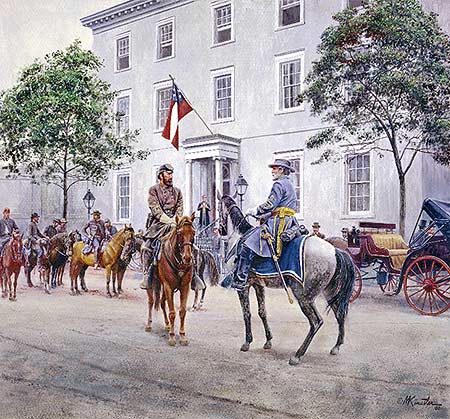
Confederate (CSA)
Colonel Alexander Swift Pendleton
"Sandie"
(1840 - 1864)
Home State: Virginia
Command Billet: Staff
Branch of Service: Infantry
Unit: Jackson's Command
Before the Antietam Campaign:
Rank history:
Lt., July 19, 1861;
Aide-de-Camp (A D C), Feb. 1862;
Assistant Adjutant-General (AAG), April 19, 1862;
Capt.and AAG., June 18, 1862;
Major, Dec. 4, 1862
Alexander (Sandie) Swift Pendleton was born near Alexandria, Virginia on September 28, 1840. He was the only son of William Nelson Pendleton. The Pendleton family moved to Lexington, Virginia in October 1853, where William became rector at Grace Episcopal Church. Sandie Pendleton graduated from Washington College (now Washington & Lee University) in 1857, and subsequently enrolled at the University of Virginia, where he was pursuing a Master of Arts degree when the Civil War began in April 1861. He received a commission as 2nd Lieutenant in Provisional Army of Virginia and reported to Harper's Ferry on June 14, 1861. Within weeks, he was asked by General Stonewall Jackson to join his staff as an ordnance officer --- Jackson had known Pendleton from their days together in Lexington, where Jackson was a Professor at the Virginia Military Institute. Pendleton subsequently served as Jackson's Assistant Adjutant General (Second Corps), and the relationship between Pendleton and Jackson was a close one-- it was said that Jackson "loved him like a son."
In the Antietam Campaign:
Capt Pendleton was AAG on Gen Jackson's staff. At one point during the battle, he describes the scene - "Such a storm of balls I never conceived it possible for men to live through. Shot and shell shrieking and crashing, canister and bullets whistling and hissing most fiend-like through the air until you could almost see them. In that mile's ride I never expected to come back alive." {quoted on the NPS Antietam site)
The remainder of the War:
He served on General "Stonewall" Jackson's staff until the Generals death at Chancellorsville in May 1863, and subsequently as adjutant-general to General Jubal A. Early and General Richard S. Ewell. He was killed at Fisher's Hill, Virginia, 22 September, 1864.
References, Sources, and other notes:
The authoritive biography is - Bean, W. G. Stonewall's Man: Sandie Pendleton, University of North Carolina Press, 1959.
More on the Web:
See a brief bio and collection of papers at VMI - the source of the picture and much of the text above, and a memorial site (with a picture of Pendleton's gravesite) on the Stonewall Jackson Cemetery in Lexington.
Birth Date: 9/28/1840
Place of Birth: Alexandria, VA
College: Washington College (VA), UVa
Death Date: 9/22/1864
Death Place: Fisher's Hill, VA
Burial Place: Stonewall Jackson Cemetery, Lexington, VA
Showing posts with label Sandie Pendleton. Show all posts
Showing posts with label Sandie Pendleton. Show all posts
Wednesday, February 11, 2009
Friday, May 9, 2008
An Account of Jackson’s Death and Funeral – Part Two
The following narrative of Jackson’s death and funeral comes from the book Stonewall’s Man: Sandie Pendleton, written by W.G. Bean.
The final tribute paid to Jackson in Richmond occurred in the early morning of May 13. His body was again taken to the Governor’s Mansion for a brief service and then to a train which carried it by way of Gordonsville to Lynchburg. From here it was transported on the James River and Kanawha Canal to Lexington. The editor of the Daily Dispatch regretted that the remains of Jackson could not be interred in Hollywood Cemetery in Richmond, “so near the theatre of his glory, where every breeze wafts his renown, and the murmuring waters, as they role solemnly by, seem to attune themselves to sweet, yet mournful melodies of the grave.” But Jackson had expressed a wish to be buried in Lexington where, as “an unknown, subordinate professor,” had been called “by Providence” to enact an important role in the affairs of mankind. The editor was prophetic in the statement that the fame of Jackson would be as enduring as the eternal mountains “at whose feet he was cradled.” Their long shadows, like those of “some majestic cathedral,” would consecrate his grave, and their loftiest pinnacles would be derive new sublimity from their association with the name of “JACKSON.”
The funeral train wended its way on May 13 from Richmond to Lynchburg amidst the homage of tearful people. In addition to the immediate family of General Jackson, the funeral party consisted of the servant Jim Lewis, Sandie Pendleton, James Power Smith, Hunter McGuire, Governor Letcher, and Confederate Senator G.A. Henry of Tennessee. Upon its arrival in Lynchburg at half past six in the afternoon, it was met by a delegation headed by Mayor W.B. Branch, R.H. Glass, Charles Dimmock, John S. Langhorne, John H. Flood, and W.M. Blackford. Minute guns were fired, and the church bells tolled their anguish. A procession was formed and marched through several streets to the wharf where the casket was placed on the packet boat, The Marshall, commanded by Captain J.B. Keffer. As the Lexington boat was very crowded, it was ten o’clock before the berths were hung.
The packet boat reached Lexington in the afternoon of May 14 (Thursday). General F.H. Smith came on board three miles from Lexington with his program for the ceremonies in Lexington. He had previously announced that the funeral would take place on Saturday, May 16, but yielded to Mrs. Jackson’s insistence that it be on May 15. A corps of cadets received the remains at the canal terminus, escorted it to the Institute, and placed it in the lecture room formerly used by Jackson. The next day, the body of Jackson was borne to its final resting place amidst the solemn pageantry of a military funeral – a novelty for the college community of Lexington.
On Friday morning at 10 o’clock, the funeral procession moved from the Institute to the Presbyterian Church. The escort was headed by Major Scott Schipp, commandant of the corps of cadets, former student of Jackson at the Institute, and an officer who had served in the Valley campaign of 1862. The military escort was composed of the cadets, a battery of First Manassas, a company of veterans of the Stonewall Brigade who happened to be in the county at that time and who bore the flag of the Liberty Hall Volunteers, a company of convalescent soldiers, a squadron of cavalry, and the clergy.
The casket which followed the escort was wrapped in the first Confederate flag ever made, which had been presented by President Davis to Mrs. Jackson. It was borne on a caisson of the cadet battery draped in black. Behind the caisson were the honorary pallbearers representing the Presbyterian Church of Lexington, the county magistrates, the Confederate district court, Washington College, the Virginia Military Institute, the Franklin Society, the town council, the Confederate Navy, and the Bible Society of Rockbridge County.
Then came in the following order: the family in a carriage followed on foot by Sandie Pendleton, Hunter McGuire, and J.P. Smith; Governor John Letcher, Senator Henry, and other representatives of the Confederate government; the faculty and officers of the Virginia Military Institute; the elders and deacons of the Presbyterian Church of Lexington; the professors and students of Washington College; members of the Franklin Society; and citizens of the community.
A simple service was conducted at the church by the pastor, the Reverend Dr. W.S. White, and other visiting ministers. The Reverend Dr. Ramsay of Lynchburg offered a prayer “of wonderful pathos.” The hymn “How Blest the Righteous, When He Dies” was sung and the Reverend Dr. White read the fifteenth chapter of First Corinthians after which another prayer was said by the Reverend Mr. W.F. Junkin, brother of Jackson’s first wife. The remains were then carried to the cemetery and with military honors committed to the grave.
The final tribute paid to Jackson in Richmond occurred in the early morning of May 13. His body was again taken to the Governor’s Mansion for a brief service and then to a train which carried it by way of Gordonsville to Lynchburg. From here it was transported on the James River and Kanawha Canal to Lexington. The editor of the Daily Dispatch regretted that the remains of Jackson could not be interred in Hollywood Cemetery in Richmond, “so near the theatre of his glory, where every breeze wafts his renown, and the murmuring waters, as they role solemnly by, seem to attune themselves to sweet, yet mournful melodies of the grave.” But Jackson had expressed a wish to be buried in Lexington where, as “an unknown, subordinate professor,” had been called “by Providence” to enact an important role in the affairs of mankind. The editor was prophetic in the statement that the fame of Jackson would be as enduring as the eternal mountains “at whose feet he was cradled.” Their long shadows, like those of “some majestic cathedral,” would consecrate his grave, and their loftiest pinnacles would be derive new sublimity from their association with the name of “JACKSON.”
The funeral train wended its way on May 13 from Richmond to Lynchburg amidst the homage of tearful people. In addition to the immediate family of General Jackson, the funeral party consisted of the servant Jim Lewis, Sandie Pendleton, James Power Smith, Hunter McGuire, Governor Letcher, and Confederate Senator G.A. Henry of Tennessee. Upon its arrival in Lynchburg at half past six in the afternoon, it was met by a delegation headed by Mayor W.B. Branch, R.H. Glass, Charles Dimmock, John S. Langhorne, John H. Flood, and W.M. Blackford. Minute guns were fired, and the church bells tolled their anguish. A procession was formed and marched through several streets to the wharf where the casket was placed on the packet boat, The Marshall, commanded by Captain J.B. Keffer. As the Lexington boat was very crowded, it was ten o’clock before the berths were hung.
The packet boat reached Lexington in the afternoon of May 14 (Thursday). General F.H. Smith came on board three miles from Lexington with his program for the ceremonies in Lexington. He had previously announced that the funeral would take place on Saturday, May 16, but yielded to Mrs. Jackson’s insistence that it be on May 15. A corps of cadets received the remains at the canal terminus, escorted it to the Institute, and placed it in the lecture room formerly used by Jackson. The next day, the body of Jackson was borne to its final resting place amidst the solemn pageantry of a military funeral – a novelty for the college community of Lexington.
On Friday morning at 10 o’clock, the funeral procession moved from the Institute to the Presbyterian Church. The escort was headed by Major Scott Schipp, commandant of the corps of cadets, former student of Jackson at the Institute, and an officer who had served in the Valley campaign of 1862. The military escort was composed of the cadets, a battery of First Manassas, a company of veterans of the Stonewall Brigade who happened to be in the county at that time and who bore the flag of the Liberty Hall Volunteers, a company of convalescent soldiers, a squadron of cavalry, and the clergy.
The casket which followed the escort was wrapped in the first Confederate flag ever made, which had been presented by President Davis to Mrs. Jackson. It was borne on a caisson of the cadet battery draped in black. Behind the caisson were the honorary pallbearers representing the Presbyterian Church of Lexington, the county magistrates, the Confederate district court, Washington College, the Virginia Military Institute, the Franklin Society, the town council, the Confederate Navy, and the Bible Society of Rockbridge County.
Then came in the following order: the family in a carriage followed on foot by Sandie Pendleton, Hunter McGuire, and J.P. Smith; Governor John Letcher, Senator Henry, and other representatives of the Confederate government; the faculty and officers of the Virginia Military Institute; the elders and deacons of the Presbyterian Church of Lexington; the professors and students of Washington College; members of the Franklin Society; and citizens of the community.
A simple service was conducted at the church by the pastor, the Reverend Dr. W.S. White, and other visiting ministers. The Reverend Dr. Ramsay of Lynchburg offered a prayer “of wonderful pathos.” The hymn “How Blest the Righteous, When He Dies” was sung and the Reverend Dr. White read the fifteenth chapter of First Corinthians after which another prayer was said by the Reverend Mr. W.F. Junkin, brother of Jackson’s first wife. The remains were then carried to the cemetery and with military honors committed to the grave.

Thursday, May 8, 2008
An Account of Jackson’s Death and Funeral – Part One
The following narrative of Jackson’s death and funeral comes from the book Stonewall’s Man: Sandie Pendleton, written by W.G. Bean
The additional work which devolved upon Sandie during the week following the wounding of Jackson prevented him from visiting the wounded chieftain until Sunday, May 10, the day Jackson died. As Sandie entered the sick chamber, Jackson recognized him and asked, “Who is preaching today at headquarters?” Sandie replied the Dr. Lacy was, and Jackson expressed his pleasure at the news. When told by Sandie that the entire army was praying for his recovery, Jackson murmured, “Thank God, they are very kind.” Presently he added, “It’s the Lord’s Day; my wish is fulfilled. I have always wanted to die on a Sunday.” So affected was Sandie by the scene that he went to the porch and wept. His intense feeling was revealed in a remark, the day after Jackson’s death, to Mrs. Jackson, “God knows I would have died for him.”
As his condition rapidly deteriorated, Jackson’s mind wandered back to the bloody night of May 2 on the Old Turnpike. In one of his early deliriums, he exclaimed, “I must find out if there is high ground between Chancellorsville and the river. Push up the columns! Hasten the columns! Pendleton, you take charge of that. Where’s Pendleton? Tell him to push up the column.”
The events of Sunday, May 10, were vividly recalled later by William Allan. “It was a beautiful day. We were terribly anxious. [Sandie] Pendleton rode down to see the General; the rest of us staid at Headquarters, where Dr. Lacy preached… The whole army was sad and anxious. The news brought to us during the forenoon was bad and I went to my tent after the preaching, feeling very gloomy. The afternoon was wearing on when Pendleton rode rapidly to my quarters and told me that the General had died an hour before.” Sandie dashing to the telegraph office at Hamilton’s Crossing and wired Governor John Letcher: “General Jackson died at fifteen minutes past 3 o’clock this afternoon. His remains will go to Richmond tomorrow.”
Sandie then return to Guiney Station to carry out the instructions of General Lee – who was doubtless aware of the close relationship existing between Jackson and Sandie – to take charge of the remains, to make all arrangements for the funeral, and to accompany the body to Lexington, where Jackson had expressed a desire during his last days to be buried.
The body, dressed by Sandie and J.P. Smith, was temporarily placed in a crude coffin constructed by the soldiers and moved to the front room of the Chandler office. It remained there until its departure for Richmond, where it was later embalmed in the reception room of the Governor’s Mansion and transferred to a metallic casket presented by the citizens of Fredericksburg.
The funeral cortege left Guiney Station on a special train on May 11 (Monday) and arrived in Richmond at 4 o’clock in the afternoon. It addition to Mrs. Jackson and her infant, Mrs. Moses Hoge, and Mrs. Chandler, the remains were accompanied by Sandie Pendleton, Hunter McGuire, J.P. Smith, J.G. Morrison, and the Reverend Dr. B.T. Lacy – all members of Jackson’s staff. Captain Henry Kyd Douglas, formerly of the staff but now of the Second Virginia Regiment, Dr. W.H. Mayo of the governor’s staff and Dr. David Tucker of Richmond, who had been summoned to Guiney Station during the last days of Jackson’s illness, were also in the party. Throngs of people awaited the train as it passed the stations, and at Ashland the ladies placed wreathes and flowers on the casket.
All activities were suspended in Richmond at 12 o’clock, the announced hour of the arrival of the train. A tremendous concourse of citizens had assembled at the depot, but when it was announced that the train would not arrive until 4 o’clock, the crowd slowly dispersed and reassembled at that hour.
Upon reaching Richmond, the train stopped at the corner of Fourth and Broad Street in order to spare Mrs. Jackson the ordeal of facing the multitude of mourners. She was met by Mrs. Letcher and other ladies to Richmond and was taken in a carriage to the Governor’s Mansion. The casket was enveloped in a Confederate flag and covered with wreathes of evergreen and rare flowers. The hearse, flanked by Sandie Pendleton, Hunter McGuire, J.P. Smith, and Henry Kyd Douglas moved amidst the tolling bells down Broad Street to the corner of Ninth; turned toward Main Street, and was taken past the classic porch of St. Paul’s Episcopal Church to the Governor’s Mansion in the Capitol Square. After its arrival there, Sandie and Douglas stood guard until darkness and the body remained in the Mansion during the night. The bells continued to toll until sundown, and thousands of people stayed in the Square until dark. Never before, the Richmond Daily Dispatch declared, had there been such an exhibition, “of heartfelt and general sorrow” in Richmond.
Tuesday, May 12, was a beautiful and warm day in Richmond. The military pageant was one never to be forgotten by those who witnessed it. Promptly at 10 o’clock in the morning, under the direction of George W. Randolph, master of ceremonies, the procession formed on the Capitol Grounds, stretching from the Governor’s Mansion to Grace Street. The band of the Thirtieth Virginia Infantry, hurriedly transported from Hamilton’s Crossing for the occasion, headed the procession. Then came the military escort followed by the hearse which was draped and drawn by four white horses appropriately caparisoned. Grouped around the hearse were the pallbearers: Sandie Pendleton, J.P. Smith, Hunter McGuire, Henry Kyd Douglas, and Generals James Longstreet, R.S. Ewell, J.H. Winder, Arnold Elzey, George E. Pickett, Richard Brooke Garnett, W.M. Kemper, M.D. Corse, and Commodore Bassett French. The carriages, conveying President Davis, who looked “think and frail in health,” and Jackson’s family, were next in line. Behind the carriage came on foot the various chiefs of department, state and Confederate, and distinguished citizens of the city. Little Sorrel, Jackson’s horse, was led by his servant, Jim Lewis.
An immense throng had gathered to move along with the procession. The flags were draped with crepe, and the swords of the military officials were draped at the hilt. The cannons of the artillery wore the sad insignia of mourning, the drums were muffled, and at a given hour a gun stationed beneath the Washington monument boomed the signal for the procession to move.
The bells pealed out their sorrow, and the melancholy dirge of the musicians of the band of the Thirtieth Virginia Infantry swelled forth in moving tones. The director of the band, A.J. Bowering, subsequently said that he had no instructions “as to what I should play but I had in mind that it must be something historical.” As he had only one copy of the “Dead March” from Saul with him upon leaving Hamilton’s Crossing, he transcribed and arranged, on the journey to Richmond, the music of this dirge for twenty different instruments. The band broke into the “Psalm of David” when George W. Randolph raised his sword for the procession to start. “I have played, [Bowering wrote] to men standing against the wall awaiting the command that would send them into eternity and in hospitals I have done my best to soothe the dying hours of the men of Virginias, but never was I so impressed. The tears rolled down the faces of my men and I knew that I was weeping.
“We played as we never played before and in that march around the city there was in line a musician, the brother of Adelina Patti. My soul, how he could play the E flat on a cornet! He played beside me in the parade.”
Emerging from the Capitol Square, the procession moved down Governor’s Street to Main, turned up Main to Second Street, through which it passed to Grace Street, and return to Capitol Square. The casket was borne by the generals of the army to the Senate chamber where, wrapped in the flag made immortal by Jackson, it lay in state until midnight.
The scene on Main Street, during the funeral procession beggared description, said the Richmond Daily Enquirer – “so impressive, so beautiful, so full of stirring associations, blending with the martial dirges of the bands, the gleam of muskets, rifles, and sabers drawn, the sheen of the cannon, the thousands of throbbing hearts, and the sorrow that mantled over all” J.B. Jones, the rebel diarist, recorded that the funeral was “very solemn and imposing because the mourning was sincere and heartfelt. There was no vain ostentation.”
The mixed scene of woe and honor in the Senate chamber was equally moving. As “shattered and emaciated veterans, noble-bowed matrons, and pale, delicate maidens gathered around that sacred bier, in the awed hush of a common sorrow, too deep for words.” T.C. DeLeon lamented, “tears rose from the hearts that had lost their dearest and nearest without a murmur, save – Thy will be done. And little children were lifted up to look upon what was left of him.” On another occasion, as the concourse of mourners passed by the bier, “an elderly and respectable-looking gentleman” addressed them in tones of confidence: Weep not; all is for the best. Though Jackson has been taken from the head of his corps, his spirit is now pleading our cause at the bar of God.”
The additional work which devolved upon Sandie during the week following the wounding of Jackson prevented him from visiting the wounded chieftain until Sunday, May 10, the day Jackson died. As Sandie entered the sick chamber, Jackson recognized him and asked, “Who is preaching today at headquarters?” Sandie replied the Dr. Lacy was, and Jackson expressed his pleasure at the news. When told by Sandie that the entire army was praying for his recovery, Jackson murmured, “Thank God, they are very kind.” Presently he added, “It’s the Lord’s Day; my wish is fulfilled. I have always wanted to die on a Sunday.” So affected was Sandie by the scene that he went to the porch and wept. His intense feeling was revealed in a remark, the day after Jackson’s death, to Mrs. Jackson, “God knows I would have died for him.”
As his condition rapidly deteriorated, Jackson’s mind wandered back to the bloody night of May 2 on the Old Turnpike. In one of his early deliriums, he exclaimed, “I must find out if there is high ground between Chancellorsville and the river. Push up the columns! Hasten the columns! Pendleton, you take charge of that. Where’s Pendleton? Tell him to push up the column.”
The events of Sunday, May 10, were vividly recalled later by William Allan. “It was a beautiful day. We were terribly anxious. [Sandie] Pendleton rode down to see the General; the rest of us staid at Headquarters, where Dr. Lacy preached… The whole army was sad and anxious. The news brought to us during the forenoon was bad and I went to my tent after the preaching, feeling very gloomy. The afternoon was wearing on when Pendleton rode rapidly to my quarters and told me that the General had died an hour before.” Sandie dashing to the telegraph office at Hamilton’s Crossing and wired Governor John Letcher: “General Jackson died at fifteen minutes past 3 o’clock this afternoon. His remains will go to Richmond tomorrow.”
Sandie then return to Guiney Station to carry out the instructions of General Lee – who was doubtless aware of the close relationship existing between Jackson and Sandie – to take charge of the remains, to make all arrangements for the funeral, and to accompany the body to Lexington, where Jackson had expressed a desire during his last days to be buried.
The body, dressed by Sandie and J.P. Smith, was temporarily placed in a crude coffin constructed by the soldiers and moved to the front room of the Chandler office. It remained there until its departure for Richmond, where it was later embalmed in the reception room of the Governor’s Mansion and transferred to a metallic casket presented by the citizens of Fredericksburg.
The funeral cortege left Guiney Station on a special train on May 11 (Monday) and arrived in Richmond at 4 o’clock in the afternoon. It addition to Mrs. Jackson and her infant, Mrs. Moses Hoge, and Mrs. Chandler, the remains were accompanied by Sandie Pendleton, Hunter McGuire, J.P. Smith, J.G. Morrison, and the Reverend Dr. B.T. Lacy – all members of Jackson’s staff. Captain Henry Kyd Douglas, formerly of the staff but now of the Second Virginia Regiment, Dr. W.H. Mayo of the governor’s staff and Dr. David Tucker of Richmond, who had been summoned to Guiney Station during the last days of Jackson’s illness, were also in the party. Throngs of people awaited the train as it passed the stations, and at Ashland the ladies placed wreathes and flowers on the casket.
All activities were suspended in Richmond at 12 o’clock, the announced hour of the arrival of the train. A tremendous concourse of citizens had assembled at the depot, but when it was announced that the train would not arrive until 4 o’clock, the crowd slowly dispersed and reassembled at that hour.
Upon reaching Richmond, the train stopped at the corner of Fourth and Broad Street in order to spare Mrs. Jackson the ordeal of facing the multitude of mourners. She was met by Mrs. Letcher and other ladies to Richmond and was taken in a carriage to the Governor’s Mansion. The casket was enveloped in a Confederate flag and covered with wreathes of evergreen and rare flowers. The hearse, flanked by Sandie Pendleton, Hunter McGuire, J.P. Smith, and Henry Kyd Douglas moved amidst the tolling bells down Broad Street to the corner of Ninth; turned toward Main Street, and was taken past the classic porch of St. Paul’s Episcopal Church to the Governor’s Mansion in the Capitol Square. After its arrival there, Sandie and Douglas stood guard until darkness and the body remained in the Mansion during the night. The bells continued to toll until sundown, and thousands of people stayed in the Square until dark. Never before, the Richmond Daily Dispatch declared, had there been such an exhibition, “of heartfelt and general sorrow” in Richmond.
Tuesday, May 12, was a beautiful and warm day in Richmond. The military pageant was one never to be forgotten by those who witnessed it. Promptly at 10 o’clock in the morning, under the direction of George W. Randolph, master of ceremonies, the procession formed on the Capitol Grounds, stretching from the Governor’s Mansion to Grace Street. The band of the Thirtieth Virginia Infantry, hurriedly transported from Hamilton’s Crossing for the occasion, headed the procession. Then came the military escort followed by the hearse which was draped and drawn by four white horses appropriately caparisoned. Grouped around the hearse were the pallbearers: Sandie Pendleton, J.P. Smith, Hunter McGuire, Henry Kyd Douglas, and Generals James Longstreet, R.S. Ewell, J.H. Winder, Arnold Elzey, George E. Pickett, Richard Brooke Garnett, W.M. Kemper, M.D. Corse, and Commodore Bassett French. The carriages, conveying President Davis, who looked “think and frail in health,” and Jackson’s family, were next in line. Behind the carriage came on foot the various chiefs of department, state and Confederate, and distinguished citizens of the city. Little Sorrel, Jackson’s horse, was led by his servant, Jim Lewis.
An immense throng had gathered to move along with the procession. The flags were draped with crepe, and the swords of the military officials were draped at the hilt. The cannons of the artillery wore the sad insignia of mourning, the drums were muffled, and at a given hour a gun stationed beneath the Washington monument boomed the signal for the procession to move.
The bells pealed out their sorrow, and the melancholy dirge of the musicians of the band of the Thirtieth Virginia Infantry swelled forth in moving tones. The director of the band, A.J. Bowering, subsequently said that he had no instructions “as to what I should play but I had in mind that it must be something historical.” As he had only one copy of the “Dead March” from Saul with him upon leaving Hamilton’s Crossing, he transcribed and arranged, on the journey to Richmond, the music of this dirge for twenty different instruments. The band broke into the “Psalm of David” when George W. Randolph raised his sword for the procession to start. “I have played, [Bowering wrote] to men standing against the wall awaiting the command that would send them into eternity and in hospitals I have done my best to soothe the dying hours of the men of Virginias, but never was I so impressed. The tears rolled down the faces of my men and I knew that I was weeping.
“We played as we never played before and in that march around the city there was in line a musician, the brother of Adelina Patti. My soul, how he could play the E flat on a cornet! He played beside me in the parade.”
Emerging from the Capitol Square, the procession moved down Governor’s Street to Main, turned up Main to Second Street, through which it passed to Grace Street, and return to Capitol Square. The casket was borne by the generals of the army to the Senate chamber where, wrapped in the flag made immortal by Jackson, it lay in state until midnight.
The scene on Main Street, during the funeral procession beggared description, said the Richmond Daily Enquirer – “so impressive, so beautiful, so full of stirring associations, blending with the martial dirges of the bands, the gleam of muskets, rifles, and sabers drawn, the sheen of the cannon, the thousands of throbbing hearts, and the sorrow that mantled over all” J.B. Jones, the rebel diarist, recorded that the funeral was “very solemn and imposing because the mourning was sincere and heartfelt. There was no vain ostentation.”
The mixed scene of woe and honor in the Senate chamber was equally moving. As “shattered and emaciated veterans, noble-bowed matrons, and pale, delicate maidens gathered around that sacred bier, in the awed hush of a common sorrow, too deep for words.” T.C. DeLeon lamented, “tears rose from the hearts that had lost their dearest and nearest without a murmur, save – Thy will be done. And little children were lifted up to look upon what was left of him.” On another occasion, as the concourse of mourners passed by the bier, “an elderly and respectable-looking gentleman” addressed them in tones of confidence: Weep not; all is for the best. Though Jackson has been taken from the head of his corps, his spirit is now pleading our cause at the bar of God.”
Subscribe to:
Posts (Atom)