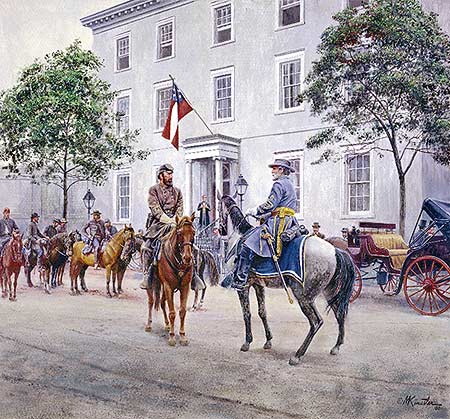
Here is the conclusion of Carlton McCarthy's article on life in the Army of Northern Virginia.
The wagon trains were devoted entirely to the transportation of ammunition and commissary and quartermaster's store, which had not been issued. Rations which had become company property, and the baggage of the men, when they had any, were carried by the men themselves. If, as was sometimes the case, three days' rations were issued at one time and the troops ordered to cook them, and be prepared to march, they did cook them, and eat them if possible, so as to avoid the labor of carrying them. It was not such an undertaking either, to eat three days' rations in one, as frequently none had been issued for more than a day, and when issued were cut down one half.
The infantry found out that bayonets were not of much use, and did not hesitate to throw them, with the scabbard, away.
The artillerymen, who started out with heavy sabres hanging to their belts, stuck them up in the mud as they marched, and left them for the ordnance officers to pick up and turn over to the cavalry.
The cavalrymen found sabres very tiresome when swung to the belt, and adopted the plan of fastening them to the saddle on the left side with the hilt in front and in reach of the hand. Finally sabres got very scarce even among the cavalrymen, who relied more and more on their short rifles.
No soldiers ever marched with less to encumber them, and none marched faster or held out longer.
The courage and devotion of the men rose equal to every hardship and privation, and the very intensity of their sufferings became a source of merriment. Instead of growling and deserting, they laughed at their own bare feet, ragged clothe, and pinched faces; and weak, hungry, cold, wet, worried with vermin and itch, dirty with no hope of reward or rest, marched cheerfully to meet the well-fed and warmly clad hosts of the enemy.
Showing posts with label Carlton McCarthy. Show all posts
Showing posts with label Carlton McCarthy. Show all posts
Wednesday, August 6, 2008
Monday, August 4, 2008
Minutiae of Soldier Life in The Army of Northern Virginia - Part Four
Carlton McCarthy continues with his description of life in the Army of Northern Virginia.
The camp chest soon vanished. The brigadiers and major generals, even, found them too troublesome, and so they were left entirely to the quartermasters and commissaries. One skillet and a couple of frying pans, a bag for flour or meal, another bag for salt, sugar, and coffee, divided by a knot tied between served the purpose as well. The skillet passed from mess to mess. Each mess generally owned a frying pan, but often one served a company. The oil-cloth was found to be as good as the wooden tray for making up the dough. The water bucket held its own to the last!
Tents were rarely seen. All the poetry about the "tented field' died. Two men slept together, each having a blanket and an oil-cloth; one oil-cloth went next to the ground. The two laid on this, covered themselves with two blankets, protected from the rain with the second oil-cloth on top, and slept very comfortably through rain, snow or hail, as it might be.
Very little money was seen in camp. The men did not expect, did not care for, or often get any pay, and they were not willing to deprive the old folks at home their little supply, so they learned to do without any money.
When rations got short and were getting shorter, it became necessary to dismiss the darkey servants. Some, however, became company servants, instead of private institutions, and held out faithfully to the end, cooking the rations away in the rear, and at the risk of life carrying them to the line of battle to their "young mahsters."
Reduced to the minimum, the private soldier consisted of one man, one hat, one jacket, one shirt, one pair of pants, one pair of drawers, one pair of shoes, and one pair of socks. His baggage was one blanket, and one haversack. The haversack generally contained smoking tobacco and a pipe, and a small piece of soap, with temporary additions of apple, persimmons, blackberries, and such other commodities as he could pick up on the march.
The company property consisted of two or three skillets and frying pans, which were sometimes carried in the wagon, but oftener in the hands of the soldiers. The infantry men generally preferred to stick the handle of the frying pan in the barrel of the musket, and so carry it.

Friday, August 1, 2008
Minutiae of Soldier Life in the Army of Northern Virginia - Part Three
Here is the next installment of Private Carlton McCarthy's account of life in the ranks of the Army of Northern Virginia.
Very little washing was done, as a matter of course. Clothes once given up were parted with forever. There were good reasons for this: cold water would not cleanse them or destroy the vermin, and hot water was not always to be had. One blanket to each man was found to be sufficient for the severest weather. This was carried generally by rolling it lengthwise, with the rubber cloth outside, tying the ends of the roll together, and throwing the loop thus made over the left shoulder with the ends fastened together hanging under the right arm.
The haversack held its own to the last, and was found practical and useful. It very seldom, however, carried rations, but was used to carry all the articles generally carried in the knapsack; of course the stock was small. Somehow or other, many men managed to do without the haversack, and carried absolutely nothing but what they wore and had in their pockets.
The infantry threw away their heavy cap boxes and cartridge boxes, and carried their caps and cartridges in their pockets. Canteens were very useful at times, but they were not as a general thing discarded. They were not much used to carry water, but were found useful when the men were driven to the necessity of foraging; for conveying buttermilk, cider, sorghum, etc., to camp. A good strong tin cup was found better than a canteen, as it was easier to fill at a well or spring, and was serviceable as a boiler for making coffee when the column halted for the night.
Revolvers were found to be about as useless and heavy lumber as a private could carry, and early in the war were sent home to be used by the women and children in protecting themselves from insult and violence at the hands of the ruffians who prowled about the country shirking duty.
Strong cotton was adopted in place of flannel and merino, for two reasons; first, because it was easier to wash; and second, because the vermin did not propagate so rapidly in cotton as in wool. Common white cotton shirts and drawers proved the best that could be used by the private soldier.
Gloves to any but a mounted man were found useless, worse than useless. With the gloves on, it was impossible to handle an axe, buckle harness, load a musket, or handle a rammer at the piece. Wearing them was found to be simply a habit, and so, on the principle that the less luggage the less labor, they were discarded.
Wednesday, July 30, 2008
Minutiae of Soldier Life in the Army of Northern Virginia - Part Two
Let's continue with Private Carlton McCarthy's account of life in the Army of Northern Virginia.
It is amusing to think of the follies of the early part of the war, as illustrated by the outfits of the volunteers. They were so heavily clad, and so burdened with all manners of things, that a march was torture, and the wagon trains were so immense in proportion to the number of troops, that it would have been impossible to guard them in an enemy's country. Subordinate officers thought themselves entitled to transportation for trunks, mattresses, and folding bedsteads, and the privates were ridiculous in their demands.
Thus much by way of introduction. The change came rapidly, and stayed not until the transformation was complete. Nor was this change attributable alone to the orders of the general officers. The men soon learned the inconvenience and danger of so much luggage, and, as they be came more experienced, they vied with each other in reducing themselves to light-marching trim.
Experience soon demonstrated that boots were not agreeable on a long march. They were heavy and irksome, and when the heels were won a little one-sided, the wearer would find his ankle twisted nearly out of joint by every unevenness of the road. When thoroughly wet, it was a laborious undertaking to get the off; and worse to get them on in time to answer the morning roll-call. And so, good, strong brogues, or brogans, with broad bottoms and big, fat heels, succeeded the boots, and were found more more comfortable and agreeable, easier on and off, and altogether the more sensible.
A short-waisted and single-breasted jacket usurped the place of the longtailed coat, and became universal. The enemy noticed this peculiarity, and called the Confederates gray jackets which name was immediately transferred to those lively creatures which were the constant admirers and inseparable companions of the Boys in Gray and Blue.
Caps were destined to hold out longer than some other uncomfortable things, but they finally yielded to the demands of comfort and common sense, and a good soft felt hat was worn instead. A man who has never been a soldier does not know, nor indeed can know, the amount of comfort there is in a good soft hat in camp, and how utterly useless is a "soldier hat" as they are generally made. Why the Prussians with all their experience, wear they heavy, unyielding helmets, and the French their little caps, is a mystery to a Confederate who has enjoyed the comfort of an old slouch.
Overcoats an inexperienced man would think an absolute necessity for men exposed to the rigors of a northern Virginia winter, but they grew scarcer and scarcer; they were found to be a great inconvenience. The men came to the conclusion that the trouble of carrying them on hot days outweighed the comfort of having them when the cold day arrived. Besides they found that life in the open air hardened them to such an extent that changes in the temperatures were not felt to any degree. Some clung to the overcoats to the last, but the majority got tired of lugging them around and either discarded them altogether, or trusted to capturing one about the time it would needed. Nearly every overcoat in the army in the later years was one of Uncle Sam's captured from his boys.
The knapsack vanished early in the struggle. It was inconvenient to "change" the underwear too often, and the disposition not to change grew, as the knapsack was found to gall the back and soldiers, and weary the man before half the march was accomplished. The better way was to dress out and out, and wear the outfit until the enemy's knapsacks, or the folks at home supplied a change. Certainly it did not pay to carry around clear clothes while waiting for the time to use them.
Tuesday, July 29, 2008
Minutia of Soldier Life in The Army of Northern Virginia - Part One
Private Carlton McCarthy of the Richmond Howitzers writes in detail what it was like to be a soldier in the Army of Northern Virginia.
The volunteer of 1861 made extensive preparations for the field. Boots, he though, were an absolute necessity, and the heavier the soles and longer the tops the better. His pants were stuffed inside the top of his boots, of course. A double-breasted coat, heavily wadded, with two rows of big brass buttons and a long skirt, was considered comfortable. A small stiff cap, with a narrow brim, took the place of the comfortable "felt," or the shining and towering tile worn in civil life.
Then over all was a huge overcoat, long and heavy, with a cape reaching nearly to the waist. on his back he strapped a knapsack containing a full stock of underwear, soap, towels, comb, brush, looking-glass, tooth-brush, paper and envelopes, pens, ink, pencils, blacking, pipes, twine string, and cotton strips for wounds and other emergencies, needles and thread, but tones, knife, fork, and spoon, and many other things as each man's idea of what he was to encounter varied. On the outside of the knapsack, solidly folded, were two great blankets and a rubber or oil-cloth. This knapsack, etc. weighed from 15 to 25 pounds, sometimes more. All seemed to think it was impossible to have on too heavy clothes, or to have too many conveniences, and each had an idea that to be a good soldier he must be provided against every emergency.
In addition to the knapsack, each man had a haversack, more or less costly, some of cloth and some of fine morocco, and stored with provisions always, as though he expected any moment to receive orders to march across the Great Desert, and supply his own wants on the way. A canteen was considered indispensable, and at the outset it was thought prudent to keep it full of water. Many, expecting terrific hand-to-hand encounters, carried revolvers, and even bowie knives. Merino shirts (and flannel) were thought to be the right thing, but experience demonstrated the contrary. Gloves were also thought to be very necessary and good things to have in winter time, the favorite style being buck gauntlets with long cuffs.
In addition to each man's private luggage, each mess, generally composed of from five to ten men, drawn together by similar tastes and associations, had its outfit, consisting of a large camp chest containing skillet, frying pan, coffee boiler, bucket for lard, coffee box, salt box, meal box, your box, knives, forks, spoons, plates, cups, etc., etc., These chests were so large that 8 to 10 filled up an army wagon, and were so heavy that two strong men had all they could do to get one of them into the wagon. In addition to the chest, each mess owned an axe, water bucket, and bread tray. Then the tents of each company, and little sheet iron stoves and stoves pipes, and the trucks and valises of the company officers, made an immense pile of stuff, so that each company had a small wagon train of its own.
All thought money to be absolutely necessary, and for a while rations were disdained and the mess supplied with the best that could be bought with the mess fund. Quite a large number had a "boy" along to do the cooking and washing. Think of it! A Confederate soldier with a body servant all his own, to bring him a drink of water, black his boots, dust his clothes, cook his corn bread and bacon, and put wood on his fire. Never was there fonder admiration than these darkies displayed for their masters. Their chief delight and glory was to praise the courage and good looks of "Mahse Tom," and prophesy great things about his future. Many a ringing laugh and shout of fun originated in the queer remarks, shining countenances, and glistening teeth of this now forever departed character.
Subscribe to:
Posts (Atom)