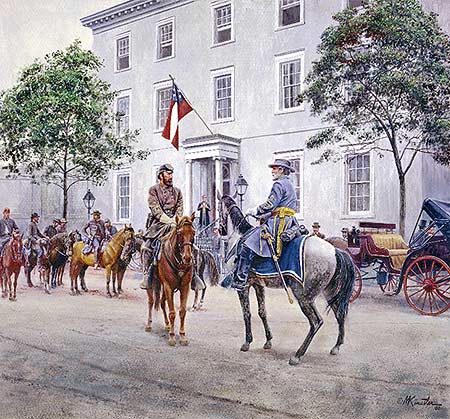
After concluding the series commemorating both Jackson and Stuart’s deaths, I came upon this eyewitness account from the Battles and Leaders of the Civil War, which is based on the Century war series published November 1884 to November 1887 in Century Magazine. This account was written by a private of the Sixth Virginia Cavalry, CSA, and comes from Volume 4, page 194.
On the morning of the fight at Yellow Tavern, May 12th, 1864, I was acting as one of Stuart's couriers. At the beginning of it, I was stationed in front of the tavern, under one of a row of trees that lined the way close by. To my left, about four hundred yards off, the enemy could be easily seen emerging from a piece of woods and forming for battle. A short distance to my right, I saw an irregular line of Confederates. Pretty soon from the enemy came lively volleys whistling through the trees and starting the dust in the road.
In a few minutes, I saw two horsemen approach from the Confederate side. As they drew near I recognized General Stuart and Colonel Walter Hullihen. They halted near by in the road, and Stuart, taking out his field-glass, deliberately watched the maneuvers of the enemy, though balls were whizzing past him. Presently, regardless of the increasing fire, which was now accompanied with shouts, Stuart put his glass away, and taking out paper and pencil wrote an order. Handing it to Colonel Hullihen, he told him to take it to General Lomax. That officer replied by pointing to me and suggesting that I should carry it. Stuart assented, and I rode off in search of General Lomax.
The firing continued to increase, and many squadrons were in sight. The enemy, awake to their superior numbers, seemed about to make a general advance, while our men were availing themselves of the character of the ground to repel their attack. After going a few rods to the rear, my horse, excited by the firing, , suddenly stopped and refused to budge. After several vain attempts with the spur and the fiat side of my sword to start him, I at last struck him with all my strength right between the ears. This "downed" him, but he soon rose and ran off at the top of his speed. I soon came to where General Lomax was, and coming into collision with his horse gained his immediate attention. After reading the note he told me to go back and tell General Stuart that the order had been delivered. In a few moments I rejoined him sitting on his horse, close behind a line of dismounted men, who were firing at the advancing Federals. The disparity of numbers between the opposing forces was very great, to judge from appearances. Our men seemed aware of their inferior strength, but were not dismayed. The enemy confidently pressed forward with exultant shouts, delivering tremendous volleys. The Confederates returned their fire with yells of defiance.
Stuart, with pistol in hand, shot over the heads of the troops, while with words of cheer he encouraged them. He kept saying: “Steady, men, Steady. Give it to them." Presently, he reeled in his saddle. His head was bowed and his hat fell off. He turned and said as I drew nearer: “Go and tell General Lee and Dr. Fontaine to come here.”
I wheeled at once and went as fast as I could to do his bidding. Coming to the part of the line where General Lomax was, I told him Stuart was hurt and that he wanted General Fitz Lee. He pointed to the left and told me to hurry. Soon I found General Lee and delivered the message. He was riding a light gray, if I remember, and instantly upon receipt of the news went like an arrow down the line. When I returned, Stuart had been taken from his horse and was being carried by his men off the field. I saw him put in an ambulance and I followed it close behind. He lay without speaking as it went along, but kept shaking his head with an expression of the deepest disappointment.
He died the next day, May 12th.
Reprinted from the "Southern Bivouac" for September, 1884.
Showing posts with label Yellow Tavern. Show all posts
Showing posts with label Yellow Tavern. Show all posts
Sunday, May 18, 2008
Tuesday, May 6, 2008
Henry McClellan's Account of Jeb Stuart's Wounding and Death
This account of the gallant and noble Stuart’s death comes from a letter Major Henry McClellan (Stuart’s adjutant) wrote to Flora Stuart after the general’s death. It was also printed in the Southern Historical Society Papers and in McClellan’s book on Stuart. The rest of the narrative comes from McClellan’s book.
“About four o’clock the enemy suddenly threw a brigade of cavalry, mounted upon our extreme left, attacking our whole line at the same time. As he always did, the general hastened to the point where the greatest danger threatened, -- and the point against which the enemy directed the mounted charge. My horse was so much exhausted by my severe ride of the morning that I could not keep pace with him, but Captain G.W. Dorsey, of company K, 1st Virginia Cavalry, gave me the particulars that follow.
The enemy’s charge captured our battery on the left of our line, and drove back almost the entire left. Where Captain Dorsey was stationed – immediately on the Telegraph Road – about eighty men had collected, his personal example held them steady while the enemy charged entirely past their position. With his men he fired into their flank and rear as they passed him, in advancing and retreating, for they were met by a mounted charge of the 1st Virginia Cavalry and driven back some distance. As they retired, one man who had been dismounted in the charge, and was running out on foot, turned as he passed the general, and discharging his pistol inflicted the fatal wound. When Captain Dorsey discovered that he was wounded he came at one to his assistance, and endeavored to lead him to the rear; but the general’s horse had become so restive and unmanageable that he insisted upon being taken down, and allowed to rest against a tree. When this was done Captain Dorsey sent for another horse. While waiting the general ordered him to leave him, and return to his men and drive back the enemy. He said he feared that he was mortally wounded, and could be of no more service. Captain Dorsey told him that he could not obey that order; that he would rather sacrifice his life than leave him until he had placed him out of all danger. The situation was an exposed one. Our men were sadly scattered, and there was hardly a handful of men between that little group and the advancing enemy. But the horse arrived in time; the general was lifted on to him, and was led by Captain Dorsey to a safer place. There, by the general’s order, he gave him into the charge of private Wheatly, of his company, and returned to rally his scattered men. Wheatly procured an ambulance, placed the general in it with the greatest of care, and supporting him in his arms, was driving toward the rear. I was hastening toward that part of the field where I had heard that he was wounded when I met the ambulance. The general had so often told me that if he were wounded I must not leave the field, but report to the officer next to him in rank, that I did not now presume to disregard his order, and the more so because I saw that Dr. Fontaine, Venable, Garnett, Hullihen, and several of his couriers were attending him. I remained with Fitz Lee until the next morning, when he sent me to the city to see General Bragg, and I thus had an opportunity to spend an hour with my general.”
As he was being driven back from the field he noticed the disorganized ranks of his retreating men, and called out to them: ----
“Go back! Go back! And do your duty, as I have done mine, and our country will be safe. Go back! Go back! I had rather die than be whipped.”
There were his last words on the battle-field, -- words not of idle egotism, but of soldierly entreaty. The shadow that for days had hung over his joyous, earnest life was deepening with the mist from out the dark valley, and ere the chill night closed in he would once again urge to effort, once again cheer to the charge, the comrades he had loved and led so well. But a few months later came the answering echo from the lips of his great commander, who would have gladly shared with him a soldier’s grave, “My men, I have done my best for you.”
While yet in the ambulance Dr. Fontaine and Lieutenant Hullihen turned the general over on his side, in order that an examination of the wound might be made While this was in progress he spoke to Hullihen, addressing him by the pet name which he usually employed: --
“Honey-bun, how do I look in the face?”
“General,” replied Hullihen, “you are looking right well. You will be all right.”
“Well,” said he, “I don’t know how this will turn out; but if it is God’s will that I shall die I am ready.”
In order to avoid the enemy, who how held full possession of the Brook turnpike, it was necessary for the ambulance to make a wide detour to reach Richmond, and it was some time after dark when the general arrived at the residence of his brother-in-law, Dr. Charles Brewer. The long ride gave him great suffering. On the morning of the 12th, after delivering General Fitz Lee’s message to General Bragg, I repaired to the bedside of my dying chief. He was calm and composed, in the full possession of his mind. Our conversation was, however, interrupted by paroxysms of suffering. He directed me to make the proper disposal of his official papers and to send his personal effects to his wife. He then said: ---
“I wish you to take one of my horses and Venable the other. Which is the heavier rider?”
I replied that I thought Venable was.
“Then,” said he, “let Venable have the gray horse, and you take the bay.”
Soon he spoke again:---
“You will find in my hat a small Confederate flag, which a lady of Columbia, South Carolina, sent me, with the request that I wear it upon my horse in a battle and return to her. Send it to her.”
I was at a loss how to interpret these instructions; for I had never seen any such decoration upon his hat. But upon examining it the flag was found within its lining, stained with the sweat of his brow; and among his papers I found the letter which had conveyed the request.
Again he said: “My spurs which I have always word in battle I promised to give to Mrs. Lilly Lee, of Shepherdstown, Virginia. My sword I leave to my son.”
While I sat by his side the sound of cannon outside the city was heard. He turned to me eagerly and inquired what it meant. I explained that Gracy’s brigade and other troops had moved out against the enemy’s rear on the Brook turnpike and that Fitz Lee would endeavor to oppose their advance at Meadow Bridge. He turned his eyes upward, and exclaimed earnestly, “God grant that they may be successful.” Then he turned his head aside, he said with a sigh, ---
“But I must be prepared for another world.”
The thought of duty was always uppermost in his mind; and after listening to the distant cannonading for a few moments, he said: “Major, Fitz Lee may need you.” I understood his meaning, and pressed his hand in a last farewell.
As I left his chamber President Davis entered. Taking the general’s hand, he asked: “General, how do you feel?”
He replied: “Easy, but willing to die, if God and my country think I have fulfilled my destiny and done my duty.”
The Reverend Mr. Peterkin visited him, and prayed with him. He requested Mr. Peterkin to sing “Rock of Ages,” and joined in the singing of the hymn.
During the afternoon he asked Dr. Brewer whether it were not possible for him to survive the night. The doctor frankly told him that death was close at hand.
He the said: “I am resigned if it be God’s will; but I would like to see my wife. But God’s will be done.”
Again he said to Dr. Brewer: “I am going fast now; I am resigned. God’s will be done.”
And thus he passed away.
“About four o’clock the enemy suddenly threw a brigade of cavalry, mounted upon our extreme left, attacking our whole line at the same time. As he always did, the general hastened to the point where the greatest danger threatened, -- and the point against which the enemy directed the mounted charge. My horse was so much exhausted by my severe ride of the morning that I could not keep pace with him, but Captain G.W. Dorsey, of company K, 1st Virginia Cavalry, gave me the particulars that follow.
The enemy’s charge captured our battery on the left of our line, and drove back almost the entire left. Where Captain Dorsey was stationed – immediately on the Telegraph Road – about eighty men had collected, his personal example held them steady while the enemy charged entirely past their position. With his men he fired into their flank and rear as they passed him, in advancing and retreating, for they were met by a mounted charge of the 1st Virginia Cavalry and driven back some distance. As they retired, one man who had been dismounted in the charge, and was running out on foot, turned as he passed the general, and discharging his pistol inflicted the fatal wound. When Captain Dorsey discovered that he was wounded he came at one to his assistance, and endeavored to lead him to the rear; but the general’s horse had become so restive and unmanageable that he insisted upon being taken down, and allowed to rest against a tree. When this was done Captain Dorsey sent for another horse. While waiting the general ordered him to leave him, and return to his men and drive back the enemy. He said he feared that he was mortally wounded, and could be of no more service. Captain Dorsey told him that he could not obey that order; that he would rather sacrifice his life than leave him until he had placed him out of all danger. The situation was an exposed one. Our men were sadly scattered, and there was hardly a handful of men between that little group and the advancing enemy. But the horse arrived in time; the general was lifted on to him, and was led by Captain Dorsey to a safer place. There, by the general’s order, he gave him into the charge of private Wheatly, of his company, and returned to rally his scattered men. Wheatly procured an ambulance, placed the general in it with the greatest of care, and supporting him in his arms, was driving toward the rear. I was hastening toward that part of the field where I had heard that he was wounded when I met the ambulance. The general had so often told me that if he were wounded I must not leave the field, but report to the officer next to him in rank, that I did not now presume to disregard his order, and the more so because I saw that Dr. Fontaine, Venable, Garnett, Hullihen, and several of his couriers were attending him. I remained with Fitz Lee until the next morning, when he sent me to the city to see General Bragg, and I thus had an opportunity to spend an hour with my general.”
As he was being driven back from the field he noticed the disorganized ranks of his retreating men, and called out to them: ----
“Go back! Go back! And do your duty, as I have done mine, and our country will be safe. Go back! Go back! I had rather die than be whipped.”
There were his last words on the battle-field, -- words not of idle egotism, but of soldierly entreaty. The shadow that for days had hung over his joyous, earnest life was deepening with the mist from out the dark valley, and ere the chill night closed in he would once again urge to effort, once again cheer to the charge, the comrades he had loved and led so well. But a few months later came the answering echo from the lips of his great commander, who would have gladly shared with him a soldier’s grave, “My men, I have done my best for you.”
While yet in the ambulance Dr. Fontaine and Lieutenant Hullihen turned the general over on his side, in order that an examination of the wound might be made While this was in progress he spoke to Hullihen, addressing him by the pet name which he usually employed: --
“Honey-bun, how do I look in the face?”
“General,” replied Hullihen, “you are looking right well. You will be all right.”
“Well,” said he, “I don’t know how this will turn out; but if it is God’s will that I shall die I am ready.”
In order to avoid the enemy, who how held full possession of the Brook turnpike, it was necessary for the ambulance to make a wide detour to reach Richmond, and it was some time after dark when the general arrived at the residence of his brother-in-law, Dr. Charles Brewer. The long ride gave him great suffering. On the morning of the 12th, after delivering General Fitz Lee’s message to General Bragg, I repaired to the bedside of my dying chief. He was calm and composed, in the full possession of his mind. Our conversation was, however, interrupted by paroxysms of suffering. He directed me to make the proper disposal of his official papers and to send his personal effects to his wife. He then said: ---
“I wish you to take one of my horses and Venable the other. Which is the heavier rider?”
I replied that I thought Venable was.
“Then,” said he, “let Venable have the gray horse, and you take the bay.”
Soon he spoke again:---
“You will find in my hat a small Confederate flag, which a lady of Columbia, South Carolina, sent me, with the request that I wear it upon my horse in a battle and return to her. Send it to her.”
I was at a loss how to interpret these instructions; for I had never seen any such decoration upon his hat. But upon examining it the flag was found within its lining, stained with the sweat of his brow; and among his papers I found the letter which had conveyed the request.
Again he said: “My spurs which I have always word in battle I promised to give to Mrs. Lilly Lee, of Shepherdstown, Virginia. My sword I leave to my son.”
While I sat by his side the sound of cannon outside the city was heard. He turned to me eagerly and inquired what it meant. I explained that Gracy’s brigade and other troops had moved out against the enemy’s rear on the Brook turnpike and that Fitz Lee would endeavor to oppose their advance at Meadow Bridge. He turned his eyes upward, and exclaimed earnestly, “God grant that they may be successful.” Then he turned his head aside, he said with a sigh, ---
“But I must be prepared for another world.”
The thought of duty was always uppermost in his mind; and after listening to the distant cannonading for a few moments, he said: “Major, Fitz Lee may need you.” I understood his meaning, and pressed his hand in a last farewell.
As I left his chamber President Davis entered. Taking the general’s hand, he asked: “General, how do you feel?”
He replied: “Easy, but willing to die, if God and my country think I have fulfilled my destiny and done my duty.”
The Reverend Mr. Peterkin visited him, and prayed with him. He requested Mr. Peterkin to sing “Rock of Ages,” and joined in the singing of the hymn.
During the afternoon he asked Dr. Brewer whether it were not possible for him to survive the night. The doctor frankly told him that death was close at hand.
He the said: “I am resigned if it be God’s will; but I would like to see my wife. But God’s will be done.”
Again he said to Dr. Brewer: “I am going fast now; I am resigned. God’s will be done.”
And thus he passed away.

Subscribe to:
Posts (Atom)