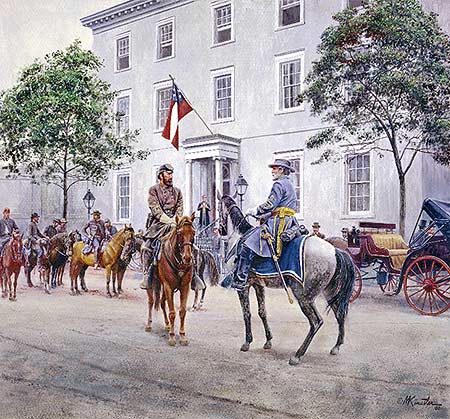
I will end my discussion on the Battle of Dranesville by saying that I think Thomason is wrong in contributing the defeat at Dranesville as a result of carelessness on the part of Stuart. My analysis is that Stuart's error was in placing trust in men who were not worthy of such. As J.B. Jones writes, Stuart was led into a trap. He had no reason to distrust the men who told him about the supply of forage in the small city. He had no reason to believe they would notify the enemy that he was coming. Adding to this scenario was the fact that his pickets, after being attacked by the on-coming Federal force, did not report this fact to Stuart. They failed in their main responsibility.
Now, about the "coincidence" of both Stuart and Federal forces descending on Dranesville on the same day at the same time for the same reason. Well, as NCIS Agent Leroy Jethro Gibbs would say, "there is no such thing as coincidence." It is too much to assume. If Jones is right, and Stuart, in his official report, suggests he was betrayed, then for me this is the more compelling reason than simple carelessness on Stuart's part. Furthermore, McCall writes in his order to Ord that he was in contact with persons unknown who gave him the position and strength of the Confederate pickets. Ord himself writes in his official report that he knew the strength and position of the Confederate pickets. Both Ord and McCall say that they were going to Dranesville for forage.
Underpining this conclusion is Stuart's report, Jones' account, Ord's and McCall's official reports, and the simple fact that I have a hard time believing that both armies headed to Dranesville at the same time to perform the same act. What I believe happened was that Stuart was sent to Dranesville for forage on the word of the men recently released by General Winder. They, in turn, notified McCall that he was coming. The Federals responded and drove in the cavalry pickets, who chose not to notify Stuart of the large Federal force in Dranesville. When Stuart appears to take possession of the roads, he is surprised to find a large Federal force at Dranesville.
Showing posts with label Battle of Dranesville. Show all posts
Showing posts with label Battle of Dranesville. Show all posts
Wednesday, September 10, 2008
Sunday, August 31, 2008
The Battle of Dranesville - Part Seven
The following is an article about the battle from Harper's Weekly, dated January 11, 1862.
By mid-December 1861, nearly 5 months of relative quiet had passed in northern Virginia since the Union defeat at First Bull Run in July. Except for the Federal disaster at Ball's Bluff in October, no significant engagement had occurred between the opposing armies. The Federals, under Maj. Gen. George B. McClellan, a superb organizer, drilled daily in their camps on the Virginia Hills opposite Washington, D.C. 25 miles to the west at Centreville, Gen. Joseph E. Johnston's Confederates also trained.
With the approach of winter, both McClellan and Johnston wrestled with logistical problems. Food and rations for the men and forage for the thousands of horses and mules were a constant need. 5 days before Christmas, both armies sent foraging parties for hay. Both sides selected the same area-the lush farmland west of Dranesville, a town about midway between Alexandria and Leesburg on the Leesburg Turnpike.
At daylight on December 20, the Confederates foraging party, composed of virtually every wagon in Johnston's army rolled out of Centreville, 16 miles south of Dranesville. Brig. Gen. J.E.B. Stuart, with 150 cavalryman, 4 infantry regiments, and an artillery battery, accompanied the wagons as an escort. Almost simultaneously Brig. Gen. E.O.C. Ord left Camp Pierpont with 5 Pennsylvania infantry regiments, a battery of four cannon, and a squadron of cavalry. Ord had been ordered to capture Southern marauders and confiscate forage from loyal Confederates. Having only 12 miles to cover, the Federals entered Dranesville first, about noon. Scattering a few Confederate horsemen, the Union troops occupied the town. An hour later the 1st Pennsylvania Reserve Rifles spotted Stuart's approaching force to the south. Lt. Col. Thomas L. Kane, commander of the Rifles, knew the terrain and quickly moved his regiment to a hill near the intersection of the Leesburg Pike and the Georgetown road. Kane deployed his soldiers while informing Ord of the oncoming Confederates. Stuart's approaching troopers soon exchanged fire with the Pennsylvanians.
Ord and Stuart, both uncertain about the situation, hurried their trailing regiments forward. The Union brigadier deployed 3 regiments on the right of Kane, south of the turnpike, keeping the 10th Pennsylvania and the cavalry squadron north of the road. The Federal battery unlimbered beside the 10th, soon sending its shells toward the deploying Southerners. Stuart meanwhile, aligned his 4 regiments in the woodlands opposite the 4 Pennsylvania regiments. His artillery unit halted behind the infantry and replied to Ord's gunners.
The infantry action began when the 9th Pennsylvania accidentally stumbled into the 1st Kentucky, who had already mistakenly exchanged volleys with the 6th South Carolina. Stuart then attacked with the 11th Virginia and 10th Alabama. The Confederates cleared the woods and drove toward Kane's soldiers, many of whom occupied a 2-story brick house. A 30-minute fire fight ensued, with the Confederates, suffering more. Stuart then shifted the 11th Virginia to the right, but the regiment passed across the front of a concealed company of the 10th Pennsylvania, whose slicing volley staggered the Virginians, sending them back into the woods.
Stuart, with his attack repulsed and certain the wagons were safe, ordered a withdrawal about 3 o'clock. Masked by the smoke and woods, the Confederates extricated themselves without additional loss. Stuart 194 casualties; Ord lost only 68. The next day both commanders returned to their camps.
By mid-December 1861, nearly 5 months of relative quiet had passed in northern Virginia since the Union defeat at First Bull Run in July. Except for the Federal disaster at Ball's Bluff in October, no significant engagement had occurred between the opposing armies. The Federals, under Maj. Gen. George B. McClellan, a superb organizer, drilled daily in their camps on the Virginia Hills opposite Washington, D.C. 25 miles to the west at Centreville, Gen. Joseph E. Johnston's Confederates also trained.
With the approach of winter, both McClellan and Johnston wrestled with logistical problems. Food and rations for the men and forage for the thousands of horses and mules were a constant need. 5 days before Christmas, both armies sent foraging parties for hay. Both sides selected the same area-the lush farmland west of Dranesville, a town about midway between Alexandria and Leesburg on the Leesburg Turnpike.
At daylight on December 20, the Confederates foraging party, composed of virtually every wagon in Johnston's army rolled out of Centreville, 16 miles south of Dranesville. Brig. Gen. J.E.B. Stuart, with 150 cavalryman, 4 infantry regiments, and an artillery battery, accompanied the wagons as an escort. Almost simultaneously Brig. Gen. E.O.C. Ord left Camp Pierpont with 5 Pennsylvania infantry regiments, a battery of four cannon, and a squadron of cavalry. Ord had been ordered to capture Southern marauders and confiscate forage from loyal Confederates. Having only 12 miles to cover, the Federals entered Dranesville first, about noon. Scattering a few Confederate horsemen, the Union troops occupied the town. An hour later the 1st Pennsylvania Reserve Rifles spotted Stuart's approaching force to the south. Lt. Col. Thomas L. Kane, commander of the Rifles, knew the terrain and quickly moved his regiment to a hill near the intersection of the Leesburg Pike and the Georgetown road. Kane deployed his soldiers while informing Ord of the oncoming Confederates. Stuart's approaching troopers soon exchanged fire with the Pennsylvanians.
Ord and Stuart, both uncertain about the situation, hurried their trailing regiments forward. The Union brigadier deployed 3 regiments on the right of Kane, south of the turnpike, keeping the 10th Pennsylvania and the cavalry squadron north of the road. The Federal battery unlimbered beside the 10th, soon sending its shells toward the deploying Southerners. Stuart meanwhile, aligned his 4 regiments in the woodlands opposite the 4 Pennsylvania regiments. His artillery unit halted behind the infantry and replied to Ord's gunners.
The infantry action began when the 9th Pennsylvania accidentally stumbled into the 1st Kentucky, who had already mistakenly exchanged volleys with the 6th South Carolina. Stuart then attacked with the 11th Virginia and 10th Alabama. The Confederates cleared the woods and drove toward Kane's soldiers, many of whom occupied a 2-story brick house. A 30-minute fire fight ensued, with the Confederates, suffering more. Stuart then shifted the 11th Virginia to the right, but the regiment passed across the front of a concealed company of the 10th Pennsylvania, whose slicing volley staggered the Virginians, sending them back into the woods.
Stuart, with his attack repulsed and certain the wagons were safe, ordered a withdrawal about 3 o'clock. Masked by the smoke and woods, the Confederates extricated themselves without additional loss. Stuart 194 casualties; Ord lost only 68. The next day both commanders returned to their camps.

Saturday, August 30, 2008
The Battle of Dranesville - Part Six
Here is General Ord's report of the battle, which is reprinted from the Official Records.
CAMP PEIRPOPOINT, VA., December 21, 1861.
Capt. H. J. BIDDLE, Assistant Adjutant-General, McCall's Division.
SIR: I have to report that, in obedience to the inclosed order, I at 6 a.m. yesterday started towards Dickey's and Henderson's, about 3 miles this side of Dranesville, on the Leesburg pike, with my brigade, the First Rifles, Lieutenant-Colonel Kane; Easton's battery, and two squadrons of cavalry. I likewise heard that it was probable there was a respectable picket of cavalry at Dranesville, and that the picket supposed by you to be near the river behind Dickey's had left. I then determined to send three companies of the Tenth and 20 cavalry with the foraging party to Gunnell's, between the pike and the river, and with the remainder of the force proceed to Dranesville, satisfied that, though I might be exceeding the letter of my instructions, should I find the enemy and pick up a few you would not object. This I did, though Colonel McCalmout, hearing that there was a large force on our left, remained with his part of a regiment, and that detained the two regiments behind him. I had sent for them, but was obliged to enter Dranesville with my artillery and cavalry and a small advance guard only on the road, the First Rifles and Colonel Jackson's regiment flanking this column in the woods on the right and left. The cavalry picket in town fled and scattered and remained in small squads watching.
While waiting in Dranesville for the regiments in the rear to come up, I posted my artillery and cavalry and Jackson's regiment of infantry and a couple of companies of the First Rifles so as to cover the approaches, and sent for Colonel Kane's regiment to occupy the road in our then rear, my front being towards Centreville. This I did because from the occasional appearance of a few mounted men on a slope behind some woods in a hollow to my left and front, and a broad mass of smoke in that neighborhood, I felt pretty sure there was a force there preparing some mischief. As soon as Colonel McCalmont came up with his regiment (the Tenth), followed by Lieutenant-Colonel Penrose (the Sixth), and Colonel Taggart with the Twelfth, and while preparing to resist any attack and to cover my foraging party, I learned that the enemy in force had approached on the south side of the Leesburg pike with field pieces and infantry, and had driven in my pickets, wounding 2 men. Thinking they would attack on both sides of the turnpike as I returned eastward, I ordered (to meet this expected attack) Colonel McCalmont's regiment on the left or river side of the road in the woods, left in front, and if the enemy showed himself on that side to bring his regiment forward into line; Colonel Jackson's regiment (of which and its gallant colonel I cannot speak in too high terms) I ordered to flank the road in the same way on the right of the road in the woods, and do the same if the enemy showed on that side. Between these flanking regiments I ordered the Kane Rifles to meet the enemy behind us in the road, the cavalry to follow, and the artillery I took with me to post them and answer the enemy's artillery, which had opened fire on our then right (the south), directing the rear guard to cover the column of the Sixth and and Twelfth Regiments of Infantry in the road from cavalry.
The artillery went at a run past the station I selected for them, capsizing one of their pieces. I brought them back, told the captain where to post his guns, and then went to remove the cavalry, then exposed in the road swept by the enemy, whose attack was from a thickly-wooded hill on our right flank (the south). Their force I saw was a very bold one, very well posted, and the artillery was only about 500 yards off, with a large force of infantry on both its flanks and in front, covered and surrounded by woods and thickets. Moving east with the cavalry, which was of no use here, I came to a place in the road covered towards the enemy by a high bluff' and dense thicket, which thicket I intended to occupy with infantry. Here I left the cavalry surrounded by dense forests, wherein they could neither fight nor be hurt. The accompanying sketch will show the ground.
As I had at first thought the enemy would attack on both sides the road and moved my infantry to meet such an attack, and as their attack was confined to the right, it became necessary for me to change my front. As neither McCalmont nor Jackson had had time to come into line under first orders when I discovered this, and were moving by the flank, and as before I placed the artillery and cavalry I had seen the Rifles closely engaging the enemy by a flank movement, covering themselves by some houses and fences, my right in meeting the attack thus became the village of Dranesville, my left the gorge and woods occupied by my cavalry on the Leesburg pike.
After securing the cavalry, I found by carefully observing the enemy's fire and battery that their guns were in a road which could be enfiladed. I ordered Captain Easton to right the capsized gun and bring it to the spot from which this road could be raked, removed two other guns to this spot, gave the gunners the distance and elevation, observed the result, and finding after a round or two that the enemy's fire slackened and the gunners were raking the road beautifully without being discomposed by the enemy's fire, I told them "to keep at that," and determined to push the infantry forward. I found them (except the Kane Rifles, the Ninth (Jackson's), and the Tenth (McCal-mont's), Regiments, which were, as above stated), in the ditches, under fences, and covering themselves as best they could. I started them forward, Kane at the head of his regiment leading. His and Jackson's regiments required no urging. McCalmont's regiment was kept in excellent order by its colonel--than whom a better officer is not found in my brigade--and acted as a reserve. I put them in the woods, pushed and exhorted them up the hill, having directed the battery to cease firing, and proceeding with my infantry with the bayonet. About this time, between 3 and 4 o'clock (the action began at 2.30), General McCall, I was informed, arrived on the field. As I was very busy urging the men forward, and they required all my attention to keep them to their work, I did not at once report, but when we reached the ground occupied by the enemy's battery I reported to him. He was so kind as to direct me to continue the pursuit in the same order and to continue my dispositions, which I did. The enemy were pursued fully half a mile farther, but they had left the neighborhood in great haste, leaving their arms, a portion of their dead and wounded, clothing, 10 horses, and a quantity of artillery equipments, with 2 caissons and a limber, scattered along the road towards Centreville and in the woods on both sides.
I beg to mention the coolness and courage of my aides, Captain Painter, assistant quartermaster; First Lieut. S. B. Smith, Tenth Regi-merit Pennsylvania Reserve Corps; First Lieut. S.S. Seward, New York Artillery, and Second Lieut. A. B. Sharpe. They not only carried orders promptly, but in instances requiring it exacted obedience. They deserve a more exalted rank than that they now hold.
The medical officers (especially the brigade surgeon, Dr. Lowman) were prompt and cool, leaving none unattended. The enemy, left 2I of their most desperately wounded on the field, who were taken up, carried to houses, and their wounds dressed by our surgeons; but they will nearly all die. Their dead left on the field is variously estimated from 50 to 75.
Our artillery did terrible havoc, exploding one ammunition wagon, and some of their men whom we brought in say the slaughter was terrible. Several dead lay around the exploded caisson, 3 of whose blackened corpses were headless. The prisoners further state that Colonel Taylor was doubtless killed. Two of their officers were left on the ground, and how many were carried off it is difficult to say. After the affair we built our bivouac fires in Dranesville.
Thus, sir, we, on returning to camp, had marched 24 miles, beaten the enemy, loaded our wagons with forage, bringing in (12 miles) our killed (7) and wounded (60), among whom are 4 captains. Some of our wounded had to be brought the whole distance on stretchers, while I am informed the Pennsylvania ambulances for this division are lying empty at Washington. Lists of killed and wounded and reports of regimental commanders are herewith inclosed.
It is impossible to remember all who were conspicuous, especially as the fighting occurred in thickets and was scattered over much ground. Captain Easton was very efficient and his battery well served.
The wounded officers, Lieutenant-Colonel Kane and Captain Niles, of the Kane Rifles; Captain Bradbury, of the Sixth, and Captains Dick and Galway, of the Ninth, Pennsylvania Reserve Volunteer Corps, were conspicuous, leading their men when wounded. Others there were, as you can well imagine, equally brave, but it would be inviduous to attempt to select them.
The prisoners report that the brigade engaged against us was composed of the Kentucky Rifles, an Alabama, a South Carolina, and a Virginia regiment, with a 6-gun battery, all under the command of General Stuart.
I must not forget the prompt manner in which General Reynolds came up from Difficult Creek, some 4 miles off, as soon as he heard the cannonading. He arrived too late, it is true, to take part in the affair, but the certainty that he would come with his brigade insured a victory, and stimulated our men to earn it.
With respect, sir, your obedient servant,E. O. C. ORD, Brigadier-General Volunteers.
So, both McCall and Ord "heard" that pickets were near. What is not written is that they had advanced warning that Stuart was coming, which Jones implies in his diary. The only evidence to support Jones' claim is the timing of both forces coming to Dranesville on the same day, at the same time, to do the same thing, and Stuart's suspicions that he had been betrayed.
Next I will produce an article written about the Battle from Harper's Ferry. I will also investigate what other Stuart biographers say about the battle as well.
CAMP PEIRPOPOINT, VA., December 21, 1861.
Capt. H. J. BIDDLE, Assistant Adjutant-General, McCall's Division.
SIR: I have to report that, in obedience to the inclosed order, I at 6 a.m. yesterday started towards Dickey's and Henderson's, about 3 miles this side of Dranesville, on the Leesburg pike, with my brigade, the First Rifles, Lieutenant-Colonel Kane; Easton's battery, and two squadrons of cavalry. I likewise heard that it was probable there was a respectable picket of cavalry at Dranesville, and that the picket supposed by you to be near the river behind Dickey's had left. I then determined to send three companies of the Tenth and 20 cavalry with the foraging party to Gunnell's, between the pike and the river, and with the remainder of the force proceed to Dranesville, satisfied that, though I might be exceeding the letter of my instructions, should I find the enemy and pick up a few you would not object. This I did, though Colonel McCalmout, hearing that there was a large force on our left, remained with his part of a regiment, and that detained the two regiments behind him. I had sent for them, but was obliged to enter Dranesville with my artillery and cavalry and a small advance guard only on the road, the First Rifles and Colonel Jackson's regiment flanking this column in the woods on the right and left. The cavalry picket in town fled and scattered and remained in small squads watching.
While waiting in Dranesville for the regiments in the rear to come up, I posted my artillery and cavalry and Jackson's regiment of infantry and a couple of companies of the First Rifles so as to cover the approaches, and sent for Colonel Kane's regiment to occupy the road in our then rear, my front being towards Centreville. This I did because from the occasional appearance of a few mounted men on a slope behind some woods in a hollow to my left and front, and a broad mass of smoke in that neighborhood, I felt pretty sure there was a force there preparing some mischief. As soon as Colonel McCalmont came up with his regiment (the Tenth), followed by Lieutenant-Colonel Penrose (the Sixth), and Colonel Taggart with the Twelfth, and while preparing to resist any attack and to cover my foraging party, I learned that the enemy in force had approached on the south side of the Leesburg pike with field pieces and infantry, and had driven in my pickets, wounding 2 men. Thinking they would attack on both sides of the turnpike as I returned eastward, I ordered (to meet this expected attack) Colonel McCalmont's regiment on the left or river side of the road in the woods, left in front, and if the enemy showed himself on that side to bring his regiment forward into line; Colonel Jackson's regiment (of which and its gallant colonel I cannot speak in too high terms) I ordered to flank the road in the same way on the right of the road in the woods, and do the same if the enemy showed on that side. Between these flanking regiments I ordered the Kane Rifles to meet the enemy behind us in the road, the cavalry to follow, and the artillery I took with me to post them and answer the enemy's artillery, which had opened fire on our then right (the south), directing the rear guard to cover the column of the Sixth and and Twelfth Regiments of Infantry in the road from cavalry.
The artillery went at a run past the station I selected for them, capsizing one of their pieces. I brought them back, told the captain where to post his guns, and then went to remove the cavalry, then exposed in the road swept by the enemy, whose attack was from a thickly-wooded hill on our right flank (the south). Their force I saw was a very bold one, very well posted, and the artillery was only about 500 yards off, with a large force of infantry on both its flanks and in front, covered and surrounded by woods and thickets. Moving east with the cavalry, which was of no use here, I came to a place in the road covered towards the enemy by a high bluff' and dense thicket, which thicket I intended to occupy with infantry. Here I left the cavalry surrounded by dense forests, wherein they could neither fight nor be hurt. The accompanying sketch will show the ground.
As I had at first thought the enemy would attack on both sides the road and moved my infantry to meet such an attack, and as their attack was confined to the right, it became necessary for me to change my front. As neither McCalmont nor Jackson had had time to come into line under first orders when I discovered this, and were moving by the flank, and as before I placed the artillery and cavalry I had seen the Rifles closely engaging the enemy by a flank movement, covering themselves by some houses and fences, my right in meeting the attack thus became the village of Dranesville, my left the gorge and woods occupied by my cavalry on the Leesburg pike.
After securing the cavalry, I found by carefully observing the enemy's fire and battery that their guns were in a road which could be enfiladed. I ordered Captain Easton to right the capsized gun and bring it to the spot from which this road could be raked, removed two other guns to this spot, gave the gunners the distance and elevation, observed the result, and finding after a round or two that the enemy's fire slackened and the gunners were raking the road beautifully without being discomposed by the enemy's fire, I told them "to keep at that," and determined to push the infantry forward. I found them (except the Kane Rifles, the Ninth (Jackson's), and the Tenth (McCal-mont's), Regiments, which were, as above stated), in the ditches, under fences, and covering themselves as best they could. I started them forward, Kane at the head of his regiment leading. His and Jackson's regiments required no urging. McCalmont's regiment was kept in excellent order by its colonel--than whom a better officer is not found in my brigade--and acted as a reserve. I put them in the woods, pushed and exhorted them up the hill, having directed the battery to cease firing, and proceeding with my infantry with the bayonet. About this time, between 3 and 4 o'clock (the action began at 2.30), General McCall, I was informed, arrived on the field. As I was very busy urging the men forward, and they required all my attention to keep them to their work, I did not at once report, but when we reached the ground occupied by the enemy's battery I reported to him. He was so kind as to direct me to continue the pursuit in the same order and to continue my dispositions, which I did. The enemy were pursued fully half a mile farther, but they had left the neighborhood in great haste, leaving their arms, a portion of their dead and wounded, clothing, 10 horses, and a quantity of artillery equipments, with 2 caissons and a limber, scattered along the road towards Centreville and in the woods on both sides.
I beg to mention the coolness and courage of my aides, Captain Painter, assistant quartermaster; First Lieut. S. B. Smith, Tenth Regi-merit Pennsylvania Reserve Corps; First Lieut. S.S. Seward, New York Artillery, and Second Lieut. A. B. Sharpe. They not only carried orders promptly, but in instances requiring it exacted obedience. They deserve a more exalted rank than that they now hold.
The medical officers (especially the brigade surgeon, Dr. Lowman) were prompt and cool, leaving none unattended. The enemy, left 2I of their most desperately wounded on the field, who were taken up, carried to houses, and their wounds dressed by our surgeons; but they will nearly all die. Their dead left on the field is variously estimated from 50 to 75.
Our artillery did terrible havoc, exploding one ammunition wagon, and some of their men whom we brought in say the slaughter was terrible. Several dead lay around the exploded caisson, 3 of whose blackened corpses were headless. The prisoners further state that Colonel Taylor was doubtless killed. Two of their officers were left on the ground, and how many were carried off it is difficult to say. After the affair we built our bivouac fires in Dranesville.
Thus, sir, we, on returning to camp, had marched 24 miles, beaten the enemy, loaded our wagons with forage, bringing in (12 miles) our killed (7) and wounded (60), among whom are 4 captains. Some of our wounded had to be brought the whole distance on stretchers, while I am informed the Pennsylvania ambulances for this division are lying empty at Washington. Lists of killed and wounded and reports of regimental commanders are herewith inclosed.
It is impossible to remember all who were conspicuous, especially as the fighting occurred in thickets and was scattered over much ground. Captain Easton was very efficient and his battery well served.
The wounded officers, Lieutenant-Colonel Kane and Captain Niles, of the Kane Rifles; Captain Bradbury, of the Sixth, and Captains Dick and Galway, of the Ninth, Pennsylvania Reserve Volunteer Corps, were conspicuous, leading their men when wounded. Others there were, as you can well imagine, equally brave, but it would be inviduous to attempt to select them.
The prisoners report that the brigade engaged against us was composed of the Kentucky Rifles, an Alabama, a South Carolina, and a Virginia regiment, with a 6-gun battery, all under the command of General Stuart.
I must not forget the prompt manner in which General Reynolds came up from Difficult Creek, some 4 miles off, as soon as he heard the cannonading. He arrived too late, it is true, to take part in the affair, but the certainty that he would come with his brigade insured a victory, and stimulated our men to earn it.
With respect, sir, your obedient servant,E. O. C. ORD, Brigadier-General Volunteers.
So, both McCall and Ord "heard" that pickets were near. What is not written is that they had advanced warning that Stuart was coming, which Jones implies in his diary. The only evidence to support Jones' claim is the timing of both forces coming to Dranesville on the same day, at the same time, to do the same thing, and Stuart's suspicions that he had been betrayed.
Next I will produce an article written about the Battle from Harper's Ferry. I will also investigate what other Stuart biographers say about the battle as well.
The Battle of Dranesville - Part Five
Here is a reprint of General Ord's orders received on December 19th. They are reprinted from the Original Record.
HEADQUARTERS MCCALL'S DIVISION,Camp Pierpoint, Va., December 19, 1861.
Brig. Gen. E. O. C. ORD, Commanding Third Brigade.
GENERAL: You will please move in command of your brigade at 6 a.m. to-morrow, on the Leesburg pike, in the direction of Dranesville. The First Rifles, Pennsylvania Reserves, Lieutenant-Colonel Kane, have been ordered to form right in front on the pike near Commodore Jones' house and await your arrival, when the commanding officer will report to you for further orders. Captain Easton's battery has been directed to form on the left of the Rifles. The captain will report to you for orders. Two squadrons of cavalry will also be placed under your command. The senior officer will report to you this evening for orders. Sherman, the guide, will likewise report to you for duty.
The object of this expedition is twofold: In the first place, to drive back the enemy's pickets, which have recently advanced within 4 or 5 miles of our lines (leaving a force of about 70 cavalry at Henderson's), and carried off two good Union men, and threatened others; and, secondly, to procure a supply of forage.
It has to-day been reported to me that there is a force of about 100 cavalry lying between Dranesville and the river. This force might be captured or routed by sending a regiment of infantry up the pike beyond their position, to strike their rear by a flank movement to the right, while your disposable cavalry, after picketing the cross-roads near Dickey's, might move near the river, and attack them in front or on the left. Should you not arrive at Dickey's in time to make this movement and leave the ground on you return before nightfall, it must not be undertaken, as I do not wish any part of your command to remain out over night.
The forage will be procured at Gunnell's or at some other rank secessionist's in the neighborhood of Dickey's. Direct your quartermaster to confine the selection of forage to corn and hay. Captain Hall will have charge of the wagon train. The regiment intended to move forward from Dickey's (if you think proper, Jackson's) might ride in the wagons as far as Dickey's, and then be fresh for the forward movement..
I am, very respectfully, your obedient servant,GEO. A. McCALL, Brigadier-General General, Commanding-Division.
Now coincidences do happen in life. Yet, I find it suspect that both the Union army and Stuart are ordered to Dranesville, at the same time, to collect forage. Now, it could happen, and that possibility must be noted.
But, to me, it strengthens the entries made in J.B. Jones' diary. Stuart was betrayed by Union sympathizers recently released from custody by General Winder.
McCall was in contact with someone (unnamed and implied) who gave him the position and strength of Confederate pickets. These seem to be the same pickets that, once driven in, did not report the presence of Union troops to Stuart.
Now, let's look at General Ord's report of the battle.
HEADQUARTERS MCCALL'S DIVISION,Camp Pierpoint, Va., December 19, 1861.
Brig. Gen. E. O. C. ORD, Commanding Third Brigade.
GENERAL: You will please move in command of your brigade at 6 a.m. to-morrow, on the Leesburg pike, in the direction of Dranesville. The First Rifles, Pennsylvania Reserves, Lieutenant-Colonel Kane, have been ordered to form right in front on the pike near Commodore Jones' house and await your arrival, when the commanding officer will report to you for further orders. Captain Easton's battery has been directed to form on the left of the Rifles. The captain will report to you for orders. Two squadrons of cavalry will also be placed under your command. The senior officer will report to you this evening for orders. Sherman, the guide, will likewise report to you for duty.
The object of this expedition is twofold: In the first place, to drive back the enemy's pickets, which have recently advanced within 4 or 5 miles of our lines (leaving a force of about 70 cavalry at Henderson's), and carried off two good Union men, and threatened others; and, secondly, to procure a supply of forage.
It has to-day been reported to me that there is a force of about 100 cavalry lying between Dranesville and the river. This force might be captured or routed by sending a regiment of infantry up the pike beyond their position, to strike their rear by a flank movement to the right, while your disposable cavalry, after picketing the cross-roads near Dickey's, might move near the river, and attack them in front or on the left. Should you not arrive at Dickey's in time to make this movement and leave the ground on you return before nightfall, it must not be undertaken, as I do not wish any part of your command to remain out over night.
The forage will be procured at Gunnell's or at some other rank secessionist's in the neighborhood of Dickey's. Direct your quartermaster to confine the selection of forage to corn and hay. Captain Hall will have charge of the wagon train. The regiment intended to move forward from Dickey's (if you think proper, Jackson's) might ride in the wagons as far as Dickey's, and then be fresh for the forward movement..
I am, very respectfully, your obedient servant,GEO. A. McCALL, Brigadier-General General, Commanding-Division.
Now coincidences do happen in life. Yet, I find it suspect that both the Union army and Stuart are ordered to Dranesville, at the same time, to collect forage. Now, it could happen, and that possibility must be noted.
But, to me, it strengthens the entries made in J.B. Jones' diary. Stuart was betrayed by Union sympathizers recently released from custody by General Winder.
McCall was in contact with someone (unnamed and implied) who gave him the position and strength of Confederate pickets. These seem to be the same pickets that, once driven in, did not report the presence of Union troops to Stuart.
Now, let's look at General Ord's report of the battle.
Tuesday, August 26, 2008
The Battle of Dranesville - Part Four
Here is Stuart's official report of the battle.
HEADQUARTERS OUTPOSTS ARMY OF THE POTOMAC, December 23, 1861.
Maj. THOMAS A. PITT, Assistant Adjutant-General.
MAJOR: I have the honor to report that on the 20th instant I was placed in command of four regiments of infantry, 150 cavalry, and a battery of four pieces of artillery, viz, Eleventh Virginia Volunteers, Col. S. Garland, jr.; Sixth South Carolina Volunteers, Lieutenant Colonel Secrest; Tenth Alabama Volunteers, Col. J. H. Forney, and First Kentucky Volunteers, Col. Thomas H. Taylor, making an aggregate force of 1,600 infantry; Sumter Flying Artillery (four pieces), Capt. A. S. Catts; One hundred [men of the First] North Carolina Cavalry, Major Gordon, and fifty [men of the] Second Virginia Cavalry, Captain Pitzer, for the purpose of covering an expedition of all the wagons of our army that could be spared (after hay) to the left of Dranesville.
I proceeded at once by the nearest route at daylight towards Dranesville, and the accompanying sketch will show the route as well as the relative situation of other objects of interest in what I am about to narrate.
Knowing the situation of the enemy's advance posts, I sent the cavalry forward far in advance of the infantry, to take possession of the two turnpikes to the right of Dranesville, leading directly to the enemy's advanced posts, so as to prevent any communication of our movements reaching them, and with the main body I followed on to take a position with two regiments and a section of artillery on each turnpike, also to the right of Dranesville, and close enough to their intersection to form a continuous line.
Such a position I knew I could hold against almost any odds, but as my cavalry came in sight of the turnpike, Captain Pitzer discovered the enemy at the point (A) on the ridge and sent me word immediately. I galloped forward at once, and, reconnoitering for myself, found that portion of the enemy was in possession of the ridge, and I could hear distinctly artillery carriages passing up the Georgetown turnpike in considerable numbers, and presently saw the cannons mounted on limber-boxes passing up towards Dranesville, about 200 yards from the intersection (A). I knew, too, that the enemy's infantry were in advance, and I at once suspected that he was either marching upon Leesburg or had received intelligence through a spy of our intended forage expedition and was marching upon it. In either case our wagons would have fallen an easy prey to him, and I saw at once that my only way to save them was to make a vigorous attack upon his rear and left flank and to compel him to desist from such a purpose.
I sent back for the infantry to hurry forward, and sent Captain Pitzer with his detachment of cavalry to gain the roads towards Leesburg, give notice to our wagons to return at once to camp, and keep between them and the enemy, threatening his front and flank; and I will state here, parenthetically, that this duty was performed by Captain Pitzer and his gallant little detachment in the most creditable manner; all our wagons reaching camp safely.
In the mean time the enemy's skirmishers took possession of the dense pine in our front, and as our infantry was met by my messenger three-fourths of a mile back, it was some time coming up. Colonel Garland's regiment, leading, was directed to deploy two companies on each side of the road to clear the ground of the enemy's skirmishers. One of these companies, having mistaken its direction, went too far to the right, and Colonel Garland had to replace it with another. The pines were cleared at doublequick, and the battery was ordered in position at (B), and fired very effectively during the whole of the engagement to the front.
The infantry were placed in position as follows: Garland's regiment on the right of the road, a little in advance of the artillery; Secrest's (South Carolina) on the left of the road. Forney's regiment, arriving later, replaced Garland's, which moved by the flank to the right, and the First Kentucky, Colonel Taylor, at first intended as a reserve, was ordered to take position on the left of the Sixth South Carolina.
As our infantry was well secured from the enemy's view, their artillery fire, which opened about fifteen minutes after ours began, had little effect upon the infantry, but played with telling effect along the road, as from its position (C) and the straightness of the road in our rear it raked the latter with shell and round shot completely. Their caissons and limbers were behind in a brick house completely protected from our shot, while our limbers and caissons were necessarily crowded and exposed. There was no outlet to right or left for a mile back by which the artillery could change its position. When our forces took their position the fire of the artillery caused great commotion in the enemy's lines and a part evidently took to their heels.
The right wing was ordered forward, and the Tenth Alabama rushed with a shout in a shower of bullets, under the gallant lead of their colonel (Forney) and Lieutenant-Colonel Martin, the latter falling in the charge. A part of this regiment crossed the road and took position along a fence, from which the enemy felt the trueness of their aim at short range. The colonel was here severely wounded and had to retire. In his absence the command devolved upon Major Woodward.
The Eleventh Virginia, holding position on the right of the Tenth Alabama, were not so much exposed to the fire of the enemy, and consequently suffered less. The Sixth South Carolina gradually gained ground also to the front, and being, together with the Tenth Alabama, exposed to the fire of the enemy's sharpshooters from a two-story brick house, suffered most. My orders to Colonel Taylor, First Kentucky, were given through Colonel Forney, and I soon knew by the commotion on my left that it was in place. The thicket where the Sixth South Carolina and First Kentucky operated was so dense that it was impossible to see either [their] exact position or their progress in the fight, and I regret to say that the First Kentucky and the Sixth South Carolina mistook each other for the enemy, and a few casualties occurred in consequence, but with that exception the whole force acted with admirable unison, and advanced upon the enemy with the steadiness of veterans, driving him several times from his position with heavy loss. When the action had lasted about two hours I found that the enemy, being already in force larger than my own, was recovering from his disorder and receiving heavy re-enforcements. I could not, with my small numbers, being beyond the reach of re-enforcements, force his position without fearful sacrifice, and seeing that his artillery, superior to ours in numbers and position only, was pouring a very destructive fire into Cutts' battery, I decided to withdraw the latter at once, preparatory to retiring from the field, judging, too, that I had given our wagons ample time to get out of reach of the enemy.
The battery suffered greatly. Its position was necessarily such that it could fire only to the front, and the caissons and limbers had no cover whatever from such a fire. Three or four cannoneers had been shot at their posts and several wounded, and every shot of the enemy was dealing destruction on either man, limber, or horse.
The conduct of the brave, true, and heroic Cutts attracted my admiration frequently during the action--now acting No. 1, and now as gunner, and still directing and disposing the whole with perfect self-command and a devotion to his duty that was, I believe, scarcely ever equaled. He executed my orders to withdraw his battery under a ricochet fire of great accuracy.
One piece I found it necessary to detail some infantry (Eleventh Virginia) to assist in conducting to the rear, which was done by them under great personal exposure.
Having secured the artillery, I sent orders to the four regimental commanders to disengage themselves from the enemy and retire slowly and in perfect order to the railroad, where a stand would be made. This delicate duty was performed admirably, and our troops marched back leisurely,' bringing with them all the wounded that could be found.
The men gathered up their blankets as they passed the points where they had been deposited before the fight. I regret to say, however, that one of the regiments reached the road this side of their blankets and knapsacks, thus missing them entirely; a circumstance which the enemy will construe into precipitate flight. The enemy was evidently too much crippled to follow in pursuit, and after a short halt at the railroad I proceeded to Fryingpan Church, where the wounded were cared for.
Early next morning, with the two fresh regiments furnished me (the Ninth Georgia and Eighteenth Virginia), and a detachment of cavalry, under Lieutenant-Colonel Baker, I proceeded towards the scene of action of the previous day, the cavalry being sent in advance. Learning that the enemy had evacuated Dranesville and had left some of our wounded there, I pushed on to that place to recover them and to take care of the dead. I found our dead on the field, and proceeded at once to remove them all to Centreville for interment. The wounded (about 10) were left by the enemy at a house at Dranesville, who intended to send for them the next day. They had been cared for with the utmost devotion by several of the ladies of the place. They were also removed to Centreville, except two, who were not able to survive the removal, who at their own desire and at the surgeon's advice were left in charge of the ladies.
As to the strength of the enemy, if the concurrent statements of the citizens residing on his route of march can be credited, he had fifteen regiments of infantry., several batteries, and seven companies of cavalry. The latter had started in the direction of our wagons just before the action began, but were then recalled.
Our wounded, who were for the time prisoners, say that the enemy's loss was acknowledged by them to be very heavy, and among the officers killed or mortally wounded was Colonel Kane, of Utah notoriety; and citizens living below declared that they carried off twenty wagon loads of killed and wounded, besides many dead before them on their horses, and that as soon as their dead and wounded were removed they left the field precipitately, leaving behind much of the material which we left on the field, but which we recovered next day.
I cannot speak in too high terms of Colonel Forney, that gallant son of Alabama, whose conspicuous bravery, leading his men in a galling fire, was the admiration of all; nor of his lieutenant colonel (Martin), who, with the battle-cry of forward on his lips, fell, bravely encouraging his men. Nor can I do more than simple justice to the officers and men of that regiment, who seemed determined to follow their colonel wherever he would lead.
Colonel Garland and Major Langhorne, of the Eleventh Virginia, behaved with great coolness under fire, and the men of that regiment, though deprived by locality from sharing as much of the danger of the engagement as the Tenth Alabama Regiment, yet acquitted themselves to my entire satisfaction.
The Sixth South Carolina and First Kentucky were, I regret to say, too much screened from my view to afford me the privilege of bearing witness, by personal observation, of individual prowess, but that the Sixth South Carolina, under the fearless Secrest, did its whole duty, let the list of killed and wounded and her battle flag, bathed in blood, with its staff shivered in the hand of the bearer, be silent but eloquent witnesses. Their major (Woodward) was painfully wounded, but bore himself heroically notwithstanding; while the telling report I could distinctly hear from the left assured me that the First Kentucky, under the gallant Taylor, the intrepid Major Crossland, and daring Desha, was all right.
Our battery's loss in killed and wounded was great, and the men deserve great credit for their devotion to their pieces under such perilous circumstances.
The detachment of North Carolina cavalry, under Major Gordon, was of great service in watching the approaches to our flanks, though the ground was extremely unfavorable for cavalry.
The attention of the general commanding is respectfully called to the detailed reports of commanders of regiments and corps, and to the special mention made by them of individual prowess.
Colonel Taylor became separated from his regiment in passing from its left to its right and found himself beyond the enemy's lines, but by great coolness and presence of mind he extricated himself and joined his regiment that night.
My thanks are due to my adjutant-general, Captain Brien; my aide, Chiswell Dabney, jr.; Lieutenants Throckmorton and Johnson, of the Fairfax Cavalry, and Lieutenant Jackson (aide to General Jones), volunteers for the occasion, for valuable services on the field. Lieutenant Throckmorton accompanied Captain Pitzer and was conspicuously useful during the day, and Lieutenant Johnson was of great service to me.
Corporal Henry Hagan, of [the] First Virginia Cavalry, was of great service in showing the First Kentucky its position in line, and proved himself on this as on every other occasion worthy of a commission.
Redmond Burke, Chief Bugler Steele, Privates Lewis, Barnes, Harris, Barton, Landstreet, Routh, Brigman, Thompson, and Carroll, of my escort, deserve my thanks for their promptness and accuracy in conveying orders and instructions.
Had we effected the safety of our wagons---constituting the greater part of the available means of transportation of this army---with great loss to ourselves, without inflicting much on the enemy, alone would have been a triumph of which the brave men of the four regiments under my command could be proud; but when it is considered what overwhelming odds were against us, notwithstanding which we saved the transportation, inflicted upon the enemy a loss severer than our own, rendering him unequal to the task of pursuit, retired in perfect order, and bringing with us nearly all our wounded, we may rightly call it a glorious success.
The list of killed has been materially increased by deaths which have occurred since the battle, as the number found dead on the field was only 27.
I have the honor to be, major, respectfully, your obedient servant,J. E. B. STUART, Brigadier-General, Commanding.
Source: "Official Records of the War of the Rebellion."
The interesting note is that Stuart contributes the large amount of Union troops at Dranesville either as an advance to Leesburg or that spies had alerted the Federals that Stuart was coming. This cooresponds with what Jones writes in his diary. Jones identifies the "spies" whereas Stuart only suspects.
HEADQUARTERS OUTPOSTS ARMY OF THE POTOMAC, December 23, 1861.
Maj. THOMAS A. PITT, Assistant Adjutant-General.
MAJOR: I have the honor to report that on the 20th instant I was placed in command of four regiments of infantry, 150 cavalry, and a battery of four pieces of artillery, viz, Eleventh Virginia Volunteers, Col. S. Garland, jr.; Sixth South Carolina Volunteers, Lieutenant Colonel Secrest; Tenth Alabama Volunteers, Col. J. H. Forney, and First Kentucky Volunteers, Col. Thomas H. Taylor, making an aggregate force of 1,600 infantry; Sumter Flying Artillery (four pieces), Capt. A. S. Catts; One hundred [men of the First] North Carolina Cavalry, Major Gordon, and fifty [men of the] Second Virginia Cavalry, Captain Pitzer, for the purpose of covering an expedition of all the wagons of our army that could be spared (after hay) to the left of Dranesville.
I proceeded at once by the nearest route at daylight towards Dranesville, and the accompanying sketch will show the route as well as the relative situation of other objects of interest in what I am about to narrate.
Knowing the situation of the enemy's advance posts, I sent the cavalry forward far in advance of the infantry, to take possession of the two turnpikes to the right of Dranesville, leading directly to the enemy's advanced posts, so as to prevent any communication of our movements reaching them, and with the main body I followed on to take a position with two regiments and a section of artillery on each turnpike, also to the right of Dranesville, and close enough to their intersection to form a continuous line.
Such a position I knew I could hold against almost any odds, but as my cavalry came in sight of the turnpike, Captain Pitzer discovered the enemy at the point (A) on the ridge and sent me word immediately. I galloped forward at once, and, reconnoitering for myself, found that portion of the enemy was in possession of the ridge, and I could hear distinctly artillery carriages passing up the Georgetown turnpike in considerable numbers, and presently saw the cannons mounted on limber-boxes passing up towards Dranesville, about 200 yards from the intersection (A). I knew, too, that the enemy's infantry were in advance, and I at once suspected that he was either marching upon Leesburg or had received intelligence through a spy of our intended forage expedition and was marching upon it. In either case our wagons would have fallen an easy prey to him, and I saw at once that my only way to save them was to make a vigorous attack upon his rear and left flank and to compel him to desist from such a purpose.
I sent back for the infantry to hurry forward, and sent Captain Pitzer with his detachment of cavalry to gain the roads towards Leesburg, give notice to our wagons to return at once to camp, and keep between them and the enemy, threatening his front and flank; and I will state here, parenthetically, that this duty was performed by Captain Pitzer and his gallant little detachment in the most creditable manner; all our wagons reaching camp safely.
In the mean time the enemy's skirmishers took possession of the dense pine in our front, and as our infantry was met by my messenger three-fourths of a mile back, it was some time coming up. Colonel Garland's regiment, leading, was directed to deploy two companies on each side of the road to clear the ground of the enemy's skirmishers. One of these companies, having mistaken its direction, went too far to the right, and Colonel Garland had to replace it with another. The pines were cleared at doublequick, and the battery was ordered in position at (B), and fired very effectively during the whole of the engagement to the front.
The infantry were placed in position as follows: Garland's regiment on the right of the road, a little in advance of the artillery; Secrest's (South Carolina) on the left of the road. Forney's regiment, arriving later, replaced Garland's, which moved by the flank to the right, and the First Kentucky, Colonel Taylor, at first intended as a reserve, was ordered to take position on the left of the Sixth South Carolina.
As our infantry was well secured from the enemy's view, their artillery fire, which opened about fifteen minutes after ours began, had little effect upon the infantry, but played with telling effect along the road, as from its position (C) and the straightness of the road in our rear it raked the latter with shell and round shot completely. Their caissons and limbers were behind in a brick house completely protected from our shot, while our limbers and caissons were necessarily crowded and exposed. There was no outlet to right or left for a mile back by which the artillery could change its position. When our forces took their position the fire of the artillery caused great commotion in the enemy's lines and a part evidently took to their heels.
The right wing was ordered forward, and the Tenth Alabama rushed with a shout in a shower of bullets, under the gallant lead of their colonel (Forney) and Lieutenant-Colonel Martin, the latter falling in the charge. A part of this regiment crossed the road and took position along a fence, from which the enemy felt the trueness of their aim at short range. The colonel was here severely wounded and had to retire. In his absence the command devolved upon Major Woodward.
The Eleventh Virginia, holding position on the right of the Tenth Alabama, were not so much exposed to the fire of the enemy, and consequently suffered less. The Sixth South Carolina gradually gained ground also to the front, and being, together with the Tenth Alabama, exposed to the fire of the enemy's sharpshooters from a two-story brick house, suffered most. My orders to Colonel Taylor, First Kentucky, were given through Colonel Forney, and I soon knew by the commotion on my left that it was in place. The thicket where the Sixth South Carolina and First Kentucky operated was so dense that it was impossible to see either [their] exact position or their progress in the fight, and I regret to say that the First Kentucky and the Sixth South Carolina mistook each other for the enemy, and a few casualties occurred in consequence, but with that exception the whole force acted with admirable unison, and advanced upon the enemy with the steadiness of veterans, driving him several times from his position with heavy loss. When the action had lasted about two hours I found that the enemy, being already in force larger than my own, was recovering from his disorder and receiving heavy re-enforcements. I could not, with my small numbers, being beyond the reach of re-enforcements, force his position without fearful sacrifice, and seeing that his artillery, superior to ours in numbers and position only, was pouring a very destructive fire into Cutts' battery, I decided to withdraw the latter at once, preparatory to retiring from the field, judging, too, that I had given our wagons ample time to get out of reach of the enemy.
The battery suffered greatly. Its position was necessarily such that it could fire only to the front, and the caissons and limbers had no cover whatever from such a fire. Three or four cannoneers had been shot at their posts and several wounded, and every shot of the enemy was dealing destruction on either man, limber, or horse.
The conduct of the brave, true, and heroic Cutts attracted my admiration frequently during the action--now acting No. 1, and now as gunner, and still directing and disposing the whole with perfect self-command and a devotion to his duty that was, I believe, scarcely ever equaled. He executed my orders to withdraw his battery under a ricochet fire of great accuracy.
One piece I found it necessary to detail some infantry (Eleventh Virginia) to assist in conducting to the rear, which was done by them under great personal exposure.
Having secured the artillery, I sent orders to the four regimental commanders to disengage themselves from the enemy and retire slowly and in perfect order to the railroad, where a stand would be made. This delicate duty was performed admirably, and our troops marched back leisurely,' bringing with them all the wounded that could be found.
The men gathered up their blankets as they passed the points where they had been deposited before the fight. I regret to say, however, that one of the regiments reached the road this side of their blankets and knapsacks, thus missing them entirely; a circumstance which the enemy will construe into precipitate flight. The enemy was evidently too much crippled to follow in pursuit, and after a short halt at the railroad I proceeded to Fryingpan Church, where the wounded were cared for.
Early next morning, with the two fresh regiments furnished me (the Ninth Georgia and Eighteenth Virginia), and a detachment of cavalry, under Lieutenant-Colonel Baker, I proceeded towards the scene of action of the previous day, the cavalry being sent in advance. Learning that the enemy had evacuated Dranesville and had left some of our wounded there, I pushed on to that place to recover them and to take care of the dead. I found our dead on the field, and proceeded at once to remove them all to Centreville for interment. The wounded (about 10) were left by the enemy at a house at Dranesville, who intended to send for them the next day. They had been cared for with the utmost devotion by several of the ladies of the place. They were also removed to Centreville, except two, who were not able to survive the removal, who at their own desire and at the surgeon's advice were left in charge of the ladies.
As to the strength of the enemy, if the concurrent statements of the citizens residing on his route of march can be credited, he had fifteen regiments of infantry., several batteries, and seven companies of cavalry. The latter had started in the direction of our wagons just before the action began, but were then recalled.
Our wounded, who were for the time prisoners, say that the enemy's loss was acknowledged by them to be very heavy, and among the officers killed or mortally wounded was Colonel Kane, of Utah notoriety; and citizens living below declared that they carried off twenty wagon loads of killed and wounded, besides many dead before them on their horses, and that as soon as their dead and wounded were removed they left the field precipitately, leaving behind much of the material which we left on the field, but which we recovered next day.
I cannot speak in too high terms of Colonel Forney, that gallant son of Alabama, whose conspicuous bravery, leading his men in a galling fire, was the admiration of all; nor of his lieutenant colonel (Martin), who, with the battle-cry of forward on his lips, fell, bravely encouraging his men. Nor can I do more than simple justice to the officers and men of that regiment, who seemed determined to follow their colonel wherever he would lead.
Colonel Garland and Major Langhorne, of the Eleventh Virginia, behaved with great coolness under fire, and the men of that regiment, though deprived by locality from sharing as much of the danger of the engagement as the Tenth Alabama Regiment, yet acquitted themselves to my entire satisfaction.
The Sixth South Carolina and First Kentucky were, I regret to say, too much screened from my view to afford me the privilege of bearing witness, by personal observation, of individual prowess, but that the Sixth South Carolina, under the fearless Secrest, did its whole duty, let the list of killed and wounded and her battle flag, bathed in blood, with its staff shivered in the hand of the bearer, be silent but eloquent witnesses. Their major (Woodward) was painfully wounded, but bore himself heroically notwithstanding; while the telling report I could distinctly hear from the left assured me that the First Kentucky, under the gallant Taylor, the intrepid Major Crossland, and daring Desha, was all right.
Our battery's loss in killed and wounded was great, and the men deserve great credit for their devotion to their pieces under such perilous circumstances.
The detachment of North Carolina cavalry, under Major Gordon, was of great service in watching the approaches to our flanks, though the ground was extremely unfavorable for cavalry.
The attention of the general commanding is respectfully called to the detailed reports of commanders of regiments and corps, and to the special mention made by them of individual prowess.
Colonel Taylor became separated from his regiment in passing from its left to its right and found himself beyond the enemy's lines, but by great coolness and presence of mind he extricated himself and joined his regiment that night.
My thanks are due to my adjutant-general, Captain Brien; my aide, Chiswell Dabney, jr.; Lieutenants Throckmorton and Johnson, of the Fairfax Cavalry, and Lieutenant Jackson (aide to General Jones), volunteers for the occasion, for valuable services on the field. Lieutenant Throckmorton accompanied Captain Pitzer and was conspicuously useful during the day, and Lieutenant Johnson was of great service to me.
Corporal Henry Hagan, of [the] First Virginia Cavalry, was of great service in showing the First Kentucky its position in line, and proved himself on this as on every other occasion worthy of a commission.
Redmond Burke, Chief Bugler Steele, Privates Lewis, Barnes, Harris, Barton, Landstreet, Routh, Brigman, Thompson, and Carroll, of my escort, deserve my thanks for their promptness and accuracy in conveying orders and instructions.
Had we effected the safety of our wagons---constituting the greater part of the available means of transportation of this army---with great loss to ourselves, without inflicting much on the enemy, alone would have been a triumph of which the brave men of the four regiments under my command could be proud; but when it is considered what overwhelming odds were against us, notwithstanding which we saved the transportation, inflicted upon the enemy a loss severer than our own, rendering him unequal to the task of pursuit, retired in perfect order, and bringing with us nearly all our wounded, we may rightly call it a glorious success.
The list of killed has been materially increased by deaths which have occurred since the battle, as the number found dead on the field was only 27.
I have the honor to be, major, respectfully, your obedient servant,J. E. B. STUART, Brigadier-General, Commanding.
Source: "Official Records of the War of the Rebellion."
The interesting note is that Stuart contributes the large amount of Union troops at Dranesville either as an advance to Leesburg or that spies had alerted the Federals that Stuart was coming. This cooresponds with what Jones writes in his diary. Jones identifies the "spies" whereas Stuart only suspects.
Sunday, August 24, 2008
Battle of Dranesville - Part Three
In Richmond, J.B. Jones worked as a clerk in the War Department. He was put in charge of issuing passports to any citizen desiring to pass between North and South. He believes the system is being abused. He makes many entries correlating how Confederate troop dispositions are mentioned in Northern papers soon after certain "citizens" were granted their passes.
On December 4, 1861, he records in his diary... "We are now tasting the bitter fruits of a too indulgent treatment of our enemies. (This would be the issuing of passports to applicants who desire to return to the North) Yesterday General Stuart's cavalry and the 6th Regiment S.C. volunteers met with a bloody disaster at Dranesville. It appears that several of the traitors arrested and sent hither by General Johnston were subsequently discharged by General Winder, under the instruction of Mr. Benjamin, and sent to the homes, in the vicinity of Dranesville, at the expense of the government. These men, with revenge rankling in their breasts, reported to General Stuart that a large amount of forage might be obtained in the vicinity of Dranesville, and that but a few companies of the enemy were in the neighborhood. The general believed these men to be loyal, since they seemed to have the confidence of the War Department, resolved to get forage; and for that purposed started some 80 wagons early in the morning, escorted by several regiments of infantry and 1000 cavalry, hoping to capture any forces of the enemy in the vicinity. Meantime in Dranesville, traitors had returned to their homes the preceding evening, and sent off intelligence to the headquarters of the enemy of the purpose of General Stuart to send out in the direction, early the next day, a foraging party consisting of so many wagons, and small forces of infantry, artillery, and cavalry.
The enemy hastened away to Dranesville an overwhelming force, and ambuscaded the road, where it entered the woods, with artillery and men of all arms. Their line was the shape of a horseshoe and completely concealed from view.
General Stuart had not entered far into the jaws of the trip, before some of his trusty scouts reported the presence of the enemy. Believing it to be only the pickets of a few companies previously reported, the general advanced still farther; but at the same time ordering the wagons to retire. He was soon undeceived by a simultaneous and concentric fire of artillery and musketry, which brought down many of his men. Nevertheless, he charged through the lines in one or two places, and brought his guns to bear with the effect of such portions of the enemy's line as were not wholly protected by the inequalities of the ground and the dense growth of the woods. He quickly ascertained, however, that he was contending against vastly superior numbers, and drew off his forces in good order, protecting his wagons. The enemy did not pursue for Stuart had rather more men than the informers reported to the enemy. But we lost 200 men, while the enemy sustained but little injury; their killed and wounded not exceeding 30.
This is the first serious wound inflicted on the country by Mr. Benjamin's policy.
December 5 - The account of Dranesville massacre was furnished me by an officer by an officer of the 6th S.C. Regiment, which suffered severely. The newspaper accounts of the occurrence, upon which, perhaps, the history of this war will be founded, give a different version of the matter. And hence, although not so designed at first, this diary will furnish more authentic data of many of th events of the war that the grave histories that will be written...
December 6 - It is rumored today, I know not on what authority, that the President mentioned the matter of the Dranesville disaster to the Secretary of War, and intimated that it was attributed to the machinations of the Union men discharged from prison here. It is said Mr. Benjamin denied it -- denied that any such men had been discharged by General Winder, or had been concerned in the affair at all. Of course the President had no alternative but to credit the solemn assertions of his confidential adviser. But my books, and the register of the prisons, would show that the Dranesville prisoners sent hither by General Joseph E. Johnston were discharged by General Winder, and that their expenses homes were paid by the government; and officers of unimpeachable veracity were ready to testify that General Stuart was misled by these very men.
My first concern with Jones' accounts are the dates. Looking at the Official Records only one battle at Dranesville is listed, but it takes place much later than Jones' entries suggest. But, Jones is speaking of the fight Stuart was engaged in.
Jones introduces an element that was not mentioned by Thomason in his seminal work about Stuart. Whereas Thomason contributes Stuart's loss to mistakes Stuart committed, Jones says the fault lies with 1) the collusion between Secretary Benjamin and General Winder's policy of granting passports to known spies/traitors. 2) These traitors deliberately misled Stuart in hopes of ambushing his troops. 3) It almost worked but Stuart's skill allowed him to withdraw the majority of his troops and wagons but not before he was bloodied.
The only thing as a historian that I will have to confirm is that Stuart did not make two forages to Dranesville. The date discrepancy in Jones' diary needs to be resolved. With the limited literature and records I have so far gathered on Stuart, it would seem that Jones' diary date is wrong. More research would have to be done on this.
If Jones is correct, then Thomason's conclusions become more suspect. It is the job of the historian to analyze and assess... but reading Thomason's biography, I find a tendancy on Thomason's part to brand Stuart as a commander who allows his vanity to affect his judgement. Since Thomason did not leave a bibliography or footnotes in his work, instead telling the reader that "I have not wanted to clutter my pages with footnotes and reference numbers... I will be happy to furnish specific sources to any person who is sufficiently interested to write me about any given point." Since Mr. Thomason is dead, I am unable to do this. Without his sources, it is hard to verify the claims he makes.
Next, we will look at the official records of the battle from both Stuart and his Northern opponent.
On December 4, 1861, he records in his diary... "We are now tasting the bitter fruits of a too indulgent treatment of our enemies. (This would be the issuing of passports to applicants who desire to return to the North) Yesterday General Stuart's cavalry and the 6th Regiment S.C. volunteers met with a bloody disaster at Dranesville. It appears that several of the traitors arrested and sent hither by General Johnston were subsequently discharged by General Winder, under the instruction of Mr. Benjamin, and sent to the homes, in the vicinity of Dranesville, at the expense of the government. These men, with revenge rankling in their breasts, reported to General Stuart that a large amount of forage might be obtained in the vicinity of Dranesville, and that but a few companies of the enemy were in the neighborhood. The general believed these men to be loyal, since they seemed to have the confidence of the War Department, resolved to get forage; and for that purposed started some 80 wagons early in the morning, escorted by several regiments of infantry and 1000 cavalry, hoping to capture any forces of the enemy in the vicinity. Meantime in Dranesville, traitors had returned to their homes the preceding evening, and sent off intelligence to the headquarters of the enemy of the purpose of General Stuart to send out in the direction, early the next day, a foraging party consisting of so many wagons, and small forces of infantry, artillery, and cavalry.
The enemy hastened away to Dranesville an overwhelming force, and ambuscaded the road, where it entered the woods, with artillery and men of all arms. Their line was the shape of a horseshoe and completely concealed from view.
General Stuart had not entered far into the jaws of the trip, before some of his trusty scouts reported the presence of the enemy. Believing it to be only the pickets of a few companies previously reported, the general advanced still farther; but at the same time ordering the wagons to retire. He was soon undeceived by a simultaneous and concentric fire of artillery and musketry, which brought down many of his men. Nevertheless, he charged through the lines in one or two places, and brought his guns to bear with the effect of such portions of the enemy's line as were not wholly protected by the inequalities of the ground and the dense growth of the woods. He quickly ascertained, however, that he was contending against vastly superior numbers, and drew off his forces in good order, protecting his wagons. The enemy did not pursue for Stuart had rather more men than the informers reported to the enemy. But we lost 200 men, while the enemy sustained but little injury; their killed and wounded not exceeding 30.
This is the first serious wound inflicted on the country by Mr. Benjamin's policy.
December 5 - The account of Dranesville massacre was furnished me by an officer by an officer of the 6th S.C. Regiment, which suffered severely. The newspaper accounts of the occurrence, upon which, perhaps, the history of this war will be founded, give a different version of the matter. And hence, although not so designed at first, this diary will furnish more authentic data of many of th events of the war that the grave histories that will be written...
December 6 - It is rumored today, I know not on what authority, that the President mentioned the matter of the Dranesville disaster to the Secretary of War, and intimated that it was attributed to the machinations of the Union men discharged from prison here. It is said Mr. Benjamin denied it -- denied that any such men had been discharged by General Winder, or had been concerned in the affair at all. Of course the President had no alternative but to credit the solemn assertions of his confidential adviser. But my books, and the register of the prisons, would show that the Dranesville prisoners sent hither by General Joseph E. Johnston were discharged by General Winder, and that their expenses homes were paid by the government; and officers of unimpeachable veracity were ready to testify that General Stuart was misled by these very men.
My first concern with Jones' accounts are the dates. Looking at the Official Records only one battle at Dranesville is listed, but it takes place much later than Jones' entries suggest. But, Jones is speaking of the fight Stuart was engaged in.
Jones introduces an element that was not mentioned by Thomason in his seminal work about Stuart. Whereas Thomason contributes Stuart's loss to mistakes Stuart committed, Jones says the fault lies with 1) the collusion between Secretary Benjamin and General Winder's policy of granting passports to known spies/traitors. 2) These traitors deliberately misled Stuart in hopes of ambushing his troops. 3) It almost worked but Stuart's skill allowed him to withdraw the majority of his troops and wagons but not before he was bloodied.
The only thing as a historian that I will have to confirm is that Stuart did not make two forages to Dranesville. The date discrepancy in Jones' diary needs to be resolved. With the limited literature and records I have so far gathered on Stuart, it would seem that Jones' diary date is wrong. More research would have to be done on this.
If Jones is correct, then Thomason's conclusions become more suspect. It is the job of the historian to analyze and assess... but reading Thomason's biography, I find a tendancy on Thomason's part to brand Stuart as a commander who allows his vanity to affect his judgement. Since Thomason did not leave a bibliography or footnotes in his work, instead telling the reader that "I have not wanted to clutter my pages with footnotes and reference numbers... I will be happy to furnish specific sources to any person who is sufficiently interested to write me about any given point." Since Mr. Thomason is dead, I am unable to do this. Without his sources, it is hard to verify the claims he makes.
Next, we will look at the official records of the battle from both Stuart and his Northern opponent.
Wednesday, August 20, 2008
Battle of Dranesville - Part Two
Stuart wrote to General D.H. Hill about the battle. Stuart says he wrote in haste… so the paragraph that follows is succinct.
“Dranesville, Virginia
December 21, 1861
General:
We had a hard-fought battle here yesterday. I had four pieces and four regiments, say 1,200 strong. The enemy had from five to ten regiments, six or seven pieces of artillery. They say 3,100. Finding heavy reinforcements arriving, I withdrew my command in perfect order from the field, carrying off nearly all wounded. The enemy’s loss was over 50 killed; our killed 27. They evacuated at dark. I return to Centreville today.
In haste.
J.E.B. Stuart,
Brigadier-General”
He also writes Flora on the 23rd and relates what happened.
“My Dear Darling,
I haven been so intensely occupied in the saddle and on my report since the battle that it has been literally impossible for me to write to you until now. I rec’d the bank acct’s last night and enclose one set signed, have them cashed, the money placed in your dear little pocket; as you are my better half, I send you the better half of a month’s pay (20 days).
On the 20th I was placed in command of 4 Inf’y Regt’s, 1 Battery & some cavalry to protect an expedition after forage over next to Dranesville. I marched over and found the enemy had that day advanced a large force to that point and in order to prevent our wagons falling his hands, I had to attack him vigorously attracting his attention to me until the wagons could escape. This I did, saving all the wagons & came very near whipping the enemy, so near that they left the placed soon after I did, & left several of our wounded having so many of their own that they couldn’t carry them off. I found after a fight of two hours that, I could not force the position, on account of their great superiority of numbers -- & being myself beyond the reach of reinforcements, I determined to withdraw my troops from the field, which was done in perfect order, the men marching leisurely & without confusion, and the enemy being too much crippled to pursue us. The loss on our side was severe 43 killed or since dead, 143 wounded and 8 missing. But strange to say the citizens of the place declare that the enemy’s loss was heavier than ours, that 20 wagon loads of killed and wounded were carried off by them, it seems almost incredible yet vouched for by the people of Dranesville, of which I took peaceable possession next day, bringing off our wounded and killed, to Centreville. The people declared that we engaged 15 Regt’s, several batteries, & 7 Co’s of cavalry. Whether this force was large or not, we can’t tell, but that it was 4 times larger than mine (1600) there could be no doubt. Our side therefore came out first best—I am perfectly satisfied that my conduct was right, and I have the satisfaction to know that it meets the approval of General Johnston, & all others who know the facts, and my reputation has not doubt been the gainer. I was never in greater personal danger & men & horses fell around me like ten-pins, but thanks to God to whom I looked for protection, neither myself nor my horse was touched.
There is a good deal of envy in this army among Ransom, Robertson, & al – but I assure you I let it trouble me precious little. I have had several Brigade drills to show them how I could handle a Brigade of Cavalry, & it went off splendidly, all hands seemed delighted. All the Generals were out to witness them, & expressed themselves highly gratified.
If you telegraph me the morning you start, I will have the conveyance for you. All hands are preparing for winter quarters.
Kisses to the dear ones and kind regards to all hands – write me often – write me long ----
Tell all our friends the correct version of the battle as they will get it mixed up in the paper.
Kisses, Dear ones. Ever yours
J.E.B. Stuart.”
Much has been written about Stuart’s vanity and this weakness will ultimately be responsible for Lee’s loss at Gettysburg. In fact, all that remains about Stuart in modern history is the vainglorious egotist…I think this is wrong. Even when I read this letter where he talks about his reputation and his assurances that his conduct was right, I don’t see a vainglorious egotist.
Am I blind? Can I not see the obvious? Maybe… but my introduction to Stuart came from reading his personal album and many of his letters written from the time he was a young teenager to his death. In them, I see a young man (and he was young – barely 31 when he died) who wanted to be valued and appreciated. He was the youngest son and somewhat lost in a big family.
But Stuart had the love of both Lee and Jackson and these two men trusted him implicitly. If Stuart was the shallow and dangerous egotist that seems to be the modern portrayal… then I don’t think he would have commanded Lee’s or Jackson’s trust and respect. Nor would he have been given the command and responsibility that they freely gave him.
His advancement to the head of the ANV’s cavalry was opposed. Obviously, word of this opposition got back to him. His reaction to such criticism was to be the best he could be. His insecurity is apparent in the lines he writes to the woman who knows him and understands him. What safer place to reveal them.
I like Jeb Stuart. I like the young man in this letter very much.
Next, I will publish excepts from the diary of J.B. Jones, a clerk in the War Department. What he has to say about the battle is very illuminating.
“Dranesville, Virginia
December 21, 1861
General:
We had a hard-fought battle here yesterday. I had four pieces and four regiments, say 1,200 strong. The enemy had from five to ten regiments, six or seven pieces of artillery. They say 3,100. Finding heavy reinforcements arriving, I withdrew my command in perfect order from the field, carrying off nearly all wounded. The enemy’s loss was over 50 killed; our killed 27. They evacuated at dark. I return to Centreville today.
In haste.
J.E.B. Stuart,
Brigadier-General”
He also writes Flora on the 23rd and relates what happened.
“My Dear Darling,
I haven been so intensely occupied in the saddle and on my report since the battle that it has been literally impossible for me to write to you until now. I rec’d the bank acct’s last night and enclose one set signed, have them cashed, the money placed in your dear little pocket; as you are my better half, I send you the better half of a month’s pay (20 days).
On the 20th I was placed in command of 4 Inf’y Regt’s, 1 Battery & some cavalry to protect an expedition after forage over next to Dranesville. I marched over and found the enemy had that day advanced a large force to that point and in order to prevent our wagons falling his hands, I had to attack him vigorously attracting his attention to me until the wagons could escape. This I did, saving all the wagons & came very near whipping the enemy, so near that they left the placed soon after I did, & left several of our wounded having so many of their own that they couldn’t carry them off. I found after a fight of two hours that, I could not force the position, on account of their great superiority of numbers -- & being myself beyond the reach of reinforcements, I determined to withdraw my troops from the field, which was done in perfect order, the men marching leisurely & without confusion, and the enemy being too much crippled to pursue us. The loss on our side was severe 43 killed or since dead, 143 wounded and 8 missing. But strange to say the citizens of the place declare that the enemy’s loss was heavier than ours, that 20 wagon loads of killed and wounded were carried off by them, it seems almost incredible yet vouched for by the people of Dranesville, of which I took peaceable possession next day, bringing off our wounded and killed, to Centreville. The people declared that we engaged 15 Regt’s, several batteries, & 7 Co’s of cavalry. Whether this force was large or not, we can’t tell, but that it was 4 times larger than mine (1600) there could be no doubt. Our side therefore came out first best—I am perfectly satisfied that my conduct was right, and I have the satisfaction to know that it meets the approval of General Johnston, & all others who know the facts, and my reputation has not doubt been the gainer. I was never in greater personal danger & men & horses fell around me like ten-pins, but thanks to God to whom I looked for protection, neither myself nor my horse was touched.
There is a good deal of envy in this army among Ransom, Robertson, & al – but I assure you I let it trouble me precious little. I have had several Brigade drills to show them how I could handle a Brigade of Cavalry, & it went off splendidly, all hands seemed delighted. All the Generals were out to witness them, & expressed themselves highly gratified.
If you telegraph me the morning you start, I will have the conveyance for you. All hands are preparing for winter quarters.
Kisses to the dear ones and kind regards to all hands – write me often – write me long ----
Tell all our friends the correct version of the battle as they will get it mixed up in the paper.
Kisses, Dear ones. Ever yours
J.E.B. Stuart.”
Much has been written about Stuart’s vanity and this weakness will ultimately be responsible for Lee’s loss at Gettysburg. In fact, all that remains about Stuart in modern history is the vainglorious egotist…I think this is wrong. Even when I read this letter where he talks about his reputation and his assurances that his conduct was right, I don’t see a vainglorious egotist.
Am I blind? Can I not see the obvious? Maybe… but my introduction to Stuart came from reading his personal album and many of his letters written from the time he was a young teenager to his death. In them, I see a young man (and he was young – barely 31 when he died) who wanted to be valued and appreciated. He was the youngest son and somewhat lost in a big family.
But Stuart had the love of both Lee and Jackson and these two men trusted him implicitly. If Stuart was the shallow and dangerous egotist that seems to be the modern portrayal… then I don’t think he would have commanded Lee’s or Jackson’s trust and respect. Nor would he have been given the command and responsibility that they freely gave him.
His advancement to the head of the ANV’s cavalry was opposed. Obviously, word of this opposition got back to him. His reaction to such criticism was to be the best he could be. His insecurity is apparent in the lines he writes to the woman who knows him and understands him. What safer place to reveal them.
I like Jeb Stuart. I like the young man in this letter very much.
Next, I will publish excepts from the diary of J.B. Jones, a clerk in the War Department. What he has to say about the battle is very illuminating.
Monday, August 18, 2008
The Battle of Dranesville
This week, we are going to look at the Battle of Dranesville, which Stuart fought on December 20, 1861. From Jeb Stuart, by John W. Thomason, Jr., one of the most popular biography’s on Stuart, comes our first account of the battle.
“General Stuart was placed in command of a detachment of four regiments of infantry, 1600 muskets, and 150 cavalry – say, two squadrons, and a battery. His mission was to cover a wagon train, sent up from Centreville to collect forage, reported to be abundantly gathered on the farms west of Dranesville, which is a village on the Leesburg-Washington Pike, 20 miles west of the Capitol, and five miles south of the Potomac at Rowser’s Ford. The same morning, it happened that there marched from the Federal lines west of Arlington a blue column, Ord’s brigade of McCall’s division, and a Pennsylvania rifle regiment, 3950 strong, with two more of McCall’s brigades in support. Their mission was to drive off Confederate patrols, who had been reported around Dranesville, and to gather in the same forage.
The Federals, their advance not burdened with a wagon train, reached Dranesville first, and chased off the Confederate pickets found in the place. These gentlemen-at-arms retired only as far as they had to, and hung around the skirts of the blue columns, not thinking to send back any message to Stuart, who came on serenely. Short of the town, he directed his wagons to the west, and kept on to Dranesville, intending to take position there to cover the foragers from the side of the enemy. Later in the war, he would have examined the region carefully before he passed his wagons from the rear; now he was learning.
His cavalry found Dranesville full of Yankees, provoked by the stubborn gray pickets into battle formation, and already stretching out an arm toward the wagons, which had been seen west of the town. Stuart had to attack at once, to save his foragers. His cavalry detachment rode to the left, to round up and draw off the wagons, and his four regiments were deployed and sent forward, into a zone of effective fire from the United States regular battery with Ord. There followed two hours of fighting, in which the raw Confederate regiments became intermingled, fired into each other, and otherwise did most of the things that green troops do in their first action. Ord stood fast in the village and volleyed mightily. The wagons were collected and escorted back to safety and Stuart drew off his infantry in fair order, the artillery covering its retirement. One regiment left its knapsacks and blankets on the field where it had deployed for action, and these were the Federal trophies of the fight for they remained in position until the Confederates were gone.
An infantry captain wrote a letter about the affair, it which he described Stuart, the last man in the retirement, riding out alone, his saddle draped with a harness cut by him from the fallen horses of his battery, for harness was scarce in the Confederacy. He retired five miles, halted, and sent for reinforcements. That night, Johnston ordered up to him two infantry regiments and some more cavalry, and he marched angrily back to Dranesville in the morning. The enemy had departed, leaving the Confederate dead on the field, and some of the wounded. Stuart’s losses was 194 killed, wounded, and missing, and Ord’s, 68."
Since I am preparing my own biography on Stuart, I am reading my hands on everything I can find on Stuart. My notes on the battle as written by Thomason leaves me with the following impressions.
1) That the battle happened because Stuart made a large mistake. He did not reconnoitered the area. This is an amateur mistake that Stuart would not repeat in later years.
2) He orders up reinforcements because he is angry.
3) The failure of the pickets who had been driven from the city by Ord did not notify Stuart that Union soldiers occupied the city. While Thomason does fault these pickets for failing to perform their duty, the blame seems to lie with Stuart for not reconnoitering the area.
If my entire knowledge of Stuart came from reading this biography, I would conclude that Stuart made an amateur mistake that resulted from lack of experience and that this amateur mistake was more costly than the pickets’ failure to notify him of Ord’s presence in the city. I would also conclude that Stuart angrily (or recklessly) ordered up reinforcements and returned to Dranesville. It’s the adverb angrily that does the most harm. How does Thomason know Stuart is angry? And why does Thomason choose that adverb, which to me, paints Stuart in a negative light? Of course I don’t know the answer. The text doesn’t tell me why.
With these questions in mind, I will read other accounts from McClellan, Blackford, and the Official Record. I also have Stuart’s letter on the battle. I will print that next so we can see how Stuart viewed the battle.
“General Stuart was placed in command of a detachment of four regiments of infantry, 1600 muskets, and 150 cavalry – say, two squadrons, and a battery. His mission was to cover a wagon train, sent up from Centreville to collect forage, reported to be abundantly gathered on the farms west of Dranesville, which is a village on the Leesburg-Washington Pike, 20 miles west of the Capitol, and five miles south of the Potomac at Rowser’s Ford. The same morning, it happened that there marched from the Federal lines west of Arlington a blue column, Ord’s brigade of McCall’s division, and a Pennsylvania rifle regiment, 3950 strong, with two more of McCall’s brigades in support. Their mission was to drive off Confederate patrols, who had been reported around Dranesville, and to gather in the same forage.
The Federals, their advance not burdened with a wagon train, reached Dranesville first, and chased off the Confederate pickets found in the place. These gentlemen-at-arms retired only as far as they had to, and hung around the skirts of the blue columns, not thinking to send back any message to Stuart, who came on serenely. Short of the town, he directed his wagons to the west, and kept on to Dranesville, intending to take position there to cover the foragers from the side of the enemy. Later in the war, he would have examined the region carefully before he passed his wagons from the rear; now he was learning.
His cavalry found Dranesville full of Yankees, provoked by the stubborn gray pickets into battle formation, and already stretching out an arm toward the wagons, which had been seen west of the town. Stuart had to attack at once, to save his foragers. His cavalry detachment rode to the left, to round up and draw off the wagons, and his four regiments were deployed and sent forward, into a zone of effective fire from the United States regular battery with Ord. There followed two hours of fighting, in which the raw Confederate regiments became intermingled, fired into each other, and otherwise did most of the things that green troops do in their first action. Ord stood fast in the village and volleyed mightily. The wagons were collected and escorted back to safety and Stuart drew off his infantry in fair order, the artillery covering its retirement. One regiment left its knapsacks and blankets on the field where it had deployed for action, and these were the Federal trophies of the fight for they remained in position until the Confederates were gone.
An infantry captain wrote a letter about the affair, it which he described Stuart, the last man in the retirement, riding out alone, his saddle draped with a harness cut by him from the fallen horses of his battery, for harness was scarce in the Confederacy. He retired five miles, halted, and sent for reinforcements. That night, Johnston ordered up to him two infantry regiments and some more cavalry, and he marched angrily back to Dranesville in the morning. The enemy had departed, leaving the Confederate dead on the field, and some of the wounded. Stuart’s losses was 194 killed, wounded, and missing, and Ord’s, 68."
Since I am preparing my own biography on Stuart, I am reading my hands on everything I can find on Stuart. My notes on the battle as written by Thomason leaves me with the following impressions.
1) That the battle happened because Stuart made a large mistake. He did not reconnoitered the area. This is an amateur mistake that Stuart would not repeat in later years.
2) He orders up reinforcements because he is angry.
3) The failure of the pickets who had been driven from the city by Ord did not notify Stuart that Union soldiers occupied the city. While Thomason does fault these pickets for failing to perform their duty, the blame seems to lie with Stuart for not reconnoitering the area.
If my entire knowledge of Stuart came from reading this biography, I would conclude that Stuart made an amateur mistake that resulted from lack of experience and that this amateur mistake was more costly than the pickets’ failure to notify him of Ord’s presence in the city. I would also conclude that Stuart angrily (or recklessly) ordered up reinforcements and returned to Dranesville. It’s the adverb angrily that does the most harm. How does Thomason know Stuart is angry? And why does Thomason choose that adverb, which to me, paints Stuart in a negative light? Of course I don’t know the answer. The text doesn’t tell me why.
With these questions in mind, I will read other accounts from McClellan, Blackford, and the Official Record. I also have Stuart’s letter on the battle. I will print that next so we can see how Stuart viewed the battle.
Subscribe to:
Posts (Atom)