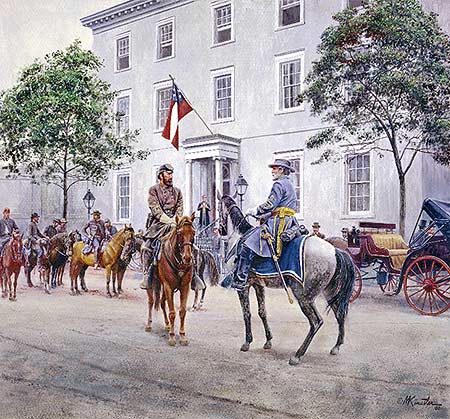
I found this jewel at http://www.fredericksburgpc.org/documents/CaptainJamesPowerSmith.pdf
STONEWALL JACKSON’S AIDE DE CAMP
Captain James Power Smith
In the spring of 1861, James Power Smith was a theological student at Virginia’s Hampden-Sydney College. He enlisted in the Rockbridge Artillery, a Confederate battery comprised of college and seminary students. The battery fought at the First Battle of Manassas (Bull Run) where Smith received his baptism of fire. It was there that General Barney Bee saw Jackson’s men holding steady while other Confederates were giving ground, and made the historic comment, “There stands Jackson like a stone wall!” From then on the name “Stonewall” Jackson became a legend in the South.
On September 7, 1862, Smith rode into Frederick,Maryland, to visit the Presbyterian Church where his father had preached when James was a boy. When he left the church, he discovered that his horse had been stolen. Then he received another surprise. He was told to report to General Thomas J. Jackson, the war’s most famous commander. He thought someone was playing a trick on him, but he went. The general had met Smith three years earlier at a wedding, and surprised the young corporal by inviting him to be the aide-de-camp on his staff.
Smith hustled to get a new uniform and a horse, and on September 20 he returned to the Army of Northern Virginia. The next day he met General Lee, who gave him a fresh peach. Later Smith traveled with Jackson from Winchester to Lee’s headquarters in Fredericksburg. On the way they passed the refugees fleeing from Fredericksburg before the battle, including many huddled in Salem Church.
On Sunday morning, November 30, 1862, Jackson and Smith rode into deserted Fredericksburg. They sat in their saddles at the eastern corner of the Presbyterian Church, and surveyed the scene of the coming battle. Smith asked if he could ride down to the river to water his horse, and “Old Jack” warned him that he would probably be shot by the Yankees on the other side of the river. But he did ride down to water his horse, and when he returned, Jackson was still in the same place. After the war, Smith identified the spot where Jackson planned strategy for the Battle of Fredericksburg, and in 1924 a marker was imbedded in the brick wall by the Presbyterian Church, commemorating it.
That night they stayed in the home of the French family—the family that gave the French Memorial Chapel and for whom the education building is named. Jackson led evening prayers, using the big family bible,and kneeling to pray with the family. Then Smith and Jackson established their headquarters south of town near Guiney’s Station.
On the morning of December 11, 1862, General Burnside’s Union guns began the bombardment of Fredericksburg. Smith spent most of the day carrying messages between the Southern commanders. Early next morning he rode with Jackson to the present Lee’s Hill, where Lee and Jackson conferred and observed the battle. They watched the Yankees “coming handsomely” across the river. However, by the end of the day the whole landscape was covered with the bodies of many men in union blue.
During the battle, a part of the Confederate line was the spot south of town commanded with one cannon by the “The Gallant Pelham.” Finally, General Lee had to send word to Pelham to pull back. Who took the message from Lee to Pelham? It was James Power Smith.
Smith also reported that a “fine handsome blooded mare” was shot out from under him that day, and many of his former comrades in the Rockbridge Artillery were killed. That night, Jackson and Smith were at Moss Neck Manor, south of town. Jackson said, “If the men sleep on the ground, I will too.” (This was in December.) They had two overcoats and two blankets. They each put on an overcoat. They put one blanket under them, one over them, and they huddled together to keep from freezing that night.
The next day they moved into Moss Neck manor, the home of the Corbins. On Christmas Day Jackson entertained General Lee, General J. E. B. Stuart and Sandie Pendleton at the manor with turkeys, oysters, a ham, cake, a bottle of wine, biscuits, and pickles. And who obtained all those fixings for the dinner? James Power Smith.
Jackson was appalled by the suffering in Fredericksburg, and led the officers and men in his command in raising $30,000 for their relief—a lot of money for that time.
On April 23, 1863, Smith was present at the baptism of Jackson’s daughter, Julia. Tucker Lacy conducted the service.
On April 29, 1863, hundreds of Federal soldiers crossed the Rappahannock River under the cover of heavy fog in the attack which led to the crucial battle of Chancellorsville. When he received the news, General Jackson sent Smith to inform General Lee of the attack. The next night Smith was sent on an errand by Lee. When he returned, Lee was sleeping at the foot of a tree and covered with his army cloak. He pulled Smith under his cloak and asked him to give his report. Smith then made his own bed, and “with my head in my saddle, near my horse’s feet, I was soon wrapped in the heavy slumber of a weary soldier.”
Smith then became the only eye-witness to a great moment in American history: “Sometime after midnight I was awakened by the chill of the early morning hours, and turning over, caught a glimpse of a little flame on the slope above me, and sitting up to see what it meant, I saw, bending over a scant fire of twigs, two men seated on old cracker boxes and warming their hands over a little fire. I had to rub my eyes and collect my wits to recognize the figures of Robert E. Lee and Stonewall Jackson. Who can tell the story of that quiet council of war between two
sleeping armies.”
As a result of Smith’s report of this scene, the event was immortalized. The famous “Cracker Barrel Conference” not only depicted the South’s two best known generals planning Jackson’s famous flank march that led to their greatest victory at the Battle of Chancellorsville, it was also the last time that the two great men ever saw each other alive. The image of the two men sitting on the cracker boxes by the fire isnow the logo which symbolizes the famous battle at the Chancellorsville Military Park, and elsewhere.
At 8 P.M. that night Smith gathered his couriers to find Jackson, and about a mile west of Chancellorsville was told that Jackson was just ahead. He rode a hundred yards further on, and heard shouting. He was told that Jackson had been wounded, and others around him killed by the fire of their own men. Smith spurred his horse forward.
On arriving at the scene he was told that “He (Jackson) was struck by three balls at the same time. One went through the palm of his right hand; a second passed through the wrist of the left arm and out of the hand; the third one was more severe. It passed through the left arm halfway from the shoulder to the elbow. The large bone of the upper arm was splintered to the elbow joint, and the wound bled freely.”
Jackson’s horse bolted, and he reeled from his saddle, but he was caught and placed gently on the ground. General A. P. Hill had come to his aid as Smith rode up. Smith cut Jackson’s sleeve open from the wrist to the shoulder, and used his handkerchief to stem the flow of blood. Couriers were sent to find a doctor and an ambulance.
Smith was one of the four litter-bearers who started to move Jackson to a safer place on a stretcher. But one of the bearers was shot, and he fell. The fire became heavier, so the litter was placed in the middle of the road, and Smith shielded Jackson’s body with his own. When the firing slackened, Smith helped Jackson up, put his arms around him, and started to drag him to safety. More litter bearers arrived. Again they started to carry him to safety. Another bearer fell, dropping his corner of the litter. This time Jackson fell and hit the ground, causing him great pain. Finally they reached comparative safety and Jackson was placed in an ambulance.
In a tent near the Wilderness Store, Jackson’s left arm was amputated near the shoulder, and a ball was taken from his right hand. Smith held the light for the operation, and “all night long it was mine to watch the sufferer and keep him warmly wrapped and undisturbed in his sleep.” All the other staff officers had to return to their duties, so only Smith remained and continued to talk with Jackson. Though he had been hit three times, fallen from a litter once, was dragged for a distance by Smith, endured a miserable ride in an army ambulance, went through shock, and then had his arm amputated, he still was very alert.
In the afternoon a courier arrived from Lee’s headquarters, and Smith gave his message to Jackson. Lee said, “Could I have directed events, I should have chosen for the good of the country to be disabled in your stead…”
Early on May 4, Jackson was placed in an army ambulance for the twenty-five mile trip to Guiney’s Station, where he would be safer. In the ambulance with Jackson were Chaplain Tucker Lacy, Smith and Doctor Hunter McGuire. McGuire, whose statue stands in front of the state Capitol and who had a Richmond hospital named after him, was a Presbyterian, too. Saddened Virginians watched the ambulance pass by. Smith remained at Guiney’s Station with Tucker Lacy and Doctor McGuire. Smith kept watch with Jackson during the night of May 5th. At dawn he called for the doctor, who recognized the early symptoms of pneumonia. While the doctor was dressing Jackson’s wounds, Anna Jackson and their daughter Julia arrived. Anna sang spiritual songs for him. He told her that he wanted to be buried in Lexington, and that he always wanted to die on Sunday.
On Sunday, May 10, 1862, Lieutenant General Thomas J. Jackson “crossed over the river to rest under the shade of the trees.” Just two weeks after the Jacksons had gone to church together and had their daughter baptized, Anna was a widow. The Confederacy was filled with grief. Smith rode in the railway car to Richmond with the Jackson family and the general’s body. General Longstreet headed the pallbearers who carried the casket up the steps of the Capitol, where over 2,000 people came to show their respects. After the burial in Lexington, Smith accompanied Anna Jackson and little Julia to their home in North Carolina.
On June 13, Smith returned to report to Lee before the battle of Gettysburg. At Lee’s request, Smith remained with him that night, and he was with the general when the battle began on July 1. Lee sent him with a message to General Ewell, and he was with Ewell when the request arrived from General Jubal Early to advance up the slope to capture Cemetery Ridge. Ewell told Smith to take the request to General Lee. He found Lee and Longstreet and conveyed the request.
After the war, Smith returned to Union Seminary, was ordained as a Presbyterian minister, and on May 24, 1869, he was called to be the minister of the Presbyterian Church of Fredericksburg,
where he served for 23 years. He shared in dedicating the Jackson Monument in Richmond and the Memorial Hall in Lexington. He dedicated the place on the Lacy farm at “Ellwood” where Tucker Lacy had buried Jackson’s arm, and also indicated the place by the brick wall in front of the Presbyterian Church where Jackson had stood to “plan the Battle of Fredericksburg.”
In 1871 he married Agnes, the daughter of Tucker Lacy’s younger brother, Major Horace J. Lacy, who lived at “Chatham” (called the “Lacy House” during the war – when it was the Federal headquarters, and then a hospital.) He wrote extensively about his war experiences including “The Religious Character of Stonewall Jackson,” “Jackson at Chancellorsville,” and “Lee at Gettysburg.”
James Power Smith returned to Gettysburg in 1917 to pronounce the invocation at the dedication of the Virginia State Monument at Seminary Ridge. He died in 1923 at 86, and was the last surviving member of Stonewall Jackson’s staff.
Showing posts with label Stonewall Jackson. Show all posts
Showing posts with label Stonewall Jackson. Show all posts
Wednesday, February 11, 2009
Sandie Pendleton
Confederate (CSA)
Colonel Alexander Swift Pendleton
"Sandie"
(1840 - 1864)
Home State: Virginia
Command Billet: Staff
Branch of Service: Infantry
Unit: Jackson's Command
Before the Antietam Campaign:
Rank history:
Lt., July 19, 1861;
Aide-de-Camp (A D C), Feb. 1862;
Assistant Adjutant-General (AAG), April 19, 1862;
Capt.and AAG., June 18, 1862;
Major, Dec. 4, 1862
Alexander (Sandie) Swift Pendleton was born near Alexandria, Virginia on September 28, 1840. He was the only son of William Nelson Pendleton. The Pendleton family moved to Lexington, Virginia in October 1853, where William became rector at Grace Episcopal Church. Sandie Pendleton graduated from Washington College (now Washington & Lee University) in 1857, and subsequently enrolled at the University of Virginia, where he was pursuing a Master of Arts degree when the Civil War began in April 1861. He received a commission as 2nd Lieutenant in Provisional Army of Virginia and reported to Harper's Ferry on June 14, 1861. Within weeks, he was asked by General Stonewall Jackson to join his staff as an ordnance officer --- Jackson had known Pendleton from their days together in Lexington, where Jackson was a Professor at the Virginia Military Institute. Pendleton subsequently served as Jackson's Assistant Adjutant General (Second Corps), and the relationship between Pendleton and Jackson was a close one-- it was said that Jackson "loved him like a son."
In the Antietam Campaign:
Capt Pendleton was AAG on Gen Jackson's staff. At one point during the battle, he describes the scene - "Such a storm of balls I never conceived it possible for men to live through. Shot and shell shrieking and crashing, canister and bullets whistling and hissing most fiend-like through the air until you could almost see them. In that mile's ride I never expected to come back alive." {quoted on the NPS Antietam site)
The remainder of the War:
He served on General "Stonewall" Jackson's staff until the Generals death at Chancellorsville in May 1863, and subsequently as adjutant-general to General Jubal A. Early and General Richard S. Ewell. He was killed at Fisher's Hill, Virginia, 22 September, 1864.
References, Sources, and other notes:
The authoritive biography is - Bean, W. G. Stonewall's Man: Sandie Pendleton, University of North Carolina Press, 1959.
More on the Web:
See a brief bio and collection of papers at VMI - the source of the picture and much of the text above, and a memorial site (with a picture of Pendleton's gravesite) on the Stonewall Jackson Cemetery in Lexington.
Birth Date: 9/28/1840
Place of Birth: Alexandria, VA
College: Washington College (VA), UVa
Death Date: 9/22/1864
Death Place: Fisher's Hill, VA
Burial Place: Stonewall Jackson Cemetery, Lexington, VA
Colonel Alexander Swift Pendleton
"Sandie"
(1840 - 1864)
Home State: Virginia
Command Billet: Staff
Branch of Service: Infantry
Unit: Jackson's Command
Before the Antietam Campaign:
Rank history:
Lt., July 19, 1861;
Aide-de-Camp (A D C), Feb. 1862;
Assistant Adjutant-General (AAG), April 19, 1862;
Capt.and AAG., June 18, 1862;
Major, Dec. 4, 1862
Alexander (Sandie) Swift Pendleton was born near Alexandria, Virginia on September 28, 1840. He was the only son of William Nelson Pendleton. The Pendleton family moved to Lexington, Virginia in October 1853, where William became rector at Grace Episcopal Church. Sandie Pendleton graduated from Washington College (now Washington & Lee University) in 1857, and subsequently enrolled at the University of Virginia, where he was pursuing a Master of Arts degree when the Civil War began in April 1861. He received a commission as 2nd Lieutenant in Provisional Army of Virginia and reported to Harper's Ferry on June 14, 1861. Within weeks, he was asked by General Stonewall Jackson to join his staff as an ordnance officer --- Jackson had known Pendleton from their days together in Lexington, where Jackson was a Professor at the Virginia Military Institute. Pendleton subsequently served as Jackson's Assistant Adjutant General (Second Corps), and the relationship between Pendleton and Jackson was a close one-- it was said that Jackson "loved him like a son."
In the Antietam Campaign:
Capt Pendleton was AAG on Gen Jackson's staff. At one point during the battle, he describes the scene - "Such a storm of balls I never conceived it possible for men to live through. Shot and shell shrieking and crashing, canister and bullets whistling and hissing most fiend-like through the air until you could almost see them. In that mile's ride I never expected to come back alive." {quoted on the NPS Antietam site)
The remainder of the War:
He served on General "Stonewall" Jackson's staff until the Generals death at Chancellorsville in May 1863, and subsequently as adjutant-general to General Jubal A. Early and General Richard S. Ewell. He was killed at Fisher's Hill, Virginia, 22 September, 1864.
References, Sources, and other notes:
The authoritive biography is - Bean, W. G. Stonewall's Man: Sandie Pendleton, University of North Carolina Press, 1959.
More on the Web:
See a brief bio and collection of papers at VMI - the source of the picture and much of the text above, and a memorial site (with a picture of Pendleton's gravesite) on the Stonewall Jackson Cemetery in Lexington.
Birth Date: 9/28/1840
Place of Birth: Alexandria, VA
College: Washington College (VA), UVa
Death Date: 9/22/1864
Death Place: Fisher's Hill, VA
Burial Place: Stonewall Jackson Cemetery, Lexington, VA

Joseph G. Morrison
In my novel, Joe Morrison plays a very important role. While researching his life, I found this article on the internet. I hope you enjoy learning more about Jackson's brother-in-law and aide-de-camp.
J.G. Morrison
Confederate (CSV)
Lieutenant J.G. Morrison (CSV)
Joseph Graham Morrison (1842 - 1906)Home State: North Carolina Command Billet: Aide-de-camp Branch of Service: Staff Unit: Jackson's Command.
Before the Antietam Campaign:
He was named for his maternal grandfather, Revolutionary War figure and later General Joseph Graham. As the Civil War began he was a student at the Virginia Military Academy (Class of 1865), but he left school and was commissioned Lieutenant and ADC on his brother-in-law Thomas "Stonewall" Jackson’s staff in June 1862. Jackson had married Morrison's sister Mary Anna in 1857.
Cedar Mountain in August …
"... was his first experience on the battlefield. His bearing was fearless and chivalric. He was riding one of the General’s horses, which, shot in the jaw, was rearing and plunging, sprinkling both his rider and himself with blood. It was suggested to the General that he had better call that youth in or his career would be a short one, but he replied that his example would not be lost upon the troops and he would learn more discretion after a battle or two. He would not permit him to be recalled. Morrison escaped that day but after the General’s death he was badly wounded twice and came out of the army with the loss of a foot."(from Douglas 1)
In the Antietam Campaign: He was aide-de-camp (ADC) to General Jackson on the Maryland Campaign.
The remainder of the War: Lieutenant Morrison was with General Jackson when he was mortally wounded by his own troops at Chancellorsville in May 1863. After Chancellorsville, in July 1863, rather than transfer to General Ewell with the rest of Jackson’s staff, he joined General Ramseur.
In September 1863 he transferred to the 57th North Carolina Infantry as Adjutant. By 1865 he was Captain of Company F, and lost a foot shortly after at Petersburg, while away from his regiment visiting General Hoke.
After the War: Also suffering from tuberculosis, Joseph spent the four years following the War in California recuperating. In 1869 he came home to North Carolina where he was a planter and ran the Mariposa Cotton Mills. He returned to claim the family home on his father’s death in 1889, and himself passed at Charlotte on 11 April 1906.
References, Sources, and other notes:Special thanks to Bill Torrens, who pointed me to Krick2 and the Douglas anecdote used here.
More on the Web:See more about the Morrison family and their famous relations on the 'behind AotW' blog.
Birth Date: 01/06/1842
Place of Birth: Lincoln County, NC
Death Date: 04/11/1906
Death Place: Charlotte, NC
Burial Place: Machpelah Presbyterian Church Cemetery, Lincoln Co
Notes
1 Douglas, Henry Kyd, I Rode With Stonewall, Chapel Hill: University of North Carolina Press, 1940, pp. 127-128 [AotW citation 600]
2 Krick, Robert E.L., Staff Officers in Gray; A Biographical Register of the Staff Officers in the Army of Northern Virginia, Chapel Hill: University of North Carolina Press, 2003, pg. 226 [AotW citation 601]
© 1996 - 2009 by Brian Downey and AotW Members
J.G. Morrison
Confederate (CSV)
Lieutenant J.G. Morrison (CSV)
Joseph Graham Morrison (1842 - 1906)Home State: North Carolina Command Billet: Aide-de-camp Branch of Service: Staff Unit: Jackson's Command.
Before the Antietam Campaign:
He was named for his maternal grandfather, Revolutionary War figure and later General Joseph Graham. As the Civil War began he was a student at the Virginia Military Academy (Class of 1865), but he left school and was commissioned Lieutenant and ADC on his brother-in-law Thomas "Stonewall" Jackson’s staff in June 1862. Jackson had married Morrison's sister Mary Anna in 1857.
Cedar Mountain in August …
"... was his first experience on the battlefield. His bearing was fearless and chivalric. He was riding one of the General’s horses, which, shot in the jaw, was rearing and plunging, sprinkling both his rider and himself with blood. It was suggested to the General that he had better call that youth in or his career would be a short one, but he replied that his example would not be lost upon the troops and he would learn more discretion after a battle or two. He would not permit him to be recalled. Morrison escaped that day but after the General’s death he was badly wounded twice and came out of the army with the loss of a foot."(from Douglas 1)
In the Antietam Campaign: He was aide-de-camp (ADC) to General Jackson on the Maryland Campaign.
The remainder of the War: Lieutenant Morrison was with General Jackson when he was mortally wounded by his own troops at Chancellorsville in May 1863. After Chancellorsville, in July 1863, rather than transfer to General Ewell with the rest of Jackson’s staff, he joined General Ramseur.
In September 1863 he transferred to the 57th North Carolina Infantry as Adjutant. By 1865 he was Captain of Company F, and lost a foot shortly after at Petersburg, while away from his regiment visiting General Hoke.
After the War: Also suffering from tuberculosis, Joseph spent the four years following the War in California recuperating. In 1869 he came home to North Carolina where he was a planter and ran the Mariposa Cotton Mills. He returned to claim the family home on his father’s death in 1889, and himself passed at Charlotte on 11 April 1906.
References, Sources, and other notes:Special thanks to Bill Torrens, who pointed me to Krick2 and the Douglas anecdote used here.
More on the Web:See more about the Morrison family and their famous relations on the 'behind AotW' blog.
Birth Date: 01/06/1842
Place of Birth: Lincoln County, NC
Death Date: 04/11/1906
Death Place: Charlotte, NC
Burial Place: Machpelah Presbyterian Church Cemetery, Lincoln Co
Notes
1 Douglas, Henry Kyd, I Rode With Stonewall, Chapel Hill: University of North Carolina Press, 1940, pp. 127-128 [AotW citation 600]
2 Krick, Robert E.L., Staff Officers in Gray; A Biographical Register of the Staff Officers in the Army of Northern Virginia, Chapel Hill: University of North Carolina Press, 2003, pg. 226 [AotW citation 601]
© 1996 - 2009 by Brian Downey and AotW Members
Wednesday, October 29, 2008
The Funeral of Stonewall Jackson - The Lexington Gazette, May 20, 1863
All that was mortal of our great and good chief, Lieut. Gen. T.J. Jackson was consigned to the tomb on Friday last.
The body having reached Lexington by the Packet boat on Thursday afternoon, accompanied by his personal staff, Maj. A.S. Pendleton, Surgeon H. McGuire, Lieut. Morrison, and Lieut. Smith, by his Excellency Gov. Letcher, and a delegation of the citizens of Lynchburg, it was received by the Corps of Cadets and escorted to the Institute, and deposited in his late Lecture Room, which had been appropriately draped in mourning.
There was the table used by the late Professor--the same chair in which he sat--the cases with the Philosophical apparatus he had used--all told of his quiet and unobtrusive labors in his Professional life--and placed just as he left them, when he received the order of the Governor of Virginia to march the Corps of Cadets to Richmond, on the 21st of April 1861. He left the Va. Military Institute in command of the Cadets. He has been brought back to sleep among us--a world renowned Christian Hero.
The procession moved from the Institute on Friday morning at 10 A.M. The Funeral escort was commanded by Maj. S. Ship, Commandant of Cadets, a former pupil of Gen. Jackson and a gallant officer who had served with him in his Valley Campaign, as Major of the 21st Va. Regt.
The Escort was composed as follows:
1. Cadet Battalion
2. Battery of Artillery of 4 pieces, the same battery he had for ten years commanded as Instructor of Artillery and which had also served with him at 1st Manassas, in [the] Stonewall Brigade.
3. A company of the original Stonewall Brigade, composed of members of different companies of the Brigade, and commanded by Capt. A. Hamilton, bearing the flag of the "Liberty Hall Volunteers."
4. A company of convalescent officers and soldiers of the army.
5. A Squadron of cavalry was all that was needed to complete the escort prescribed by the Army Regulations. This squadron opportunely made its appearance before the procession moved from the church. The Squadron was a part of Sweeny's battalion of Jenkin's command, and many of its members were from the General's native North-western Virginia.
6. The Clergy.
7. The Body enveloped in the Confederate Flag and covered with flowers, was borne on a caisson of the Cadet Battery, draped in mourning.The pall bearers were as follows:Wm. White ; Professor J.L. Campbell--representing the Elders of the Lexington Presbyterian Church.Wm. C. Lewis; Col. S. McD. Reid--County Magistrates.Prof. J.J. White; Prof. C.J. Harris--Washington College.S. McD. Moore; John W. Fuller--Franklin Society.George W. Adams; Robt. I. White--Town Council.Judge J. W. Brockenbrough; Joseph G. Steel--Confederate District CourtDr. H.H. McGuire; Capt. F.W. Henderson--C.S. Army.Rev. W. McElwee; John Hamilton--Bible Society of Rockbridge
8. The Family and Personal Staff of the deceased.
9. The Governor of Va., Confederate States Senator Henry of Tenn. The Sergeant-at-Arms of C.S. Senate, and a member of the City of Richmond Council.
10. Faculty and Officers of Va. Mil. Institute.
11. Elders and Deacons of Lexington Presbyterian Church of which church Gen. Jackson was a Deacon.
12. Professors and Students of Washington College.
13. Franklin Society.
14. Citizens.
The body having reached Lexington by the Packet boat on Thursday afternoon, accompanied by his personal staff, Maj. A.S. Pendleton, Surgeon H. McGuire, Lieut. Morrison, and Lieut. Smith, by his Excellency Gov. Letcher, and a delegation of the citizens of Lynchburg, it was received by the Corps of Cadets and escorted to the Institute, and deposited in his late Lecture Room, which had been appropriately draped in mourning.
There was the table used by the late Professor--the same chair in which he sat--the cases with the Philosophical apparatus he had used--all told of his quiet and unobtrusive labors in his Professional life--and placed just as he left them, when he received the order of the Governor of Virginia to march the Corps of Cadets to Richmond, on the 21st of April 1861. He left the Va. Military Institute in command of the Cadets. He has been brought back to sleep among us--a world renowned Christian Hero.
The procession moved from the Institute on Friday morning at 10 A.M. The Funeral escort was commanded by Maj. S. Ship, Commandant of Cadets, a former pupil of Gen. Jackson and a gallant officer who had served with him in his Valley Campaign, as Major of the 21st Va. Regt.
The Escort was composed as follows:
1. Cadet Battalion
2. Battery of Artillery of 4 pieces, the same battery he had for ten years commanded as Instructor of Artillery and which had also served with him at 1st Manassas, in [the] Stonewall Brigade.
3. A company of the original Stonewall Brigade, composed of members of different companies of the Brigade, and commanded by Capt. A. Hamilton, bearing the flag of the "Liberty Hall Volunteers."
4. A company of convalescent officers and soldiers of the army.
5. A Squadron of cavalry was all that was needed to complete the escort prescribed by the Army Regulations. This squadron opportunely made its appearance before the procession moved from the church. The Squadron was a part of Sweeny's battalion of Jenkin's command, and many of its members were from the General's native North-western Virginia.
6. The Clergy.
7. The Body enveloped in the Confederate Flag and covered with flowers, was borne on a caisson of the Cadet Battery, draped in mourning.The pall bearers were as follows:Wm. White ; Professor J.L. Campbell--representing the Elders of the Lexington Presbyterian Church.Wm. C. Lewis; Col. S. McD. Reid--County Magistrates.Prof. J.J. White; Prof. C.J. Harris--Washington College.S. McD. Moore; John W. Fuller--Franklin Society.George W. Adams; Robt. I. White--Town Council.Judge J. W. Brockenbrough; Joseph G. Steel--Confederate District CourtDr. H.H. McGuire; Capt. F.W. Henderson--C.S. Army.Rev. W. McElwee; John Hamilton--Bible Society of Rockbridge
8. The Family and Personal Staff of the deceased.
9. The Governor of Va., Confederate States Senator Henry of Tenn. The Sergeant-at-Arms of C.S. Senate, and a member of the City of Richmond Council.
10. Faculty and Officers of Va. Mil. Institute.
11. Elders and Deacons of Lexington Presbyterian Church of which church Gen. Jackson was a Deacon.
12. Professors and Students of Washington College.
13. Franklin Society.
14. Citizens.
Wednesday, July 23, 2008
Henry Kyd Douglas Relates a Comic Scene
Here is a rather funny account by Henry Kyd Douglas that reveals the relationship between Jackson and Stuart. It comes from Douglas’ autobiography, I Rode With Stonewall.
One night, after the middle of it, General Stuart came riding into our Headquarters accompanied by his artillery pet, Captain John Pelham, the “boy Major,” as he was afterwards called, or the “the gallant Pelham,” as General Lee named him at Fredericksburg… Everyone had gone to rest. Stuart went directly to General Jackson’s tent; Pelham came into mine. The General was asleep and the cavalry chief threw himself down by his side, taking off nothing but his saber. As the night became chilly, so did he, and unconsciously he began to take possession of blankets and got between the sheets. There he discovered himself in the early morn in the full panoply of war, and he got out of it. After a while, when a lot of us were standing by a blazing log-fire before the General’s tent, he came out for us ablutions.
“Good morning, General Jackson,” said Stuart, “how are you?”
Old Jack passed his hands through his thin and uncombed hair and then in tones as nearly comic as he could muster, he said, “General Stuart, I’m always glad to see you here. You might select better hours sometimes, but I’m always glad to have you. But, General” – as he stooped and rubbed himself along the legs – “you must not get into my bed with your boots and spurs on and ride me around like a cavalry horse all night!”
One night, after the middle of it, General Stuart came riding into our Headquarters accompanied by his artillery pet, Captain John Pelham, the “boy Major,” as he was afterwards called, or the “the gallant Pelham,” as General Lee named him at Fredericksburg… Everyone had gone to rest. Stuart went directly to General Jackson’s tent; Pelham came into mine. The General was asleep and the cavalry chief threw himself down by his side, taking off nothing but his saber. As the night became chilly, so did he, and unconsciously he began to take possession of blankets and got between the sheets. There he discovered himself in the early morn in the full panoply of war, and he got out of it. After a while, when a lot of us were standing by a blazing log-fire before the General’s tent, he came out for us ablutions.
“Good morning, General Jackson,” said Stuart, “how are you?”
Old Jack passed his hands through his thin and uncombed hair and then in tones as nearly comic as he could muster, he said, “General Stuart, I’m always glad to see you here. You might select better hours sometimes, but I’m always glad to have you. But, General” – as he stooped and rubbed himself along the legs – “you must not get into my bed with your boots and spurs on and ride me around like a cavalry horse all night!”
Friday, July 18, 2008
Who Could Not Conquer With Such Troops as These? - Part Two
Below is the conclusion to Dabney's article.
On the morning of the 26th, he (Jackson) turned eastward, and passing through the Bull Run Mountains, at Thoroughfare Gap, proceeded to Bristoe Station, on the Orange Railroad, by another equally arduous march. At Gainesville, he was joined by Stuart, with his cavalry, who now assumed the duty of guarding his right flank and watching the main army of Pope about Warrenton. As the Confederates approached Bristoe Station, about sunset, the roar of a railroad train proceeding eastward was heard and dispositions were made to arrest it by placing the brigade of Hays, under Colonel Forno, across the track. The first train broke through the obstructions placed before it and escaped. Two others which followed it were captured but were found to contain nothing.
The corps of Jackson had now marched fifty miles in two days. The whole army of Pope was interposed between it and its friends. They had no supplies whatever, save those which the might capture from the enemy. But they were between the enemy and his capital and were cheered by the hope of inflicting a vital blow upon him before he escaped. This movement would be pronounced wrong if judged by a formal and common-place application of the maxims of the military art. But it is the very prerogative of true genius to know how to modify the application of those rules according to circumstances. It might have been objected that such a division of the Confederate Army into two parts; subjected to the risk of being beaten in detail; that while the Federal commander detained and amused one by a detachment, he would turn upon the other with the chief weight of his forces and crush it into fragments. Had Pope been a Jackson this danger would have been real; but because Pope was but Pope and General Lee had a Jackson to execute the bold conception and a Stuart to mask his movements during its progress, the risk was too small to forbid the attempt. The promptitude of General Stuart in seizing the only signal station whence the line of march could possibly be perceived and the secrecy and rapidity of General Jackson in pursuing it. with the energy of his action when he had reached his goal, ensured the success of the movement.
On the morning of the 26th, he (Jackson) turned eastward, and passing through the Bull Run Mountains, at Thoroughfare Gap, proceeded to Bristoe Station, on the Orange Railroad, by another equally arduous march. At Gainesville, he was joined by Stuart, with his cavalry, who now assumed the duty of guarding his right flank and watching the main army of Pope about Warrenton. As the Confederates approached Bristoe Station, about sunset, the roar of a railroad train proceeding eastward was heard and dispositions were made to arrest it by placing the brigade of Hays, under Colonel Forno, across the track. The first train broke through the obstructions placed before it and escaped. Two others which followed it were captured but were found to contain nothing.
The corps of Jackson had now marched fifty miles in two days. The whole army of Pope was interposed between it and its friends. They had no supplies whatever, save those which the might capture from the enemy. But they were between the enemy and his capital and were cheered by the hope of inflicting a vital blow upon him before he escaped. This movement would be pronounced wrong if judged by a formal and common-place application of the maxims of the military art. But it is the very prerogative of true genius to know how to modify the application of those rules according to circumstances. It might have been objected that such a division of the Confederate Army into two parts; subjected to the risk of being beaten in detail; that while the Federal commander detained and amused one by a detachment, he would turn upon the other with the chief weight of his forces and crush it into fragments. Had Pope been a Jackson this danger would have been real; but because Pope was but Pope and General Lee had a Jackson to execute the bold conception and a Stuart to mask his movements during its progress, the risk was too small to forbid the attempt. The promptitude of General Stuart in seizing the only signal station whence the line of march could possibly be perceived and the secrecy and rapidity of General Jackson in pursuing it. with the energy of his action when he had reached his goal, ensured the success of the movement.
Wednesday, July 16, 2008
Who Could Not Conquer With Such Troops as These? - Part One
After the victories on the Peninsula, Jackson started toward the Valley on August 7. On August 9, he reached Cedar Mountain, south of Culpepper, and there ran into a Federal force under General Banks. Banks attacked, won some initial success, and was then thrown back and overwhelmed by superior numbers. Finding the whole of Pope's army in front of him, on the Rapidan line, Jackson fell back toward Gordonsville. After some maneuvering for position, Lee decided to send Jackson around Pope's army, and it is one phase of this great swinging movement that the Reverend Robert Dabney, Jackson's adjutant, describes in his book Life and Campaigns of Lt. Gen. Thomas J. Jackson.
While the enemy was thus deluded with the belief that the race up the Rappahannock was ended, and that he now had nothing more to do than to hold its northern bank at this place, General Jackson was preparing, under the instruction of the Commander-in-Chief, for the most adventurous and brilliant of his exploits. This was no less than to separate himself from the support of the remainder of the army, pass around Pope to the west and place his corps between him and Washington City, at Manassas Junction. To effect this, the Rappahannock must be passed on the upper part of its course, and now two forced marches made through the western quarters of the county of Fauquier, which lie between the Blue Ridge and the subsidiary range of the Bull Run Mountains. Having made a hasty and imperfect issue of rations, Jackson disembarassed himself of all his trains, save the ambulances and the carriages for the ammunition, and left Jefferson early on the morning of August 25th. Marching first westward, he crossed the two branches of the Rappahannock, passed the hamlet of Orlean, and paused at night, after a march of twenty-five miles, near Salem, a village upon the Manassas Gap Railroad. His troops had been constantly marching and fighting since the 20th; many of them had no rations, and subsisted upon the green corn gathered along the route; yet their indomitable enthusiasm and devotion knew no flagging. As the weary column approached the end of the day's march, they found Jackson, who had ridden forward, dismounted, and standing upon a great stone by the road-side.
His sun-burned cap was lifted from the brow, and he was gazing toward the west, where the splendid August sun was bout to kiss the distant crest of the Blue Ridge, which stretched far away, bathed in azure and gold; and his blue eyes, beaming with martial pride, returned the rays of the evening with almost equal brightness. His men burst forth into their accustomed cheers, forgetting all their fatigue at his inspiring presence to the enemy. They at once repressed their applause; and passed the word down the column to their comrades: "No cheering boys; the General requests it." But as they passed him, their eyes and gestures, eloquent with suppressed affection, silently declared what their lips were forbidden to utter. Jackson turned to his staff, his face beaming with delight, and said: "Who could not conquer, with such troops as these?"
While the enemy was thus deluded with the belief that the race up the Rappahannock was ended, and that he now had nothing more to do than to hold its northern bank at this place, General Jackson was preparing, under the instruction of the Commander-in-Chief, for the most adventurous and brilliant of his exploits. This was no less than to separate himself from the support of the remainder of the army, pass around Pope to the west and place his corps between him and Washington City, at Manassas Junction. To effect this, the Rappahannock must be passed on the upper part of its course, and now two forced marches made through the western quarters of the county of Fauquier, which lie between the Blue Ridge and the subsidiary range of the Bull Run Mountains. Having made a hasty and imperfect issue of rations, Jackson disembarassed himself of all his trains, save the ambulances and the carriages for the ammunition, and left Jefferson early on the morning of August 25th. Marching first westward, he crossed the two branches of the Rappahannock, passed the hamlet of Orlean, and paused at night, after a march of twenty-five miles, near Salem, a village upon the Manassas Gap Railroad. His troops had been constantly marching and fighting since the 20th; many of them had no rations, and subsisted upon the green corn gathered along the route; yet their indomitable enthusiasm and devotion knew no flagging. As the weary column approached the end of the day's march, they found Jackson, who had ridden forward, dismounted, and standing upon a great stone by the road-side.
His sun-burned cap was lifted from the brow, and he was gazing toward the west, where the splendid August sun was bout to kiss the distant crest of the Blue Ridge, which stretched far away, bathed in azure and gold; and his blue eyes, beaming with martial pride, returned the rays of the evening with almost equal brightness. His men burst forth into their accustomed cheers, forgetting all their fatigue at his inspiring presence to the enemy. They at once repressed their applause; and passed the word down the column to their comrades: "No cheering boys; the General requests it." But as they passed him, their eyes and gestures, eloquent with suppressed affection, silently declared what their lips were forbidden to utter. Jackson turned to his staff, his face beaming with delight, and said: "Who could not conquer, with such troops as these?"
Monday, July 14, 2008
Colonel Wolseley Visits Stonewall Jackson
Fresh from campaigns in the Crimea, India, and China, Colonel Garnet Wolseley--later Lord Wolseley--was ordered to Canada as quartermaster general in December 1861. In August of the next year, he applied for leave of absence and, without the approval of his superiors, made his way into the Confederate States and visited scenes of recent battles, and the headquarters of Lee and Jackson. Already favorable to the Confederate cause, his enthusiasm was confirmed by what he saw. His account of his month's visit to Confederate Headquarters which appeared anonymously in Blackwood's Magazine, aroused widespread interest in Britain and America.
Here is his the portion of the article that deals with his visit to Jackson's headquarters.
We drove to Bunker's Hill, six miles nearer Martinsburg, as which place Stonewall Jackson, now of world wide celebrity, had his headquarters. With him we spent a most pleasant hour, and were agreeably surprised to find him very affable, having been led to expect that he was silent and almost morose. Dressed in his grey uniform, he looks the hero that he is; and his thin compressed lips and calm glance, which meets yours unflinchingly, give evidence of that firmness and decision of character for which he is so famous. He has a broad open forehead, from which the hair is well brushed back; a shapely nose, straight, and rather long; thin colorless cheeks, with only a very small allowance of whisker; a cleanly shaven upper lip and chin; and a pair of fine greyish-blue eyes, rather sunken, with overhanging brows, which intensify the keeness of his gaze, but without imparting any fierceness to it. Such are the general characteristics of his face; and I have only to add, that a smile seems always lurking about his mouth when he speaks; and that, though his voice partakes slightly of that harshness which Europeans unjustly attribute to all Americans, there is much unmistakable cordiality in his manner; and to us he talked most affectionately of England, and of his brief but enjoyable sojourn there.
The religious element seems strongly developed in him; and though his conversation is perfectly free from all puritanical cant, it is evident that he is a person who never loses sight of the fact that there is an omnipresent Deity ever presiding over the minutest occurrences of life, as well as over the most important.
Altogether, as one of his soldiers said to me in talking of him, "he is a glorious fellow!" and, after I left him, I felt that I had at last solved the mystery of the Stonewall Brigade, and discovered why it was that it had accomplished such almost miraculous feats. With such a leader men would go anywhere, and face any amount of difficulties; and for myself, I believe that, inspired by the presence of such a man, I should be perfectly insensible to fatigue, and reckon upon success as a moral certainty.
Whilst General Lee is regard in the light of infallible Jove, a man to be reverenced, Jackson is loved and adored with all that childlike and trustful affection which the ancients are said to have lavished upon the particular deity presiding over their affairs. The feeling of the soldiers for General Lee resembles that which Wellington's troops entertained for him -- namely, a fixed and unshakable faith in all he did, and a calm confidence of victory when serving under him. But Jackson, like Napoleon, is idolized with that intense fervor which, consisting of mingled personal attachment and devoted loyalty, causes them to meet death for his sake, and bless him when dying.
Here is his the portion of the article that deals with his visit to Jackson's headquarters.
We drove to Bunker's Hill, six miles nearer Martinsburg, as which place Stonewall Jackson, now of world wide celebrity, had his headquarters. With him we spent a most pleasant hour, and were agreeably surprised to find him very affable, having been led to expect that he was silent and almost morose. Dressed in his grey uniform, he looks the hero that he is; and his thin compressed lips and calm glance, which meets yours unflinchingly, give evidence of that firmness and decision of character for which he is so famous. He has a broad open forehead, from which the hair is well brushed back; a shapely nose, straight, and rather long; thin colorless cheeks, with only a very small allowance of whisker; a cleanly shaven upper lip and chin; and a pair of fine greyish-blue eyes, rather sunken, with overhanging brows, which intensify the keeness of his gaze, but without imparting any fierceness to it. Such are the general characteristics of his face; and I have only to add, that a smile seems always lurking about his mouth when he speaks; and that, though his voice partakes slightly of that harshness which Europeans unjustly attribute to all Americans, there is much unmistakable cordiality in his manner; and to us he talked most affectionately of England, and of his brief but enjoyable sojourn there.
The religious element seems strongly developed in him; and though his conversation is perfectly free from all puritanical cant, it is evident that he is a person who never loses sight of the fact that there is an omnipresent Deity ever presiding over the minutest occurrences of life, as well as over the most important.
Altogether, as one of his soldiers said to me in talking of him, "he is a glorious fellow!" and, after I left him, I felt that I had at last solved the mystery of the Stonewall Brigade, and discovered why it was that it had accomplished such almost miraculous feats. With such a leader men would go anywhere, and face any amount of difficulties; and for myself, I believe that, inspired by the presence of such a man, I should be perfectly insensible to fatigue, and reckon upon success as a moral certainty.
Whilst General Lee is regard in the light of infallible Jove, a man to be reverenced, Jackson is loved and adored with all that childlike and trustful affection which the ancients are said to have lavished upon the particular deity presiding over their affairs. The feeling of the soldiers for General Lee resembles that which Wellington's troops entertained for him -- namely, a fixed and unshakable faith in all he did, and a calm confidence of victory when serving under him. But Jackson, like Napoleon, is idolized with that intense fervor which, consisting of mingled personal attachment and devoted loyalty, causes them to meet death for his sake, and bless him when dying.
Saturday, July 12, 2008
Jackson Describe the Battle of First Manassas
In a letter to his wife, Anna, Jackson describes the battle.
Manassas, July 23, 1861
My Precious Pet,
Yesterday we fought a great battle and gained a great victory, for which all the glory is due to God alone. Although under a heavy fire for several continuous hours, I received only one wound, the breaking of the longest finger of my left hand; but the doctor says the finger can be saved. It was broken about midway between the hand and knuckle, the ball passing on the side next the fore finger. Had it struck the centre, I should have lost the finger. My horse was wounded, but not killed. Your coat got an ugly wound near the hip, but my servant, who is very handy, has so far repaired it that it doesn't show very much. My preservation was entirely due, as was the glorious victory, to our God, to whom be all honor, praise and glory. The battle was the hardest that I have been in, but not near so hot in its fire. I commanded the centre more particularly, though one of my regiment extended to the right for some distance. There were other commanders on my right and left. Whilst great credit is due to other parts of our gallant army, God made my brigade more instrumental than any other in repulsing the main attack. This is for your information only -- say nothing about it. Let others speak praise, not myself.
Manassas, July 23, 1861
My Precious Pet,
Yesterday we fought a great battle and gained a great victory, for which all the glory is due to God alone. Although under a heavy fire for several continuous hours, I received only one wound, the breaking of the longest finger of my left hand; but the doctor says the finger can be saved. It was broken about midway between the hand and knuckle, the ball passing on the side next the fore finger. Had it struck the centre, I should have lost the finger. My horse was wounded, but not killed. Your coat got an ugly wound near the hip, but my servant, who is very handy, has so far repaired it that it doesn't show very much. My preservation was entirely due, as was the glorious victory, to our God, to whom be all honor, praise and glory. The battle was the hardest that I have been in, but not near so hot in its fire. I commanded the centre more particularly, though one of my regiment extended to the right for some distance. There were other commanders on my right and left. Whilst great credit is due to other parts of our gallant army, God made my brigade more instrumental than any other in repulsing the main attack. This is for your information only -- say nothing about it. Let others speak praise, not myself.
Saturday, June 14, 2008
Jackson is a Roundhead
The following is an excerpt from Captain Charles Minor Blackford's diary. On July 13, 1862, Captain Blackford meets Stonewall Jackson and records his thoughts about the famous general. Included is a description of Jackson and a wonderful story about Jackson's run-in with a farmer that gives the reader a perfect study of ole Stonewall.
I reached camp yesterday, which I found about three miles from Richmond. My company has been up to Jackson's headquarters for a some special duty. I was told he sent to the regiment for a Captain who knew something about the country about Fredericksburg and his company. My company was selected as I was a native of that place. I am comfortably camped on the Mechanicsville Pike about a hundred yards from Jackson's headquarters. I am writing from Mr. Peach R. Grattan's where I came this morning to meet William. (William Blackford was Charles' oldest brother and served on Jeb Stuart's staff as engineer. He also authored War Year with Jeb Stuart) This is Mr. Wyndham Robertson's house now occupied by the Grattans.
My men received me with open arms yesterday and seemed to be so glad to see me back that it touched me greatly. I wish I could in some way recruit the ranks somewhat. It is very hard to keep a cavalry company from a town. All the other companies in the regiment have the advantage of mine in the matter of securing horses. I have as many thus far as many other companies but I know that from this time on it will be hard to keep the ranks full.
All I hear are stories about Stonewall Jackson. There are lots of jokes, too, one of which I heard just now:
As he was crossing the Blue Ridge en route to Richmond, two Irishmen were sitting by the roadside talking during a rest period. When one said to the other:
"I wish all the Yankees was in Hell!"
"And faith," said the other, "and I don't wish anything of the the sort."
"The divvel you don't, and why don't you?"
"Because Old Jack would have us standing picket at the gate before night and in there before morning -- and it's too hot where we is to suit me!"
I am told by one of the staff that in Monday's fight at Port Republic, in the Valley, Jackson was on the opposite side of the river when the enemy's battery commenced playing on the bridge. He rode up to it and said to the commander. "Fire into those woods over there and not at the bridge." As Jackson was in a blue coat, they took him for a Federal officer and obeyed. Upon which he calmly rode over the bridge and at once brought one of his batteries to bear upon the deluded Federal who was still shelling the harmless woods and drove him from his position.
Jackson excites great enthusiasm everywhere, second only to Lee. The regiment is ordered to Gordonsville. I am glad I will not have to march up there with it.
We will move from here tonight or early tomorrow, I think, for I am sure General Jackson got orders or arranged to move tonight when in town. I was invited by Colonel A.S. (Sandie) Pendleton, his adjutant, to go with General Jackson and his staff into town this morning. I was proud to be of such a distinguished party although a very small atom of it. We went first to the Governor's mansion and there, I suppose by appointment, we met General Lee. The two generals and Governor Letcher came out on the front steps and told the generals good-bye. The two then rode around to Jefferson Davis' house where some other generals met them and I suppose they had a council of war -- certainly a lunch. While they were lunching and conferring I rode around to Cousin Mary G. Watkins' and got a very nice lunch which she kindly prepared for me in an hour, the period for which we were dismissed at the President's house. Any kind of hospitality is a strain now when bacon is seventy-five and fresh meat fifty cents a pound, potatoes sixteen dollars a bushel and other things in proportion.
When the lunch was over, I went back to the President's house where I found the staff officers assembling in front. We still had to wait awhile, but soon the different generals, Longstreet and others, came out, but the particular two were kept to the last and then Lee, Jackson and President Davis came out together, a very distinguished trio, and stood talking on the steps. Lee was elegantly dressed in full uniform, sword and sash, spotless boots, beautiful spurs and by far the most magnificent man I ever saw. The highest type of the Cavalier class to which by blood and rearing he belongs. Jackson, on the other hand, was a typical Roundhead. He was poorly dressed, that is, he looked so, though his clothes were made of good material. His cap was very indifferent and pulled down over one eye, much stained by weather and without insignia. His coat was closely buttoned up to his chin and had upon the collar the stars and wreath of a general. His shoulders were stopped and one shoulder was lower than the other, and his coat showed signs of much exposure to the weather.
He had a plain swordbelt without sash and a sword in no respect different from that of other infantry officers that I could see. His face, in repose, is not handsome or agreeable, and he would be passed by anyone without a second look, though anyone could see determination and will in his face by the most casual glance -- much I would say to fear but not to love. I, of course, speak only from a casual observation and from no acquaintance, but that of a line officer who, in the course of his military duties, has been introduced to the commanding general. A means of observation and acquaintanceship that might be likened to that of a glowworm with the moon.
Davis looks like a statesman. His face is pale and thin but very intellectual, and he had graceful manner and easy bearing. He was dressed in a black suit and left a pleasing impression on anyone looking at him.
After the distinguished gentlemen had talked a few minutes on the steps, they shook hands very cordially in telling each other good-bye, but our observant eyes satisfied us that both Lee and Davis bade Jackson farewell in a manner that indicated they would not see him again for a while, -- or in other words that he had been ordered to move. The opinion was confirmed by the manner in which his rejoined his staff. He got on his old sorrel horse, which his courier was holding for him, and without saying a word to anyone , in a deep brown and abstracted study, started to gallop towards the Mechanicsville Pike, which we soon reached. His orders, published to his corps, very strictly enjoined the preservation of the crops along which the army and its trains moved and forbade all officers and men from riding out into the fields on each side of the road. This day, Jackson was especially anxious to get back to his quarters. Unfortunately for his speed, the pike was filled with long wagon trains, one set coming in, the other going out. It was impossible to make the time under these circumstance and still obey orders. He had not spoken a word since we had gotten underway. He first dodged in and out among the wagons, but his progress was slow, much slower than his needs demanded. He obviously remembered his orders, but determined to violate them.
He told his adjutant to have the cavalcade fall into single file and thereupon dashed into an extensive field of oats, overripe for the harvest, on the left of the pike. Several hundred yards ahead of the place he thusly violated the sacred oat field, there was a very nice brick house sitting back some distance, in a grove of oaks with a lane leading down to the pike. On a porch, a round and fat little gentleman was sitting smoking his pipe, his bald head and red face in his shirtsleeves with an eye on his morning "Examiner" and the other on his field of oats. When he saw the cavalcade ride out of the road, he threw down his paper, rushed down the stops and flew down the land and before we reached the place where the lane and pike united, he was standing like a lion in the pathway. He was puffing and blowing, wiping the perspiration off his forehead and so bursting with rage that all power of articulation seemed for a moment suspended.
The General saw him and for the first time in his career seemed inclined to retreat, but our irate friend had regained his speech and made his attack as Jackson drew rein before him.
"What in hell are you riding over my oats for?" The little mans shouted. "Don't you know it's against orders?"
The General looked confused, fumbled with his bridle rein and was as much abashed as any schoolboy ever caught in a watermelon patch. Before, with his slow speech, he could ever get a word out of explanation, our volcanic friend had another eruption.
"Damnit! Don't you know it's against orders? I intend to have every damned one of you arrested! What's your name anyhow?"
"My name is Jackson," said the General, half as if, for the occasion, he wished it was something else.
"Jackson! Jackson!" in a voice of great contempt. "Jackson, I intend to report every one of you and have you every one arrested. Yes, I'd report you if were old Stonewall himself instead of a set of damned quartermasters and commissaries riding through my oats! Yes, I'll report you to Stonewall Jackson myself, that's what I'll do!"
"They call me that name sometimes," said the General in the same subdued, half-alarmed tone.
"What name?"
"Stonewall."
"You don't mean to say you are Stonewall Jackson, do you?"
"Yes, sir, I am."
I can give no adequate description of the sudden change. His anger was gone in an instant and in its place came an admiring look that was adoring. His color vanished, his lips parted and tears stood in his eyes. His emotions stilled his tongue an instant, then his speech returned with all the vigor of his vernacular and he shouted as he waved his big bandana around his head:
"Hurrah for Stonewall Jackson! By God, General, please do me the honor to ride all over my damned old oats!"
He would not let the General pass until we had all taken a glass of cold buttermilk with him. He pressed the General to take every variety of strong drink, but buttermilk was all he would accept. So great was our friend's admiration for old Stonewall that even refusing to take something stronger did not lower him in his estimation as I think it might have done if the refusal came from a lesser light. He made no apology for his oaths, on the contrary emphasized his admiration, as he had his anger, with a choice selection.
The interview over, we hurried on to headquarters and, very soon after, I was informed that we were to go up to Gordonsville tomorrow. I shall watch Jackson closely while I am with him and put down what I see and what I think of him. He is , of course, a great military genius and has made such an impression on the men that "Old Jack" is at once a rallying cry and a term of endearment. The army is full of of stories about him and everybody, citizens and soldiers, is tyring to get a glimpse of him. Whenever he is recognized by the soldiers he is cheered. Of course in many brigades which have not served under him he is unknown and tries to go about unrecognized. I have no chance to learn anything about him socially and will have none. Even if I had, I doubt from what his staff tells me, whether I would be any wiser or know him any better by the opportunities for observation I have otherwise. He seems to have no social life. He divides his time between military duties, prayer, sleep, and solitary thought. He holds converse with few.
I reached camp yesterday, which I found about three miles from Richmond. My company has been up to Jackson's headquarters for a some special duty. I was told he sent to the regiment for a Captain who knew something about the country about Fredericksburg and his company. My company was selected as I was a native of that place. I am comfortably camped on the Mechanicsville Pike about a hundred yards from Jackson's headquarters. I am writing from Mr. Peach R. Grattan's where I came this morning to meet William. (William Blackford was Charles' oldest brother and served on Jeb Stuart's staff as engineer. He also authored War Year with Jeb Stuart) This is Mr. Wyndham Robertson's house now occupied by the Grattans.
My men received me with open arms yesterday and seemed to be so glad to see me back that it touched me greatly. I wish I could in some way recruit the ranks somewhat. It is very hard to keep a cavalry company from a town. All the other companies in the regiment have the advantage of mine in the matter of securing horses. I have as many thus far as many other companies but I know that from this time on it will be hard to keep the ranks full.
All I hear are stories about Stonewall Jackson. There are lots of jokes, too, one of which I heard just now:
As he was crossing the Blue Ridge en route to Richmond, two Irishmen were sitting by the roadside talking during a rest period. When one said to the other:
"I wish all the Yankees was in Hell!"
"And faith," said the other, "and I don't wish anything of the the sort."
"The divvel you don't, and why don't you?"
"Because Old Jack would have us standing picket at the gate before night and in there before morning -- and it's too hot where we is to suit me!"
I am told by one of the staff that in Monday's fight at Port Republic, in the Valley, Jackson was on the opposite side of the river when the enemy's battery commenced playing on the bridge. He rode up to it and said to the commander. "Fire into those woods over there and not at the bridge." As Jackson was in a blue coat, they took him for a Federal officer and obeyed. Upon which he calmly rode over the bridge and at once brought one of his batteries to bear upon the deluded Federal who was still shelling the harmless woods and drove him from his position.
Jackson excites great enthusiasm everywhere, second only to Lee. The regiment is ordered to Gordonsville. I am glad I will not have to march up there with it.
We will move from here tonight or early tomorrow, I think, for I am sure General Jackson got orders or arranged to move tonight when in town. I was invited by Colonel A.S. (Sandie) Pendleton, his adjutant, to go with General Jackson and his staff into town this morning. I was proud to be of such a distinguished party although a very small atom of it. We went first to the Governor's mansion and there, I suppose by appointment, we met General Lee. The two generals and Governor Letcher came out on the front steps and told the generals good-bye. The two then rode around to Jefferson Davis' house where some other generals met them and I suppose they had a council of war -- certainly a lunch. While they were lunching and conferring I rode around to Cousin Mary G. Watkins' and got a very nice lunch which she kindly prepared for me in an hour, the period for which we were dismissed at the President's house. Any kind of hospitality is a strain now when bacon is seventy-five and fresh meat fifty cents a pound, potatoes sixteen dollars a bushel and other things in proportion.
When the lunch was over, I went back to the President's house where I found the staff officers assembling in front. We still had to wait awhile, but soon the different generals, Longstreet and others, came out, but the particular two were kept to the last and then Lee, Jackson and President Davis came out together, a very distinguished trio, and stood talking on the steps. Lee was elegantly dressed in full uniform, sword and sash, spotless boots, beautiful spurs and by far the most magnificent man I ever saw. The highest type of the Cavalier class to which by blood and rearing he belongs. Jackson, on the other hand, was a typical Roundhead. He was poorly dressed, that is, he looked so, though his clothes were made of good material. His cap was very indifferent and pulled down over one eye, much stained by weather and without insignia. His coat was closely buttoned up to his chin and had upon the collar the stars and wreath of a general. His shoulders were stopped and one shoulder was lower than the other, and his coat showed signs of much exposure to the weather.
He had a plain swordbelt without sash and a sword in no respect different from that of other infantry officers that I could see. His face, in repose, is not handsome or agreeable, and he would be passed by anyone without a second look, though anyone could see determination and will in his face by the most casual glance -- much I would say to fear but not to love. I, of course, speak only from a casual observation and from no acquaintance, but that of a line officer who, in the course of his military duties, has been introduced to the commanding general. A means of observation and acquaintanceship that might be likened to that of a glowworm with the moon.
Davis looks like a statesman. His face is pale and thin but very intellectual, and he had graceful manner and easy bearing. He was dressed in a black suit and left a pleasing impression on anyone looking at him.
After the distinguished gentlemen had talked a few minutes on the steps, they shook hands very cordially in telling each other good-bye, but our observant eyes satisfied us that both Lee and Davis bade Jackson farewell in a manner that indicated they would not see him again for a while, -- or in other words that he had been ordered to move. The opinion was confirmed by the manner in which his rejoined his staff. He got on his old sorrel horse, which his courier was holding for him, and without saying a word to anyone , in a deep brown and abstracted study, started to gallop towards the Mechanicsville Pike, which we soon reached. His orders, published to his corps, very strictly enjoined the preservation of the crops along which the army and its trains moved and forbade all officers and men from riding out into the fields on each side of the road. This day, Jackson was especially anxious to get back to his quarters. Unfortunately for his speed, the pike was filled with long wagon trains, one set coming in, the other going out. It was impossible to make the time under these circumstance and still obey orders. He had not spoken a word since we had gotten underway. He first dodged in and out among the wagons, but his progress was slow, much slower than his needs demanded. He obviously remembered his orders, but determined to violate them.
He told his adjutant to have the cavalcade fall into single file and thereupon dashed into an extensive field of oats, overripe for the harvest, on the left of the pike. Several hundred yards ahead of the place he thusly violated the sacred oat field, there was a very nice brick house sitting back some distance, in a grove of oaks with a lane leading down to the pike. On a porch, a round and fat little gentleman was sitting smoking his pipe, his bald head and red face in his shirtsleeves with an eye on his morning "Examiner" and the other on his field of oats. When he saw the cavalcade ride out of the road, he threw down his paper, rushed down the stops and flew down the land and before we reached the place where the lane and pike united, he was standing like a lion in the pathway. He was puffing and blowing, wiping the perspiration off his forehead and so bursting with rage that all power of articulation seemed for a moment suspended.
The General saw him and for the first time in his career seemed inclined to retreat, but our irate friend had regained his speech and made his attack as Jackson drew rein before him.
"What in hell are you riding over my oats for?" The little mans shouted. "Don't you know it's against orders?"
The General looked confused, fumbled with his bridle rein and was as much abashed as any schoolboy ever caught in a watermelon patch. Before, with his slow speech, he could ever get a word out of explanation, our volcanic friend had another eruption.
"Damnit! Don't you know it's against orders? I intend to have every damned one of you arrested! What's your name anyhow?"
"My name is Jackson," said the General, half as if, for the occasion, he wished it was something else.
"Jackson! Jackson!" in a voice of great contempt. "Jackson, I intend to report every one of you and have you every one arrested. Yes, I'd report you if were old Stonewall himself instead of a set of damned quartermasters and commissaries riding through my oats! Yes, I'll report you to Stonewall Jackson myself, that's what I'll do!"
"They call me that name sometimes," said the General in the same subdued, half-alarmed tone.
"What name?"
"Stonewall."
"You don't mean to say you are Stonewall Jackson, do you?"
"Yes, sir, I am."
I can give no adequate description of the sudden change. His anger was gone in an instant and in its place came an admiring look that was adoring. His color vanished, his lips parted and tears stood in his eyes. His emotions stilled his tongue an instant, then his speech returned with all the vigor of his vernacular and he shouted as he waved his big bandana around his head:
"Hurrah for Stonewall Jackson! By God, General, please do me the honor to ride all over my damned old oats!"
He would not let the General pass until we had all taken a glass of cold buttermilk with him. He pressed the General to take every variety of strong drink, but buttermilk was all he would accept. So great was our friend's admiration for old Stonewall that even refusing to take something stronger did not lower him in his estimation as I think it might have done if the refusal came from a lesser light. He made no apology for his oaths, on the contrary emphasized his admiration, as he had his anger, with a choice selection.
The interview over, we hurried on to headquarters and, very soon after, I was informed that we were to go up to Gordonsville tomorrow. I shall watch Jackson closely while I am with him and put down what I see and what I think of him. He is , of course, a great military genius and has made such an impression on the men that "Old Jack" is at once a rallying cry and a term of endearment. The army is full of of stories about him and everybody, citizens and soldiers, is tyring to get a glimpse of him. Whenever he is recognized by the soldiers he is cheered. Of course in many brigades which have not served under him he is unknown and tries to go about unrecognized. I have no chance to learn anything about him socially and will have none. Even if I had, I doubt from what his staff tells me, whether I would be any wiser or know him any better by the opportunities for observation I have otherwise. He seems to have no social life. He divides his time between military duties, prayer, sleep, and solitary thought. He holds converse with few.
Monday, May 19, 2008
General Orders Seventeen
This story circulated among Stonewall Jackson’s men after his death: Two angels came to carry Stonewall back to Heaven with them. They searched all through his camp but couldn’t find him. They went to the prayer meeting, to the hospital, every place they thought he might be, all to no avail. They finally returned to Heaven to find Stonewall had executed a splendid flanking movement and gotten to Heaven before them.
Saturday, May 10, 2008
Lee's Reaction to the Death of Stonewall Jackson
The following narrative comes from Douglas Freeman Southall's R.E. Lee. Southall's volumes are invaluable to the Lee literature and, in fact, serves as the seminal and definitive work on Lee's life. I have a problem with the volumes though. Southall puts his opinion in Lee's voice, therefore making it appear as if Lee is voicing these concerns, ideas, etc. Unfortunately, these opinions have worked their way into the current Civil War historiography as Lee's opinion and, therefore, as fact. As discerning historians, scholars, or even enthusiasts, it is our responsibility to separate the author's opinion from fact.
"One of Jackson's chaplains, Reverend B. T. Lacy, came to headquarters during the morning of the 7th on his way to find Doctor S. B. Morrison, Early's chief surgeon, whom Doctor McGuire desired in consultation. Jackson was worse, Mr. Lacy said. He had done very well on the 6th except for slight nausea, but at dawn Doctor McGuire had found unmistakable symptoms of pneumonia. There was fear, for the first time, that his illness might be fatal. Lee would not admit the possibility of such an outcome. His own faith in God was so complete that he did not believe Heaven would deprive the South of a man whose services were essential to victory. He said to Lacy: "Give [Jackson] my affectionate regards, and tell him to make haste and get well, and come back to me as soon as he can. He has lost his left arm, but I have lost my right."
What would become of the army if Jackson died? Where, among all his lieutenants, could Lee look for another man to execute with swift certainty the flank marches he so much employed in his strategy? Longstreet was a fine fighter, once the issue was drawn, but Longstreet was slow and contentious, always arguing for his own plan, even to the last minute, whereas Jackson, after advancing his own proposals, would execute Lee's orders as readily as if they were his own. In the Army of Northern Virginia, he had no peer. For him to die would be in very truth for Lee to lose his "right arm."
That evening Jackson was reported better. The pneumonia did not seem to be filling the lung. But the next morning, Friday, May 8, as Lee went about the routine duties of the day, gloom settled again. Jackson was weaker, the pneumonia was advancing, he was in mild delirium at intervals, babbling orders and, with his old concern for the welfare of his men, repeatedly calling, "Tell Major Hawks to send forward provisions for the troops." Despite these ominous symptoms, Lee would not give him up. Jackson could not die, he kept telling himself! He was unable to go to Jackson, both because he could not trust his emotions and because there was no one in whose hands he would feel safe in leaving the army. He had even been compelled to ask the President to come to headquarters for the discussion of important military questions, inasmuch as he felt that his own presence there was essential. There was one thing, only one, that he could do for Jackson. That was to pray for him. On Saturday night, as the doctors shook their heads and expressed the fear that the outlook was hopeless, Lee went down spiritually to the brook Jabbok and, like Jacob, wrestled with the angel. Never in his life had he prayed with so much agony of spirit. While the army slept and Jackson in his stupor fought his battles over, Lee on his knees implored Heaven to grant to his country the mercy of the deliverance of Jackson from death.
When the troops began to gather for worship during the forenoon of the next day — a beautiful Sabbath that the commanding general had recommended as a day of thanksgiving for the victory — Lee was still unconvinced that Jackson would be taken. Eagerly he met the chaplain who came from Guiney's at Jackson's request to preach at headquarters. The face of the clergyman told his story: The doctors ahead given Jackson up and did not believe he could survive, except by a miracle. He was in virtual coma, breathing very badly, and muttering still of his warring. "A. P. Hill," he was saying, "prepare for action." And again: "I must find out whether there is high ground between Chancellorsville and the river . . . push up the columns, hasten the columns. . . ." Even in the face of this, Lee refused to believe it could happen. "Surely, General Jackson must recover," he said, in a shaken voice. "God will not take him from us, now that we need him so much. Surely he will be spared to us, in answer to the many prayers which are offered for him!"
The minister preached to a large company of officers and to a multitude of men who had escaped the fangs of death in the Wilderness, but it is doubtful if Lee heard much that the earnest and eloquent Mr. Lacy had to say. His mind was at Guiney's, with Jackson, and so were his prayers. When the service was over, Lee spoke again to the chaplain: "When you return, I trust you will find him better. When a suitable occasion offers, give him my love, and tell him that I wrestled in prayer for him last night, as I never prayed, I believe, for myself." And he had to turn abruptly away to conceal his emotion."
But it was not to be so. At 3:15, on a beautiful spring day, Jackson’s delirium stopped. With a smile, he said, “Let us cross over the river and rest under the shade of the trees.” And then he closed his eyes, and died.
"One of Jackson's chaplains, Reverend B. T. Lacy, came to headquarters during the morning of the 7th on his way to find Doctor S. B. Morrison, Early's chief surgeon, whom Doctor McGuire desired in consultation. Jackson was worse, Mr. Lacy said. He had done very well on the 6th except for slight nausea, but at dawn Doctor McGuire had found unmistakable symptoms of pneumonia. There was fear, for the first time, that his illness might be fatal. Lee would not admit the possibility of such an outcome. His own faith in God was so complete that he did not believe Heaven would deprive the South of a man whose services were essential to victory. He said to Lacy: "Give [Jackson] my affectionate regards, and tell him to make haste and get well, and come back to me as soon as he can. He has lost his left arm, but I have lost my right."
What would become of the army if Jackson died? Where, among all his lieutenants, could Lee look for another man to execute with swift certainty the flank marches he so much employed in his strategy? Longstreet was a fine fighter, once the issue was drawn, but Longstreet was slow and contentious, always arguing for his own plan, even to the last minute, whereas Jackson, after advancing his own proposals, would execute Lee's orders as readily as if they were his own. In the Army of Northern Virginia, he had no peer. For him to die would be in very truth for Lee to lose his "right arm."
That evening Jackson was reported better. The pneumonia did not seem to be filling the lung. But the next morning, Friday, May 8, as Lee went about the routine duties of the day, gloom settled again. Jackson was weaker, the pneumonia was advancing, he was in mild delirium at intervals, babbling orders and, with his old concern for the welfare of his men, repeatedly calling, "Tell Major Hawks to send forward provisions for the troops." Despite these ominous symptoms, Lee would not give him up. Jackson could not die, he kept telling himself! He was unable to go to Jackson, both because he could not trust his emotions and because there was no one in whose hands he would feel safe in leaving the army. He had even been compelled to ask the President to come to headquarters for the discussion of important military questions, inasmuch as he felt that his own presence there was essential. There was one thing, only one, that he could do for Jackson. That was to pray for him. On Saturday night, as the doctors shook their heads and expressed the fear that the outlook was hopeless, Lee went down spiritually to the brook Jabbok and, like Jacob, wrestled with the angel. Never in his life had he prayed with so much agony of spirit. While the army slept and Jackson in his stupor fought his battles over, Lee on his knees implored Heaven to grant to his country the mercy of the deliverance of Jackson from death.
When the troops began to gather for worship during the forenoon of the next day — a beautiful Sabbath that the commanding general had recommended as a day of thanksgiving for the victory — Lee was still unconvinced that Jackson would be taken. Eagerly he met the chaplain who came from Guiney's at Jackson's request to preach at headquarters. The face of the clergyman told his story: The doctors ahead given Jackson up and did not believe he could survive, except by a miracle. He was in virtual coma, breathing very badly, and muttering still of his warring. "A. P. Hill," he was saying, "prepare for action." And again: "I must find out whether there is high ground between Chancellorsville and the river . . . push up the columns, hasten the columns. . . ." Even in the face of this, Lee refused to believe it could happen. "Surely, General Jackson must recover," he said, in a shaken voice. "God will not take him from us, now that we need him so much. Surely he will be spared to us, in answer to the many prayers which are offered for him!"
The minister preached to a large company of officers and to a multitude of men who had escaped the fangs of death in the Wilderness, but it is doubtful if Lee heard much that the earnest and eloquent Mr. Lacy had to say. His mind was at Guiney's, with Jackson, and so were his prayers. When the service was over, Lee spoke again to the chaplain: "When you return, I trust you will find him better. When a suitable occasion offers, give him my love, and tell him that I wrestled in prayer for him last night, as I never prayed, I believe, for myself." And he had to turn abruptly away to conceal his emotion."
But it was not to be so. At 3:15, on a beautiful spring day, Jackson’s delirium stopped. With a smile, he said, “Let us cross over the river and rest under the shade of the trees.” And then he closed his eyes, and died.
Friday, May 9, 2008
An Account of Jackson’s Death and Funeral – Part Two
The following narrative of Jackson’s death and funeral comes from the book Stonewall’s Man: Sandie Pendleton, written by W.G. Bean.
The final tribute paid to Jackson in Richmond occurred in the early morning of May 13. His body was again taken to the Governor’s Mansion for a brief service and then to a train which carried it by way of Gordonsville to Lynchburg. From here it was transported on the James River and Kanawha Canal to Lexington. The editor of the Daily Dispatch regretted that the remains of Jackson could not be interred in Hollywood Cemetery in Richmond, “so near the theatre of his glory, where every breeze wafts his renown, and the murmuring waters, as they role solemnly by, seem to attune themselves to sweet, yet mournful melodies of the grave.” But Jackson had expressed a wish to be buried in Lexington where, as “an unknown, subordinate professor,” had been called “by Providence” to enact an important role in the affairs of mankind. The editor was prophetic in the statement that the fame of Jackson would be as enduring as the eternal mountains “at whose feet he was cradled.” Their long shadows, like those of “some majestic cathedral,” would consecrate his grave, and their loftiest pinnacles would be derive new sublimity from their association with the name of “JACKSON.”
The funeral train wended its way on May 13 from Richmond to Lynchburg amidst the homage of tearful people. In addition to the immediate family of General Jackson, the funeral party consisted of the servant Jim Lewis, Sandie Pendleton, James Power Smith, Hunter McGuire, Governor Letcher, and Confederate Senator G.A. Henry of Tennessee. Upon its arrival in Lynchburg at half past six in the afternoon, it was met by a delegation headed by Mayor W.B. Branch, R.H. Glass, Charles Dimmock, John S. Langhorne, John H. Flood, and W.M. Blackford. Minute guns were fired, and the church bells tolled their anguish. A procession was formed and marched through several streets to the wharf where the casket was placed on the packet boat, The Marshall, commanded by Captain J.B. Keffer. As the Lexington boat was very crowded, it was ten o’clock before the berths were hung.
The packet boat reached Lexington in the afternoon of May 14 (Thursday). General F.H. Smith came on board three miles from Lexington with his program for the ceremonies in Lexington. He had previously announced that the funeral would take place on Saturday, May 16, but yielded to Mrs. Jackson’s insistence that it be on May 15. A corps of cadets received the remains at the canal terminus, escorted it to the Institute, and placed it in the lecture room formerly used by Jackson. The next day, the body of Jackson was borne to its final resting place amidst the solemn pageantry of a military funeral – a novelty for the college community of Lexington.
On Friday morning at 10 o’clock, the funeral procession moved from the Institute to the Presbyterian Church. The escort was headed by Major Scott Schipp, commandant of the corps of cadets, former student of Jackson at the Institute, and an officer who had served in the Valley campaign of 1862. The military escort was composed of the cadets, a battery of First Manassas, a company of veterans of the Stonewall Brigade who happened to be in the county at that time and who bore the flag of the Liberty Hall Volunteers, a company of convalescent soldiers, a squadron of cavalry, and the clergy.
The casket which followed the escort was wrapped in the first Confederate flag ever made, which had been presented by President Davis to Mrs. Jackson. It was borne on a caisson of the cadet battery draped in black. Behind the caisson were the honorary pallbearers representing the Presbyterian Church of Lexington, the county magistrates, the Confederate district court, Washington College, the Virginia Military Institute, the Franklin Society, the town council, the Confederate Navy, and the Bible Society of Rockbridge County.
Then came in the following order: the family in a carriage followed on foot by Sandie Pendleton, Hunter McGuire, and J.P. Smith; Governor John Letcher, Senator Henry, and other representatives of the Confederate government; the faculty and officers of the Virginia Military Institute; the elders and deacons of the Presbyterian Church of Lexington; the professors and students of Washington College; members of the Franklin Society; and citizens of the community.
A simple service was conducted at the church by the pastor, the Reverend Dr. W.S. White, and other visiting ministers. The Reverend Dr. Ramsay of Lynchburg offered a prayer “of wonderful pathos.” The hymn “How Blest the Righteous, When He Dies” was sung and the Reverend Dr. White read the fifteenth chapter of First Corinthians after which another prayer was said by the Reverend Mr. W.F. Junkin, brother of Jackson’s first wife. The remains were then carried to the cemetery and with military honors committed to the grave.
The final tribute paid to Jackson in Richmond occurred in the early morning of May 13. His body was again taken to the Governor’s Mansion for a brief service and then to a train which carried it by way of Gordonsville to Lynchburg. From here it was transported on the James River and Kanawha Canal to Lexington. The editor of the Daily Dispatch regretted that the remains of Jackson could not be interred in Hollywood Cemetery in Richmond, “so near the theatre of his glory, where every breeze wafts his renown, and the murmuring waters, as they role solemnly by, seem to attune themselves to sweet, yet mournful melodies of the grave.” But Jackson had expressed a wish to be buried in Lexington where, as “an unknown, subordinate professor,” had been called “by Providence” to enact an important role in the affairs of mankind. The editor was prophetic in the statement that the fame of Jackson would be as enduring as the eternal mountains “at whose feet he was cradled.” Their long shadows, like those of “some majestic cathedral,” would consecrate his grave, and their loftiest pinnacles would be derive new sublimity from their association with the name of “JACKSON.”
The funeral train wended its way on May 13 from Richmond to Lynchburg amidst the homage of tearful people. In addition to the immediate family of General Jackson, the funeral party consisted of the servant Jim Lewis, Sandie Pendleton, James Power Smith, Hunter McGuire, Governor Letcher, and Confederate Senator G.A. Henry of Tennessee. Upon its arrival in Lynchburg at half past six in the afternoon, it was met by a delegation headed by Mayor W.B. Branch, R.H. Glass, Charles Dimmock, John S. Langhorne, John H. Flood, and W.M. Blackford. Minute guns were fired, and the church bells tolled their anguish. A procession was formed and marched through several streets to the wharf where the casket was placed on the packet boat, The Marshall, commanded by Captain J.B. Keffer. As the Lexington boat was very crowded, it was ten o’clock before the berths were hung.
The packet boat reached Lexington in the afternoon of May 14 (Thursday). General F.H. Smith came on board three miles from Lexington with his program for the ceremonies in Lexington. He had previously announced that the funeral would take place on Saturday, May 16, but yielded to Mrs. Jackson’s insistence that it be on May 15. A corps of cadets received the remains at the canal terminus, escorted it to the Institute, and placed it in the lecture room formerly used by Jackson. The next day, the body of Jackson was borne to its final resting place amidst the solemn pageantry of a military funeral – a novelty for the college community of Lexington.
On Friday morning at 10 o’clock, the funeral procession moved from the Institute to the Presbyterian Church. The escort was headed by Major Scott Schipp, commandant of the corps of cadets, former student of Jackson at the Institute, and an officer who had served in the Valley campaign of 1862. The military escort was composed of the cadets, a battery of First Manassas, a company of veterans of the Stonewall Brigade who happened to be in the county at that time and who bore the flag of the Liberty Hall Volunteers, a company of convalescent soldiers, a squadron of cavalry, and the clergy.
The casket which followed the escort was wrapped in the first Confederate flag ever made, which had been presented by President Davis to Mrs. Jackson. It was borne on a caisson of the cadet battery draped in black. Behind the caisson were the honorary pallbearers representing the Presbyterian Church of Lexington, the county magistrates, the Confederate district court, Washington College, the Virginia Military Institute, the Franklin Society, the town council, the Confederate Navy, and the Bible Society of Rockbridge County.
Then came in the following order: the family in a carriage followed on foot by Sandie Pendleton, Hunter McGuire, and J.P. Smith; Governor John Letcher, Senator Henry, and other representatives of the Confederate government; the faculty and officers of the Virginia Military Institute; the elders and deacons of the Presbyterian Church of Lexington; the professors and students of Washington College; members of the Franklin Society; and citizens of the community.
A simple service was conducted at the church by the pastor, the Reverend Dr. W.S. White, and other visiting ministers. The Reverend Dr. Ramsay of Lynchburg offered a prayer “of wonderful pathos.” The hymn “How Blest the Righteous, When He Dies” was sung and the Reverend Dr. White read the fifteenth chapter of First Corinthians after which another prayer was said by the Reverend Mr. W.F. Junkin, brother of Jackson’s first wife. The remains were then carried to the cemetery and with military honors committed to the grave.
Thursday, May 8, 2008
An Account of Jackson’s Death and Funeral – Part One
The following narrative of Jackson’s death and funeral comes from the book Stonewall’s Man: Sandie Pendleton, written by W.G. Bean
The additional work which devolved upon Sandie during the week following the wounding of Jackson prevented him from visiting the wounded chieftain until Sunday, May 10, the day Jackson died. As Sandie entered the sick chamber, Jackson recognized him and asked, “Who is preaching today at headquarters?” Sandie replied the Dr. Lacy was, and Jackson expressed his pleasure at the news. When told by Sandie that the entire army was praying for his recovery, Jackson murmured, “Thank God, they are very kind.” Presently he added, “It’s the Lord’s Day; my wish is fulfilled. I have always wanted to die on a Sunday.” So affected was Sandie by the scene that he went to the porch and wept. His intense feeling was revealed in a remark, the day after Jackson’s death, to Mrs. Jackson, “God knows I would have died for him.”
As his condition rapidly deteriorated, Jackson’s mind wandered back to the bloody night of May 2 on the Old Turnpike. In one of his early deliriums, he exclaimed, “I must find out if there is high ground between Chancellorsville and the river. Push up the columns! Hasten the columns! Pendleton, you take charge of that. Where’s Pendleton? Tell him to push up the column.”
The events of Sunday, May 10, were vividly recalled later by William Allan. “It was a beautiful day. We were terribly anxious. [Sandie] Pendleton rode down to see the General; the rest of us staid at Headquarters, where Dr. Lacy preached… The whole army was sad and anxious. The news brought to us during the forenoon was bad and I went to my tent after the preaching, feeling very gloomy. The afternoon was wearing on when Pendleton rode rapidly to my quarters and told me that the General had died an hour before.” Sandie dashing to the telegraph office at Hamilton’s Crossing and wired Governor John Letcher: “General Jackson died at fifteen minutes past 3 o’clock this afternoon. His remains will go to Richmond tomorrow.”
Sandie then return to Guiney Station to carry out the instructions of General Lee – who was doubtless aware of the close relationship existing between Jackson and Sandie – to take charge of the remains, to make all arrangements for the funeral, and to accompany the body to Lexington, where Jackson had expressed a desire during his last days to be buried.
The body, dressed by Sandie and J.P. Smith, was temporarily placed in a crude coffin constructed by the soldiers and moved to the front room of the Chandler office. It remained there until its departure for Richmond, where it was later embalmed in the reception room of the Governor’s Mansion and transferred to a metallic casket presented by the citizens of Fredericksburg.
The funeral cortege left Guiney Station on a special train on May 11 (Monday) and arrived in Richmond at 4 o’clock in the afternoon. It addition to Mrs. Jackson and her infant, Mrs. Moses Hoge, and Mrs. Chandler, the remains were accompanied by Sandie Pendleton, Hunter McGuire, J.P. Smith, J.G. Morrison, and the Reverend Dr. B.T. Lacy – all members of Jackson’s staff. Captain Henry Kyd Douglas, formerly of the staff but now of the Second Virginia Regiment, Dr. W.H. Mayo of the governor’s staff and Dr. David Tucker of Richmond, who had been summoned to Guiney Station during the last days of Jackson’s illness, were also in the party. Throngs of people awaited the train as it passed the stations, and at Ashland the ladies placed wreathes and flowers on the casket.
All activities were suspended in Richmond at 12 o’clock, the announced hour of the arrival of the train. A tremendous concourse of citizens had assembled at the depot, but when it was announced that the train would not arrive until 4 o’clock, the crowd slowly dispersed and reassembled at that hour.
Upon reaching Richmond, the train stopped at the corner of Fourth and Broad Street in order to spare Mrs. Jackson the ordeal of facing the multitude of mourners. She was met by Mrs. Letcher and other ladies to Richmond and was taken in a carriage to the Governor’s Mansion. The casket was enveloped in a Confederate flag and covered with wreathes of evergreen and rare flowers. The hearse, flanked by Sandie Pendleton, Hunter McGuire, J.P. Smith, and Henry Kyd Douglas moved amidst the tolling bells down Broad Street to the corner of Ninth; turned toward Main Street, and was taken past the classic porch of St. Paul’s Episcopal Church to the Governor’s Mansion in the Capitol Square. After its arrival there, Sandie and Douglas stood guard until darkness and the body remained in the Mansion during the night. The bells continued to toll until sundown, and thousands of people stayed in the Square until dark. Never before, the Richmond Daily Dispatch declared, had there been such an exhibition, “of heartfelt and general sorrow” in Richmond.
Tuesday, May 12, was a beautiful and warm day in Richmond. The military pageant was one never to be forgotten by those who witnessed it. Promptly at 10 o’clock in the morning, under the direction of George W. Randolph, master of ceremonies, the procession formed on the Capitol Grounds, stretching from the Governor’s Mansion to Grace Street. The band of the Thirtieth Virginia Infantry, hurriedly transported from Hamilton’s Crossing for the occasion, headed the procession. Then came the military escort followed by the hearse which was draped and drawn by four white horses appropriately caparisoned. Grouped around the hearse were the pallbearers: Sandie Pendleton, J.P. Smith, Hunter McGuire, Henry Kyd Douglas, and Generals James Longstreet, R.S. Ewell, J.H. Winder, Arnold Elzey, George E. Pickett, Richard Brooke Garnett, W.M. Kemper, M.D. Corse, and Commodore Bassett French. The carriages, conveying President Davis, who looked “think and frail in health,” and Jackson’s family, were next in line. Behind the carriage came on foot the various chiefs of department, state and Confederate, and distinguished citizens of the city. Little Sorrel, Jackson’s horse, was led by his servant, Jim Lewis.
An immense throng had gathered to move along with the procession. The flags were draped with crepe, and the swords of the military officials were draped at the hilt. The cannons of the artillery wore the sad insignia of mourning, the drums were muffled, and at a given hour a gun stationed beneath the Washington monument boomed the signal for the procession to move.
The bells pealed out their sorrow, and the melancholy dirge of the musicians of the band of the Thirtieth Virginia Infantry swelled forth in moving tones. The director of the band, A.J. Bowering, subsequently said that he had no instructions “as to what I should play but I had in mind that it must be something historical.” As he had only one copy of the “Dead March” from Saul with him upon leaving Hamilton’s Crossing, he transcribed and arranged, on the journey to Richmond, the music of this dirge for twenty different instruments. The band broke into the “Psalm of David” when George W. Randolph raised his sword for the procession to start. “I have played, [Bowering wrote] to men standing against the wall awaiting the command that would send them into eternity and in hospitals I have done my best to soothe the dying hours of the men of Virginias, but never was I so impressed. The tears rolled down the faces of my men and I knew that I was weeping.
“We played as we never played before and in that march around the city there was in line a musician, the brother of Adelina Patti. My soul, how he could play the E flat on a cornet! He played beside me in the parade.”
Emerging from the Capitol Square, the procession moved down Governor’s Street to Main, turned up Main to Second Street, through which it passed to Grace Street, and return to Capitol Square. The casket was borne by the generals of the army to the Senate chamber where, wrapped in the flag made immortal by Jackson, it lay in state until midnight.
The scene on Main Street, during the funeral procession beggared description, said the Richmond Daily Enquirer – “so impressive, so beautiful, so full of stirring associations, blending with the martial dirges of the bands, the gleam of muskets, rifles, and sabers drawn, the sheen of the cannon, the thousands of throbbing hearts, and the sorrow that mantled over all” J.B. Jones, the rebel diarist, recorded that the funeral was “very solemn and imposing because the mourning was sincere and heartfelt. There was no vain ostentation.”
The mixed scene of woe and honor in the Senate chamber was equally moving. As “shattered and emaciated veterans, noble-bowed matrons, and pale, delicate maidens gathered around that sacred bier, in the awed hush of a common sorrow, too deep for words.” T.C. DeLeon lamented, “tears rose from the hearts that had lost their dearest and nearest without a murmur, save – Thy will be done. And little children were lifted up to look upon what was left of him.” On another occasion, as the concourse of mourners passed by the bier, “an elderly and respectable-looking gentleman” addressed them in tones of confidence: Weep not; all is for the best. Though Jackson has been taken from the head of his corps, his spirit is now pleading our cause at the bar of God.”
The additional work which devolved upon Sandie during the week following the wounding of Jackson prevented him from visiting the wounded chieftain until Sunday, May 10, the day Jackson died. As Sandie entered the sick chamber, Jackson recognized him and asked, “Who is preaching today at headquarters?” Sandie replied the Dr. Lacy was, and Jackson expressed his pleasure at the news. When told by Sandie that the entire army was praying for his recovery, Jackson murmured, “Thank God, they are very kind.” Presently he added, “It’s the Lord’s Day; my wish is fulfilled. I have always wanted to die on a Sunday.” So affected was Sandie by the scene that he went to the porch and wept. His intense feeling was revealed in a remark, the day after Jackson’s death, to Mrs. Jackson, “God knows I would have died for him.”
As his condition rapidly deteriorated, Jackson’s mind wandered back to the bloody night of May 2 on the Old Turnpike. In one of his early deliriums, he exclaimed, “I must find out if there is high ground between Chancellorsville and the river. Push up the columns! Hasten the columns! Pendleton, you take charge of that. Where’s Pendleton? Tell him to push up the column.”
The events of Sunday, May 10, were vividly recalled later by William Allan. “It was a beautiful day. We were terribly anxious. [Sandie] Pendleton rode down to see the General; the rest of us staid at Headquarters, where Dr. Lacy preached… The whole army was sad and anxious. The news brought to us during the forenoon was bad and I went to my tent after the preaching, feeling very gloomy. The afternoon was wearing on when Pendleton rode rapidly to my quarters and told me that the General had died an hour before.” Sandie dashing to the telegraph office at Hamilton’s Crossing and wired Governor John Letcher: “General Jackson died at fifteen minutes past 3 o’clock this afternoon. His remains will go to Richmond tomorrow.”
Sandie then return to Guiney Station to carry out the instructions of General Lee – who was doubtless aware of the close relationship existing between Jackson and Sandie – to take charge of the remains, to make all arrangements for the funeral, and to accompany the body to Lexington, where Jackson had expressed a desire during his last days to be buried.
The body, dressed by Sandie and J.P. Smith, was temporarily placed in a crude coffin constructed by the soldiers and moved to the front room of the Chandler office. It remained there until its departure for Richmond, where it was later embalmed in the reception room of the Governor’s Mansion and transferred to a metallic casket presented by the citizens of Fredericksburg.
The funeral cortege left Guiney Station on a special train on May 11 (Monday) and arrived in Richmond at 4 o’clock in the afternoon. It addition to Mrs. Jackson and her infant, Mrs. Moses Hoge, and Mrs. Chandler, the remains were accompanied by Sandie Pendleton, Hunter McGuire, J.P. Smith, J.G. Morrison, and the Reverend Dr. B.T. Lacy – all members of Jackson’s staff. Captain Henry Kyd Douglas, formerly of the staff but now of the Second Virginia Regiment, Dr. W.H. Mayo of the governor’s staff and Dr. David Tucker of Richmond, who had been summoned to Guiney Station during the last days of Jackson’s illness, were also in the party. Throngs of people awaited the train as it passed the stations, and at Ashland the ladies placed wreathes and flowers on the casket.
All activities were suspended in Richmond at 12 o’clock, the announced hour of the arrival of the train. A tremendous concourse of citizens had assembled at the depot, but when it was announced that the train would not arrive until 4 o’clock, the crowd slowly dispersed and reassembled at that hour.
Upon reaching Richmond, the train stopped at the corner of Fourth and Broad Street in order to spare Mrs. Jackson the ordeal of facing the multitude of mourners. She was met by Mrs. Letcher and other ladies to Richmond and was taken in a carriage to the Governor’s Mansion. The casket was enveloped in a Confederate flag and covered with wreathes of evergreen and rare flowers. The hearse, flanked by Sandie Pendleton, Hunter McGuire, J.P. Smith, and Henry Kyd Douglas moved amidst the tolling bells down Broad Street to the corner of Ninth; turned toward Main Street, and was taken past the classic porch of St. Paul’s Episcopal Church to the Governor’s Mansion in the Capitol Square. After its arrival there, Sandie and Douglas stood guard until darkness and the body remained in the Mansion during the night. The bells continued to toll until sundown, and thousands of people stayed in the Square until dark. Never before, the Richmond Daily Dispatch declared, had there been such an exhibition, “of heartfelt and general sorrow” in Richmond.
Tuesday, May 12, was a beautiful and warm day in Richmond. The military pageant was one never to be forgotten by those who witnessed it. Promptly at 10 o’clock in the morning, under the direction of George W. Randolph, master of ceremonies, the procession formed on the Capitol Grounds, stretching from the Governor’s Mansion to Grace Street. The band of the Thirtieth Virginia Infantry, hurriedly transported from Hamilton’s Crossing for the occasion, headed the procession. Then came the military escort followed by the hearse which was draped and drawn by four white horses appropriately caparisoned. Grouped around the hearse were the pallbearers: Sandie Pendleton, J.P. Smith, Hunter McGuire, Henry Kyd Douglas, and Generals James Longstreet, R.S. Ewell, J.H. Winder, Arnold Elzey, George E. Pickett, Richard Brooke Garnett, W.M. Kemper, M.D. Corse, and Commodore Bassett French. The carriages, conveying President Davis, who looked “think and frail in health,” and Jackson’s family, were next in line. Behind the carriage came on foot the various chiefs of department, state and Confederate, and distinguished citizens of the city. Little Sorrel, Jackson’s horse, was led by his servant, Jim Lewis.
An immense throng had gathered to move along with the procession. The flags were draped with crepe, and the swords of the military officials were draped at the hilt. The cannons of the artillery wore the sad insignia of mourning, the drums were muffled, and at a given hour a gun stationed beneath the Washington monument boomed the signal for the procession to move.
The bells pealed out their sorrow, and the melancholy dirge of the musicians of the band of the Thirtieth Virginia Infantry swelled forth in moving tones. The director of the band, A.J. Bowering, subsequently said that he had no instructions “as to what I should play but I had in mind that it must be something historical.” As he had only one copy of the “Dead March” from Saul with him upon leaving Hamilton’s Crossing, he transcribed and arranged, on the journey to Richmond, the music of this dirge for twenty different instruments. The band broke into the “Psalm of David” when George W. Randolph raised his sword for the procession to start. “I have played, [Bowering wrote] to men standing against the wall awaiting the command that would send them into eternity and in hospitals I have done my best to soothe the dying hours of the men of Virginias, but never was I so impressed. The tears rolled down the faces of my men and I knew that I was weeping.
“We played as we never played before and in that march around the city there was in line a musician, the brother of Adelina Patti. My soul, how he could play the E flat on a cornet! He played beside me in the parade.”
Emerging from the Capitol Square, the procession moved down Governor’s Street to Main, turned up Main to Second Street, through which it passed to Grace Street, and return to Capitol Square. The casket was borne by the generals of the army to the Senate chamber where, wrapped in the flag made immortal by Jackson, it lay in state until midnight.
The scene on Main Street, during the funeral procession beggared description, said the Richmond Daily Enquirer – “so impressive, so beautiful, so full of stirring associations, blending with the martial dirges of the bands, the gleam of muskets, rifles, and sabers drawn, the sheen of the cannon, the thousands of throbbing hearts, and the sorrow that mantled over all” J.B. Jones, the rebel diarist, recorded that the funeral was “very solemn and imposing because the mourning was sincere and heartfelt. There was no vain ostentation.”
The mixed scene of woe and honor in the Senate chamber was equally moving. As “shattered and emaciated veterans, noble-bowed matrons, and pale, delicate maidens gathered around that sacred bier, in the awed hush of a common sorrow, too deep for words.” T.C. DeLeon lamented, “tears rose from the hearts that had lost their dearest and nearest without a murmur, save – Thy will be done. And little children were lifted up to look upon what was left of him.” On another occasion, as the concourse of mourners passed by the bier, “an elderly and respectable-looking gentleman” addressed them in tones of confidence: Weep not; all is for the best. Though Jackson has been taken from the head of his corps, his spirit is now pleading our cause at the bar of God.”
Sunday, May 4, 2008
Dr. Hunter McGuire's Account of Jackson's Wounding- Part Two
At this time the battle was raging fearfully, and the sound of the cannon and musketry could be distinctly heard at the hospital. The General’s attention was attracted to it from the first and when the noise was at its height, and indicated how fiercely the conflict was being carried on, he directed all his attendants, except Captain Smith, to return to the battlefield and attend to their different duties. By 8 o’clock Sunday night the pain in his side had disappeared, and in all respects he seemed to be doing well. He inquired minutely about the battle and the different troops engaged, and his face would light up with enthusiasm and interest when told how this brigade acted, or that officer displayed conspicuous courage, and his head gave the peculiar shake from side to side, and he uttered his usual, “Good, good,” with unwonted energy when the gallant behavior of the “Stonewall brigade” was alluded to. He said, “the men of the brigade will be someday proud to say to their children, I was one of the ‘Stonewall brigade.’” He disclaimed any right of his own to the name Stonewall. “It belongs to the brigade and not to me.” This night he slept well, and was free from pain.
A message was received from General Lee the next morning directing me to remove the General to Guinea’s station as soon as his condition would justify it, as there was some danger of capture by the Federals, who were threatening to cross at Ely’s Ford. In the meantime to protect the hospital, some troops were sent to this point. The General objected to being moved, if, in my opinion, it would do him any injury. He said he had no objection to staying in a tent, and would prefer it if his wife, when she came, could find lodging in a neighboring house, “and if the enemy does come,” he added, “I am not afraid of them; I have always been kind to their wounded, and I am sure they will be kind to me.” General Lee sent word again late that evening that he must be moved if possible, and preparations were made to leave the next morning. I was directed to accompany him and remain with him, and my duties with the corps as medical direction were turned over to the surgeon next in rank. General Jackson had previously declined to permit me to go with him to Guinea’s, because complaints had been so frequently made of general officers, when wounded, carrying off with them the surgeons belonging to their command. When informed of this order of the commanding general, he said, “General Lee has always been very kind to me, and I thank him.” Very early Tuesday morning he was placed in an ambulance and started for Guinea’s station, and at 8 o’clock that evening he arrived at the Chandler house, where he remained until he died. Captain Hotchkiss, with a party of engineers, was sent in front to clear the road of wood, stone, etc., and to order the wagons out of the track to let the ambulance pass.
The rough teamsters sometimes refused to move their loaded wagons out of the way for an ambulance until told that it was Jackson, and then, with all possible speed, they gave the way and stood with hats off and sweeping as he went by. At Spotsylvania Court House and along the whole route men and women rushed to the ambulance, bringing all the poor delicacies they had and with tearful eyes the blessed him and prayed for his recovery. He bore the journey well, and was cheerful throughout the day. He talked freely about the late battle, and among other things said that he had intended to endeavor to cut the Federals off from the United States ford, and taking a position between them and the river, oblige them to attack him, and he added, with a smile, “My men sometimes fail to drive the enemy from a position, but they always fail to drive us away.” He spoke of Rodes, and alluded in high terms to his magnificent behavior on the field Saturday evening. He hoped he would be promoted. He thought promotion for gallantry should be made at one, upon the field and not delayed. Made very early, or upon the field, they would be the greatest incentives to gallantry in others. He spoke of Colonel Willis (subsequently killed in battle),who commanded the skirmishers of Rodes’s division, and praised him very highly, and referred to the deaths of Paxton and Boswell very feelingly. He alluded to them as officers of great merit and promise. The day was quite warm, and at one time he suffered from slight nausea. At his suggestion, I placed over his stomach a wet towel; and he expressed great relief from it. After he arrived at Chandler’s house he ate some bread and tea with evident relish, and slept well throughout the entire night. Wednesday he thought to be doing remarkably well. He ate heartily for one in his condition, and was uniformly cheerful.
I found his wounds to be very well to-day. Union by the first intention had taken place to some extent in the stump, and the rest of the surface of the wound exposed was covered with healthy granulations. The wound in his hand gave him little pain, and the discharge was healthy. Simple line and water dressings were used, both for the stump and hand, and upon the palm of the latter a light, short splint was applied to assist in keeping at rest the fragments of the second and third metacarpal bones. He expressed great satisfaction when told that his wounds were healing and asked if I could tell from their appearance how long he would probably be kept from the field. Conversing with Captain Smith a few moments afterwards, he alluded to his injuries and said, “Many would regard them as a great misfortune. I regard them as one of the blessings of my life.” Captain Smith replied: “All things work together for good to those that love God.” “Yes,” he answered, “that’s it, that’s it.”
At my request Dr. Morrison came to-day and remained with him. About 1 o’clock Thursday morning, while I was asleep upon a lounge in his room, he directed his servant (Jim) to apply a wet towel to his stomach to relieve an attack of nausea, with which he was again troubled. The servant asked permission to first consult me, but the General knowing that I had slept none for nearly three nights, refused to allow the servant to disturb me, and demanded the towel. About daylight I was aroused, and found him suffering great pain. An examination disclosed pleuro-pneumonia of the right side. I believed, and the consulting physicians concurred in their opinion, that it was attributable to the fall from the litter the night he was wounded. The General himself referred to this accident. I think the disease came on too soon after the application of the wet cloths to admit the supposition, once believed, that it was induced by them. The nausea, for which the cloths were applied that night, may have been a result of inflammation already begun. Contusion of the lung, with extravasation of blood prevented any ill effects until reaction had been well established, and then inflammation ensured. Cups were applied and mercury, with antimony and opium administered.
Towards the evening he became better, and hopes were again entertained of his recovery. Mrs Jackson arrived to-day and nursed him faithfully to the end. She was a devoted wife and earnest Christian, and endeared us all by her great kindness and gentleness. The General’s joy at the presence of his wife and child was very great; and for him unusually demonstrative. Noting the sadness of his wife, he said to her tenderly: “I know you would gladly give your life for me, but I am perfectly resigned. Do not be sad. I hope I may recover. Pray for me, but always remember in your prayers to use the petition, ‘Thy will be done.’”
Friday his wounds were again dressed and although the quantity of discharge from them had diminished, the process of healing was still going on. The pain in his side had disappeared, but he breath with difficulty, and complained of a feeling of great exhaustion. When Dr. Breckenridge (who, with Dr. Smith, had been sent for in consultation) said he hoped that the blister which had been applied would afford him great relief, he expressed his own confidence in it, and in his final recovery.
Dr. Tucker, from Richmond, arrived on Saturday, and all that human skill could devise was done to stay the hand of death. He suffered n pain today, and his breathing was less difficult, but he was evidently hourly growing weaker.
When his child was brought to him to-day he played with her for sometime, frequently caressing her and calling her his “little comforter.” At one time he raised his wounded hand above his head and closing his eye, was for some moments silently engaged in prayer. He said to me, “I see from the number of physicians that you think my condition dangerous, but I think God, if it is His will, than I am ready to go.”
About daylight on Sunday morning Mrs. Jackson informed him that his recovered way very doubtful, and that it was better that he should be prepared for the worse. He was silent for a moment and then said: “It will be infinite gain to be translated to Heaven.” He advised his wife, in the event of his death, to return to her father’s house, and added: “You have a good and kind father, but there is no one so kind and good as your Heavenly Father.” He still expressed a hope of his recovery, but requested her, if he should die, to have him buried in Lexington, in the Valley of Virginia. His exhaustion increased so rapidly that at 11 o’clock Mrs. Jackson knelt by his bed and told him before the sun went down he would be with his Savior. He replied: “Oh, no, you are frightened, my child, death is not so near; I may yet get well.” She fell upon the bed weeping bitterly and told him again that the physicians said there was no hope. After a moment’s pause he asked her to call me. “Doctor, Anna informs me that you have told her that I am to die to-day, is it so?” When he was answered, he turned his eyes toward the ceiling and gazed for a moment or two as if in intense thought, he replied, “Very good, very good, it is all right.” He then tried to comfort his almost broken-hearted wife, and told her that he had a great deal to say to her, but he was too weak.
Colonel Pendleton came into the room about 1 o’clock, and he asked him, “Who was preaching at headquarters today?” When told that the whole army was praying for him, he replied, “Thank God, they are very kind.” He said: “It is the Lord’s Day, my wish is fulfilled. I have always desired to die on Sunday.”
His mind now began to fail and wander, and he frequently talked as if in command upon the field, giving orders in his own way; then the scene shifted and he was at the mess-table, in conversation with members of his staff; now with his wife and child; now at prayers with his military family. Occasional intervals of return of his mind would appear, and during one of them I offered him some brandy and water, but he declined it, saying, “It will only delay my departure, and do no good; I want to preserve my mind if possible, to the last.” About half-past one he was told that he had but two hours to live, and he answered again, feebly, but firmly, “Very good, it is alright.”
A few moments before he died he cried out in his delirium, “Order A.P. Hill to prepare for action!” Pass the infantry to the front rapidly. Tell Major Hawkes,” then he stopped leaving the sentence unfinished. Presently a smile of ineffable sweetness spread itself over his pale face, and he cried quietly and with an expression of relief. “Let us cross over the river and rest under the shades of the tree.” And without pain or the least struggle, his spirit passed from earth to the God who gave it.
A message was received from General Lee the next morning directing me to remove the General to Guinea’s station as soon as his condition would justify it, as there was some danger of capture by the Federals, who were threatening to cross at Ely’s Ford. In the meantime to protect the hospital, some troops were sent to this point. The General objected to being moved, if, in my opinion, it would do him any injury. He said he had no objection to staying in a tent, and would prefer it if his wife, when she came, could find lodging in a neighboring house, “and if the enemy does come,” he added, “I am not afraid of them; I have always been kind to their wounded, and I am sure they will be kind to me.” General Lee sent word again late that evening that he must be moved if possible, and preparations were made to leave the next morning. I was directed to accompany him and remain with him, and my duties with the corps as medical direction were turned over to the surgeon next in rank. General Jackson had previously declined to permit me to go with him to Guinea’s, because complaints had been so frequently made of general officers, when wounded, carrying off with them the surgeons belonging to their command. When informed of this order of the commanding general, he said, “General Lee has always been very kind to me, and I thank him.” Very early Tuesday morning he was placed in an ambulance and started for Guinea’s station, and at 8 o’clock that evening he arrived at the Chandler house, where he remained until he died. Captain Hotchkiss, with a party of engineers, was sent in front to clear the road of wood, stone, etc., and to order the wagons out of the track to let the ambulance pass.
The rough teamsters sometimes refused to move their loaded wagons out of the way for an ambulance until told that it was Jackson, and then, with all possible speed, they gave the way and stood with hats off and sweeping as he went by. At Spotsylvania Court House and along the whole route men and women rushed to the ambulance, bringing all the poor delicacies they had and with tearful eyes the blessed him and prayed for his recovery. He bore the journey well, and was cheerful throughout the day. He talked freely about the late battle, and among other things said that he had intended to endeavor to cut the Federals off from the United States ford, and taking a position between them and the river, oblige them to attack him, and he added, with a smile, “My men sometimes fail to drive the enemy from a position, but they always fail to drive us away.” He spoke of Rodes, and alluded in high terms to his magnificent behavior on the field Saturday evening. He hoped he would be promoted. He thought promotion for gallantry should be made at one, upon the field and not delayed. Made very early, or upon the field, they would be the greatest incentives to gallantry in others. He spoke of Colonel Willis (subsequently killed in battle),who commanded the skirmishers of Rodes’s division, and praised him very highly, and referred to the deaths of Paxton and Boswell very feelingly. He alluded to them as officers of great merit and promise. The day was quite warm, and at one time he suffered from slight nausea. At his suggestion, I placed over his stomach a wet towel; and he expressed great relief from it. After he arrived at Chandler’s house he ate some bread and tea with evident relish, and slept well throughout the entire night. Wednesday he thought to be doing remarkably well. He ate heartily for one in his condition, and was uniformly cheerful.
I found his wounds to be very well to-day. Union by the first intention had taken place to some extent in the stump, and the rest of the surface of the wound exposed was covered with healthy granulations. The wound in his hand gave him little pain, and the discharge was healthy. Simple line and water dressings were used, both for the stump and hand, and upon the palm of the latter a light, short splint was applied to assist in keeping at rest the fragments of the second and third metacarpal bones. He expressed great satisfaction when told that his wounds were healing and asked if I could tell from their appearance how long he would probably be kept from the field. Conversing with Captain Smith a few moments afterwards, he alluded to his injuries and said, “Many would regard them as a great misfortune. I regard them as one of the blessings of my life.” Captain Smith replied: “All things work together for good to those that love God.” “Yes,” he answered, “that’s it, that’s it.”
At my request Dr. Morrison came to-day and remained with him. About 1 o’clock Thursday morning, while I was asleep upon a lounge in his room, he directed his servant (Jim) to apply a wet towel to his stomach to relieve an attack of nausea, with which he was again troubled. The servant asked permission to first consult me, but the General knowing that I had slept none for nearly three nights, refused to allow the servant to disturb me, and demanded the towel. About daylight I was aroused, and found him suffering great pain. An examination disclosed pleuro-pneumonia of the right side. I believed, and the consulting physicians concurred in their opinion, that it was attributable to the fall from the litter the night he was wounded. The General himself referred to this accident. I think the disease came on too soon after the application of the wet cloths to admit the supposition, once believed, that it was induced by them. The nausea, for which the cloths were applied that night, may have been a result of inflammation already begun. Contusion of the lung, with extravasation of blood prevented any ill effects until reaction had been well established, and then inflammation ensured. Cups were applied and mercury, with antimony and opium administered.
Towards the evening he became better, and hopes were again entertained of his recovery. Mrs Jackson arrived to-day and nursed him faithfully to the end. She was a devoted wife and earnest Christian, and endeared us all by her great kindness and gentleness. The General’s joy at the presence of his wife and child was very great; and for him unusually demonstrative. Noting the sadness of his wife, he said to her tenderly: “I know you would gladly give your life for me, but I am perfectly resigned. Do not be sad. I hope I may recover. Pray for me, but always remember in your prayers to use the petition, ‘Thy will be done.’”
Friday his wounds were again dressed and although the quantity of discharge from them had diminished, the process of healing was still going on. The pain in his side had disappeared, but he breath with difficulty, and complained of a feeling of great exhaustion. When Dr. Breckenridge (who, with Dr. Smith, had been sent for in consultation) said he hoped that the blister which had been applied would afford him great relief, he expressed his own confidence in it, and in his final recovery.
Dr. Tucker, from Richmond, arrived on Saturday, and all that human skill could devise was done to stay the hand of death. He suffered n pain today, and his breathing was less difficult, but he was evidently hourly growing weaker.
When his child was brought to him to-day he played with her for sometime, frequently caressing her and calling her his “little comforter.” At one time he raised his wounded hand above his head and closing his eye, was for some moments silently engaged in prayer. He said to me, “I see from the number of physicians that you think my condition dangerous, but I think God, if it is His will, than I am ready to go.”
About daylight on Sunday morning Mrs. Jackson informed him that his recovered way very doubtful, and that it was better that he should be prepared for the worse. He was silent for a moment and then said: “It will be infinite gain to be translated to Heaven.” He advised his wife, in the event of his death, to return to her father’s house, and added: “You have a good and kind father, but there is no one so kind and good as your Heavenly Father.” He still expressed a hope of his recovery, but requested her, if he should die, to have him buried in Lexington, in the Valley of Virginia. His exhaustion increased so rapidly that at 11 o’clock Mrs. Jackson knelt by his bed and told him before the sun went down he would be with his Savior. He replied: “Oh, no, you are frightened, my child, death is not so near; I may yet get well.” She fell upon the bed weeping bitterly and told him again that the physicians said there was no hope. After a moment’s pause he asked her to call me. “Doctor, Anna informs me that you have told her that I am to die to-day, is it so?” When he was answered, he turned his eyes toward the ceiling and gazed for a moment or two as if in intense thought, he replied, “Very good, very good, it is all right.” He then tried to comfort his almost broken-hearted wife, and told her that he had a great deal to say to her, but he was too weak.
Colonel Pendleton came into the room about 1 o’clock, and he asked him, “Who was preaching at headquarters today?” When told that the whole army was praying for him, he replied, “Thank God, they are very kind.” He said: “It is the Lord’s Day, my wish is fulfilled. I have always desired to die on Sunday.”
His mind now began to fail and wander, and he frequently talked as if in command upon the field, giving orders in his own way; then the scene shifted and he was at the mess-table, in conversation with members of his staff; now with his wife and child; now at prayers with his military family. Occasional intervals of return of his mind would appear, and during one of them I offered him some brandy and water, but he declined it, saying, “It will only delay my departure, and do no good; I want to preserve my mind if possible, to the last.” About half-past one he was told that he had but two hours to live, and he answered again, feebly, but firmly, “Very good, it is alright.”
A few moments before he died he cried out in his delirium, “Order A.P. Hill to prepare for action!” Pass the infantry to the front rapidly. Tell Major Hawkes,” then he stopped leaving the sentence unfinished. Presently a smile of ineffable sweetness spread itself over his pale face, and he cried quietly and with an expression of relief. “Let us cross over the river and rest under the shades of the tree.” And without pain or the least struggle, his spirit passed from earth to the God who gave it.
Friday, May 2, 2008
Dr. Hunter McGuire's Account of Jackson's Wounding - Part One
The following article is from the Southern Historical Society Papers, Volume XIV, January 1886.
The Death of Stonewall Jackson
By Doctor Hunter McGuire, Medical Director of Jackson's Corps
Supported upon either side by his aides -- Captain James Power Smith and Joseph Morrison -- the General moved slowly and painfully towards the rear. Occasionally resting for a moment to shake off the exhaustion which pain and the loss of blood produced, he at last reached the line of battle, where most of the men were lying down to escape the shell and canister with which the Federals raked the road. General Pender rode up here to the little party and asked who was wounded and Captain Smith, who had been instructed by General Jackson to tell no one of his injury, simply answered, "A Confederate officer;" but Pender recognized the General, and, springing from his horse, hurriedly expressed his regret, and added that his lines were so broken he feared it would be necessary to fall back. At this moment the scene was a fearful one. The air seemed to be alive with the shrieks of shells and the whistling of bullets; horses, riderless and mad with fright, dashed in every direction; hundreds left the ranks and fled to the rear, and the groans of the wounded and dying mingled with the shouts of others being led again to the assault. Almost fainting as he was, from loss of blood, fearfully wounded, and as he thought, dying, Jackson was undismayed by this terrible scene. The words of Pender seemed to rouse him to life. Pushing aside the men who supported him, he stretched himself to his full height and answered feebly, but distinctly enough to be heard above the din of battle: "General Pender, you must hold on to the field; you must hold out to the last."
It was Jackson's last order upon the field of battle. Still more exhausted by his effort, he asked to be permitted to lie down for a few minutes, but the danger from the fire, and capture by the Federal advance, was too imminent, and his aides hurried him on. A litter having been obtained, he was placed upon it, and the bearers passed on as rapidly as the thick woods and rough ground permitted. Unfortunately, another one of the bearers was struck down, and the litter having been supported at each of the four corners by a man, fell and threw the General to the ground. The fall was a serious one, and as he touched the earth, he gave, for the first time, expression to his suffering, and groaned piteously.
Captain Smith sprang to his side, and as he raised his head, a bright beam of moonlight made its way through the thick foliage and rested upon the pale face of the sufferer. The captain was startled by its great pallor and stillness, and cried out: "Oh! General, are you seriously hurt?" "No," he answered, "don't trouble yourself, my friend, about me;" and presently added something about winning the battle first and attending to the wounded afterwards. He was placed upon the litter again, and carried a few hundred yards, when I met him with the ambulance. I knelt down by him and said, "I hope you are not badly hurt, General?" He replied very calmly but feebly, "I am badly injured, Doctor; I fear I am dying." After a paused he continued, "I am glad you have come. I think the wound in my shoulder is still bleeding." His clothes were saturated with blood, and hemorrhage was still going on from the wound. Compression to the artery with the finger arrested it until, light being procured from the ambulance, the handkerchief, which had slipped a little, was readjusted.
His calmness amid the dangers which surrounded him and at the supposed presence of death, and his uniform politeness, which did not forsake him, even under these, the most trying circumstances, were remarkable. His complete control, too, over his mind enfeebled as it was by loss of blood, pain &c., was wonderful. His suffering as this time was intense; his hands were cold, his skin clammy, his face pale, and his lips compressed and bloodless; not a groan escaped him -- not a sign of suffering except the slight corrugation of his brow; the fixed rigid face, and the thin lips too tightly compressed that the impression of the teeth could be seen through them. Except these, he controlled by his iron will all evidence of emotion, and more difficult than this even, he controlled that disposition to restlessness, which many of us have observed upon the field of battle, attending great loss of blood. Some whiskey and morphine were procured from Dr. Straith and administered to him, and placing him in the ambulance it was started for the corps field infirmary at Wilderness Tavern. Colonel Crutchfield, his chief of artillery, was also in the ambulance wagon. He had been wounded very seriously in the leg, and was suffering intensely.
The General expressed, very feelingly his sympathy for Crutchfield, and once, when the latter groaned aloud, he directed the ambulance to stop, and requested me to see if something could not be done for his relief. Torches had been provided, and every means to carry them to the hospital as safely and easily as possible. I sat in the front part of the ambulance, with my finger resting upon the artery above the wound, to arrest bleeding if it should occur. When I was recognized by acquaintances and asked who was wounded, the General would tell me to say, "A Confederate officer." At one time he put his right hand upon my head, and pulling me down to him, asked if Crutchfield was dangerously injured. When answered, "No, only painfully hurt," he replied. "I am glad it is no worse." In a few moments after Crutchfield did the same thing, and when he was told that the General was seriously wounded, he groaned and cried out, "Oh, my God!" It was for this that the General directed the ambulance to be halted, and requested that something should be done for Crutchfield's relief.
After reaching the hospital he was placed in a bed, covered with blankets, and another drink of whiskey and water given to him. Two hours and a half elapsed before sufficient reaction took place to warrant an examination. At 2 o'clock, Sunday morning, Surgeons Black, Walls, and Coleman being present, I informed him that chloroform would be given him, and his wounds examined. I told him that amputation would probably be required, and asked it was found necessary whether it should be done at once. He replied promptly, "Yes, certainly. Dr. McGuire, do for me whatever you think best." Chloroform was then administered, and as he began to feel its effects, and its relief to the pain he was suffering, he exclaimed: "What an infinite blessing," and continued to repeat the word "blessing," until he became insensible. The round ball (such as is used for the smooth-bore Springfield musket), which had lodged under the skin upon the back of his right hand, was extracted first. It had entered the palm about the middle of the hand, and had fractured two of the bones. The left arm was then amputated about two inches below the shoulder, very rapidly and with slight loss of blood, the ordinary circular operation having been made. There were two wounds in his arm. The first and most serious was about three inches below the shoulder-joint, the ball dividing the main artery and fracturing the bone. The second was several inches in length, a ball having entered the outside of the forearm, an inch below the elbow, came out upon the opposite side just above the wrist. Throughout the whole of the operation, and until all the dressings were applied, he continued insensible. Two or three slight wounds of the skin of his face, received from the branches of trees when his horse dashed through the woods, were dressed simply with isinglass plaster.
About half-past 3 o'clock, Colonel (then Major) Pendleton, the assistant adjutant-general, arrived at the hospital and asked to see the General. He stated that General Hill had been wounded, and that the troops were in great disorder. General Stuart was in command, and had sent him to see the General. At first I declined to permit an interview, but the colonel urged the safety of the army and success of the cause depended upon his seeing him. When he entered the tent, the General said: "Well, major, I am glad to see you. I thought you were killed." Pendleton briefly explained the condition of affairs, gave Stuart's message, and asked what should be done. General Jackson at once was interested, and asked in his quick, rapid way several questions. When they were answered, he remained silent for a moment, evidently trying to think; he contracted his brow, set his mouth, and for some moments was obviously endeavoring to concentrate his thoughts. For a moment it was believed he had succeeded, for his nostrils dilated, and his eye flashed its old fire, but it was only for a moment; his face relaxed again, and presently he answered very feebly and sadly, "I don't know. I can't tell, say to General Stuart he must do what he thinks best." Soon after this he slept hours and seemed to be doing well. The next morning he was free from pain, and expressed himself sanguine of recovery. He sent his aide-de-camp, Morrison, to inform his wife of his injuries, and to bring her at once to see him. The following note from General Lee was read to him that morning by Captain Smith. "I have just received your note, informing me that you were wounded. I cannot express my regret at that occurence. Could I have directed events, I should have chosen, for the good of the country to have been disabled in your stead. I congratulate you upon the victory, which is due to your skill and energy." He replied: "General Lee should give praise to God."
About 10 o'clock his right side began to pain him so much that he asked me to examine it. He said he had injured it in falling from the litter the night before, and believed that he had struck it against a stone or the stump of a sapling. No evidence of injury could be discovered by examination. The skin was not broken or bruised, and the long performed, as far as I could tell, its proper function. Some simple application was recommended, in the belief that the pain would soon disappear.
The Death of Stonewall Jackson
By Doctor Hunter McGuire, Medical Director of Jackson's Corps
Supported upon either side by his aides -- Captain James Power Smith and Joseph Morrison -- the General moved slowly and painfully towards the rear. Occasionally resting for a moment to shake off the exhaustion which pain and the loss of blood produced, he at last reached the line of battle, where most of the men were lying down to escape the shell and canister with which the Federals raked the road. General Pender rode up here to the little party and asked who was wounded and Captain Smith, who had been instructed by General Jackson to tell no one of his injury, simply answered, "A Confederate officer;" but Pender recognized the General, and, springing from his horse, hurriedly expressed his regret, and added that his lines were so broken he feared it would be necessary to fall back. At this moment the scene was a fearful one. The air seemed to be alive with the shrieks of shells and the whistling of bullets; horses, riderless and mad with fright, dashed in every direction; hundreds left the ranks and fled to the rear, and the groans of the wounded and dying mingled with the shouts of others being led again to the assault. Almost fainting as he was, from loss of blood, fearfully wounded, and as he thought, dying, Jackson was undismayed by this terrible scene. The words of Pender seemed to rouse him to life. Pushing aside the men who supported him, he stretched himself to his full height and answered feebly, but distinctly enough to be heard above the din of battle: "General Pender, you must hold on to the field; you must hold out to the last."
It was Jackson's last order upon the field of battle. Still more exhausted by his effort, he asked to be permitted to lie down for a few minutes, but the danger from the fire, and capture by the Federal advance, was too imminent, and his aides hurried him on. A litter having been obtained, he was placed upon it, and the bearers passed on as rapidly as the thick woods and rough ground permitted. Unfortunately, another one of the bearers was struck down, and the litter having been supported at each of the four corners by a man, fell and threw the General to the ground. The fall was a serious one, and as he touched the earth, he gave, for the first time, expression to his suffering, and groaned piteously.
Captain Smith sprang to his side, and as he raised his head, a bright beam of moonlight made its way through the thick foliage and rested upon the pale face of the sufferer. The captain was startled by its great pallor and stillness, and cried out: "Oh! General, are you seriously hurt?" "No," he answered, "don't trouble yourself, my friend, about me;" and presently added something about winning the battle first and attending to the wounded afterwards. He was placed upon the litter again, and carried a few hundred yards, when I met him with the ambulance. I knelt down by him and said, "I hope you are not badly hurt, General?" He replied very calmly but feebly, "I am badly injured, Doctor; I fear I am dying." After a paused he continued, "I am glad you have come. I think the wound in my shoulder is still bleeding." His clothes were saturated with blood, and hemorrhage was still going on from the wound. Compression to the artery with the finger arrested it until, light being procured from the ambulance, the handkerchief, which had slipped a little, was readjusted.
His calmness amid the dangers which surrounded him and at the supposed presence of death, and his uniform politeness, which did not forsake him, even under these, the most trying circumstances, were remarkable. His complete control, too, over his mind enfeebled as it was by loss of blood, pain &c., was wonderful. His suffering as this time was intense; his hands were cold, his skin clammy, his face pale, and his lips compressed and bloodless; not a groan escaped him -- not a sign of suffering except the slight corrugation of his brow; the fixed rigid face, and the thin lips too tightly compressed that the impression of the teeth could be seen through them. Except these, he controlled by his iron will all evidence of emotion, and more difficult than this even, he controlled that disposition to restlessness, which many of us have observed upon the field of battle, attending great loss of blood. Some whiskey and morphine were procured from Dr. Straith and administered to him, and placing him in the ambulance it was started for the corps field infirmary at Wilderness Tavern. Colonel Crutchfield, his chief of artillery, was also in the ambulance wagon. He had been wounded very seriously in the leg, and was suffering intensely.
The General expressed, very feelingly his sympathy for Crutchfield, and once, when the latter groaned aloud, he directed the ambulance to stop, and requested me to see if something could not be done for his relief. Torches had been provided, and every means to carry them to the hospital as safely and easily as possible. I sat in the front part of the ambulance, with my finger resting upon the artery above the wound, to arrest bleeding if it should occur. When I was recognized by acquaintances and asked who was wounded, the General would tell me to say, "A Confederate officer." At one time he put his right hand upon my head, and pulling me down to him, asked if Crutchfield was dangerously injured. When answered, "No, only painfully hurt," he replied. "I am glad it is no worse." In a few moments after Crutchfield did the same thing, and when he was told that the General was seriously wounded, he groaned and cried out, "Oh, my God!" It was for this that the General directed the ambulance to be halted, and requested that something should be done for Crutchfield's relief.
After reaching the hospital he was placed in a bed, covered with blankets, and another drink of whiskey and water given to him. Two hours and a half elapsed before sufficient reaction took place to warrant an examination. At 2 o'clock, Sunday morning, Surgeons Black, Walls, and Coleman being present, I informed him that chloroform would be given him, and his wounds examined. I told him that amputation would probably be required, and asked it was found necessary whether it should be done at once. He replied promptly, "Yes, certainly. Dr. McGuire, do for me whatever you think best." Chloroform was then administered, and as he began to feel its effects, and its relief to the pain he was suffering, he exclaimed: "What an infinite blessing," and continued to repeat the word "blessing," until he became insensible. The round ball (such as is used for the smooth-bore Springfield musket), which had lodged under the skin upon the back of his right hand, was extracted first. It had entered the palm about the middle of the hand, and had fractured two of the bones. The left arm was then amputated about two inches below the shoulder, very rapidly and with slight loss of blood, the ordinary circular operation having been made. There were two wounds in his arm. The first and most serious was about three inches below the shoulder-joint, the ball dividing the main artery and fracturing the bone. The second was several inches in length, a ball having entered the outside of the forearm, an inch below the elbow, came out upon the opposite side just above the wrist. Throughout the whole of the operation, and until all the dressings were applied, he continued insensible. Two or three slight wounds of the skin of his face, received from the branches of trees when his horse dashed through the woods, were dressed simply with isinglass plaster.
About half-past 3 o'clock, Colonel (then Major) Pendleton, the assistant adjutant-general, arrived at the hospital and asked to see the General. He stated that General Hill had been wounded, and that the troops were in great disorder. General Stuart was in command, and had sent him to see the General. At first I declined to permit an interview, but the colonel urged the safety of the army and success of the cause depended upon his seeing him. When he entered the tent, the General said: "Well, major, I am glad to see you. I thought you were killed." Pendleton briefly explained the condition of affairs, gave Stuart's message, and asked what should be done. General Jackson at once was interested, and asked in his quick, rapid way several questions. When they were answered, he remained silent for a moment, evidently trying to think; he contracted his brow, set his mouth, and for some moments was obviously endeavoring to concentrate his thoughts. For a moment it was believed he had succeeded, for his nostrils dilated, and his eye flashed its old fire, but it was only for a moment; his face relaxed again, and presently he answered very feebly and sadly, "I don't know. I can't tell, say to General Stuart he must do what he thinks best." Soon after this he slept hours and seemed to be doing well. The next morning he was free from pain, and expressed himself sanguine of recovery. He sent his aide-de-camp, Morrison, to inform his wife of his injuries, and to bring her at once to see him. The following note from General Lee was read to him that morning by Captain Smith. "I have just received your note, informing me that you were wounded. I cannot express my regret at that occurence. Could I have directed events, I should have chosen, for the good of the country to have been disabled in your stead. I congratulate you upon the victory, which is due to your skill and energy." He replied: "General Lee should give praise to God."
About 10 o'clock his right side began to pain him so much that he asked me to examine it. He said he had injured it in falling from the litter the night before, and believed that he had struck it against a stone or the stump of a sapling. No evidence of injury could be discovered by examination. The skin was not broken or bruised, and the long performed, as far as I could tell, its proper function. Some simple application was recommended, in the belief that the pain would soon disappear.
Wednesday, April 30, 2008
Captain James Power Smith's Account of Jackson's Wounding
Reprinted from an earlier post.
Stonewall’s Last Battle
By Captain James Power Smith
Published in The Century Magazine. Vol. XXXII. October 1886, No. 6.
At daybreak on the morning of the 29th of April, 1863, sleeping in our tents at corps headquarters, near Hamilton's Crossing, we were aroused by Major Samuel Hale, of Early's staff, with the stirring news that Federal troops were crossing the Rappahannock on pontoons under cover of a heavy fog. General Jackson had spent the night at Mr. Yerby's hospitable mansion near by, where Mrs. Jackson [his second wife] had brought her infant child for the father to see. He was at once informed, and promptly issued to his division commanders orders of preparation for action. At his direction I rode a mile across the fields to army headquarters, and finding General Robert E. Lee still slumbering quietly, at the suggestion of Colonel Venable, whom I found stirring, I entered his tent and awoke the general. Turning his feet out of his cot he sat upon its side as I gave him the tidings from the front. Expressing no surprise, he playfully said: "Well, I thought I heard firing, and was beginning to think it was time some of you young fellows were coming to tell me what it was all about. Tell your good general that I am sure he knows what to do. I will meet him at the front very soon."
It was Sedgwick who had crossed, and, marching along the river front to impress us with his numbers, was now intrenching his line on the river road, under cover of Federal batteries on the north bank.
All day long we lay in the old lines of the action of December preceding, watching the operation of the enemy. Nor did we move through the next day, the 30th of April. General Lee had been informed promptly by General J. E. B. Stuart, of the Confederate cavalry, of the movement in force by General Hooker across the Rappahannock upon Chancellorsville; and during the night of Thursday, April 30th, General Jackson withdrew his corps, leaving Early and his division with Barksdale's brigade to hold the old lines from Hamilton's Crossing along the rear of Fredericksburg.
By the light of a brilliant moon, at midnight, that passed into an early dawn of dense mist, the troops were moved, by the Old Mine road, out of sight of the enemy, until, about eleven A.M. of Friday, May 1st, they reached Anderson's position, confronting Hooker's advance from Chancellorsville, near the Tabernacle Church on the plank road. To meet the whole Army of the Potomac, under Hooker, General Lee had of all arms about sixty thousand men. General Longstreet, with part of his corps, was absent below Petersburg. General Lee had two divisions of Longstreet's corps, Anderson's and McLaws's, and Jackson's corps, consisting of four divisions, A. P. Hill's, D. H. Hill's commanded by Rodes, Trimble's commanded by Colston, and Early's; and about a hundred and seventy pieces of field artillery. The divisions of Anderson and McLaws had been sent from Fredericksburg to meet Hooker's advance from Chancellorsville; Anderson on Wednesday, and McLaws (except Barksdale's brigade left with Early) on Thursday. At the Tabernacle Church, about four miles east of Chancellorsville, the opposing forces met and brisk skirmishing began. On Friday Jackson, reaching Anderson's position, took command of the Confederate advance, and urged on his skirmish line under Brigadier-General Ramseur with great vigor. How the muskets rattled across a front of a mile or two, across the unfenced fields, and through the woodlands! What spirit was imparted to the line, and cheers rolled along its length, when Jackson, and then Lee himself, appeared riding abreast of the line along the plank road! Slowly but steadily the line advanced, until at nightfall all Federal pickets and skirmishes were driven back upon the body of Hooker's force at Chancellorsville.
Here we reached a point, a mile and a half from Hooker's lines, where a road turns down to the left toward the old Catherine Furnace; and here at the fork of the roads General Lee and General Jackson spent the night, resting on the pine straw, curtained only by the close shadow of the pine forest. A little after night-fall I was sent by General Lee upon an errand to General A. P. Hill, on the old stone turnpike a mile or two north; and returning some time later with information of matters on our right, I found General Jackson retired to rest, and General Lee sleeping at the foot of a tree, covered with his army cloak. As I aroused the sleeper, he slowly sat up on the ground and said, "Ah, Captain, you have returned, have you? Come here and tell me what you have learned on the right." Laying his hand on me he drew me down by his side, and, passing his arm around my shoulder, drew me near to him in a fatherly way that told of his warm and kindly heart. When I had related such information as I had secured for him, he thanked me for accomplishing his commission, and then said that he regretted that the young men about General Jackson had not relieved him of annoyance, by finding a battery of the enemy which had harassed our advance, adding that the young men of that day were not equal to what they were when he was a young man. Seeing immediately that he was jesting and disposed to rally me, as he often did younger officers, I broke away from the hold on me which he tried to retain, and, as he laughed heartily through the stillness of the night, I went off to make a bed of my saddle-blanket, and, with my head in my saddle, near my horse's feet, was soon wrapped in the heavy slumber of a wearied soldier.
Some time after midnight I was awakened by the chill of the early morning hours, and, turning over, caught a glimpse of a little flame on the slope above me, and looking up to see what it meant I saw, bending over a scant fire of twigs, two men seated on old cracker boxes and warming their hands over the little fire. I had but to rub my eyes and collect my wits to recognize the figures of Robert E. Lee and Stonewall Jackson. Who can tell the story of that quiet council of war between two sleeping armies? Nothing remains on record to tell of plans discussed, and dangers weighed, and a great purpose formed, but the story of the great day so soon to follow.
It was broad daylight, and the thick beams of yellow sunlight came through the pine branches, when some one touched me rudely with his foot, saying, "Get up, Smith, the general wants you!" As I leaped to my feet, the rhythmic click of canteens of marching infantry caught my ear. Already in motion! What could it mean? In a moment I was mounted and at the side of the general, who sat on his horse by the roadside, as the long line of our troops cheerily, but in silence as directed, poured down the Furnace road. His cap was pulled low over his eyes, and, looking up from under the visor, with lips compressed, indicating the firm purpose within, he nodded to me, and in brief and rapid utterance, without a superfluous word, as though all were distinctly formed in his mind and beyond question, he gave me orders for our wagon and ambulance trains. From the open fields in our rear, at the head of the Carthapin road, all trains were to be moved upon that road to Todd's tavern, and thence west by interior roads, so that our troops would be between them and the enemy at Chancellorsville.
My orders delivered and the trains set in motion, I returned to the site of our night's bivouac, to find that General Jackson and staff had followed the marching column.
Who was the young ordnance officer who so kindly fed my horse at the tail of his wagon and then added the few camp biscuits, which were breakfast, dinner, and supper to me that day? Many thanks to my unknown friend.
Slow and tedious is the advance of a mounted officer who has to pass in narrow wood roads through dense thickets, the packed column of marching infantry, to be recognized all along the line and good-naturedly chaffed by many a gay-spirited fellow: "Say, here's one of old Jack's little boys, let him by, boys!" in a most patronizing tone. "Have a good breakfast this morning, sonny?" "Better hurry up, or you'll catch it for getting behind." "Tell Old Jack we're all a-comin'." "Don't let him begin the fuss till we get thar!" And so on, until about three P. M., after a ride of ten miles of tortuous road, I found the general seated on a stump by the Brock road, writing this dispatch.
Near 2 P. M., May 2nd, 1863.
GENERAL: The enemy has made a stand at Chancellor's, which is about two miles from Chancellorsville. I hope as soon as practicable to attack.
I trust that an ever kind Providence will bless us with success.
Respectfully,
T. J. JACKSON,
Lieutenant-General.
GENERAL ROBERT E. LEE.
P. S. The leading division is up, and the next two appear to be well closed.
T. J. J.
The place here mentioned as Chancellor's was also known as Dowdall's Tavern. It was the farm of the Rev. Melzi Chancellor, two miles west of Chancellorsville, and the Federal forces found here and at Talley's, a mile farther to the west, was the Eleventh Corps, under General Howard. General Fitz Lee, with cavalry scouts, had advanced until he had view of the position of Howard's corps, and found them unprotected by pickets, and unsuspicious of a possible attack.
Reaching the Orange plank road, General Jackson himself rode with Fitz Lee to reconnoiter the position of Howard, and then sent the Stonewall brigade of Virginia troops, under Brigadier-General Paxton, to hold the point where the Germanna plank road obliquely enters the Orange road. Leading the main column of his force farther on the Brock road to the old turnpike, the head of the column turned sharply eastward, toward Chancellorsville. About a mile had been passed, when he halted and began the disposition of his forces to attack Howard.
Rodes's division, at the head of the column, was thrown into line of battle, with Colston forming the second line and A. P. Hill's the third, while the artillery under Colonel Stapleton Crutchfield moved in column on the road, or was parked in a field on the right. The well-trained skirmishers of Rodes's division, under Major Eugene Blackford, were thrown to the front. It must have been between five and six o'clock in the evening, Saturday, May 2nd, when these dispositions were completed. Upon his stout-built, long-paced little sorrel, General Jackson sat, with visor low over his eyes, and lips compressed, and with his watch in his hand. Upon his right sat General Robert E. Rodes, the very picture of a soldier, and every inch all that he appeared. Upon his right sat Major Blackford.
"Are you ready, General Rodes?" said Jackson.
"Yes, sir!" said Rodes, impatient for the advance.
"You can go forward then," said Jackson.
A nod from Rodes was order enough for Blackford, and then suddenly the woods rang with the bugle call, and back came the responses from bugles on the right and left, and the long line of skirmishers, through the wild thicket of undergrowth, sprang eagerly to their work, followed promptly by the quick steps of the line of battle. For a moment all the troops seemed buried in the depths of the gloomy forest, and then suddenly the echoes wakes and swept the country, for miles, never failing, until heard at the headquarters of Hooker at Chancellorsville—the wild "rebel yell" of the long Confederate lines.
Never was assault delivered with grander enthusiasm. Fresh from the long winter's waiting, and confident from the preparation of the spring, the troops were in fine condition and in high spirits. The boys were all back from home or sick leave. "Old Jack" was there upon the road in their midst; there could be no mistake and no failure. And there were Rodes and A. P. Hill. Had they not seen and cheered as long and loud as they were permitted the gay-hearted Stuart and the splendid Fitz Lee, with long beard and fiery charger? Was not Crutchfield's array of brass and iron "dogs of war" at hand, with Poague and Palmer, and all the rest, ready to bark loud and deep with half a chance?
Alas! for Howard and his uniformed lines, and his brigades with guns stacked, and officers at dinner or asleep under the trees, and butchers deep in the blood of beeves! Scattered through field and forest, his men were preparing their evening meal. A little show of earthwork facing the south was quickly taken by us in reverse from the west. Flying battalions are not flying buttresses for an army's stability. Across Talley's field the rout begins. Over at Hawkins's hill, on the north of the road, Carl Schurz makes a stand, soon to be driven into the same hopeless panic. By the quiet Wilderness Church in the vale, leaving wounded and dead everywhere, by Melzi Chancellor's, on into the deep thicket, again the Confederate lines press forward,—now broken and all disaligned by the density of bush that tears the clothes away; now halting to deliver a volley upon some regiment or fragment of the enemy that will not move as fast as others. Thus the attack upon Hooker's flank was a grand success, beyond the most sanguine expectation.
The writer of this narrative, an aide-de-camp of Jackson's, was ordered to remain at the point where the advance began, to be a center of communication between the general and the cavalry on the flanks, and to deliver orders to detachments of artillery still moving up from the rear.
Whose fine black charger, with such elegant trappings, was that, deserted by his owner and found tied to a tree, which became mine only for that short and eventful nightfall?
It was about eight P. M., in the twilight, that, so comfortably mounted, I gathered my couriers about me and went forward to find General Jackson. The storm of battle had swept far on to the east, and become more and more faint to the ear, until silence came with night over the fields and woods. As I rode along that old turnpike, passing scattered fragments of Confederates looking for their regiments, parties of prisoners concentrating under guards, wounded men by the roadside and under the trees at Talley's and Chancellor's, I had reached an open field on the right, a mile west of Chancellorsville, when, in the dusky twilight, I saw horsemen near an old cabin in the field. Turning toward them, I found Rodes and his staff engaged in gathering the broken and scattered troops that had swept the two miles of battle-field. "General Jackson is just ahead on the road, Captain," said Rodes; "tell him I will be here at this cabin if I am wanted." I had not gone a hundred yards before I heard firing, a shot or two, and then a company volley upon the right of the road, and another upon the left.
A few moments farther on I met Captain Murray Taylor, an aide of A. P. Hill's, with tidings that Jackson and Hill were wounded, and some around them killed, by the fire of their own men. Spurring my horse into a sweeping gallop, I soon passed the Confederate line of battle, and, some three or four rods on its front, found the general's horse beside a pine sapling on the left, and a rod beyond a little party of men caring for a wounded officer. The story of the sad event is briefly told, and very much in essentials as it came to me from the lips of the wounded general himself, and in everything confirmed and completed by those who were eye-witnesses and near companions.
When Jackson had reached the point where his line now crossed the turnpike, scarcely a mile west of Chancellorsville, and not half a mile from a line of Federal troops, he had found his front line unfit for the farther and vigorous advance he desired, by reason of the irregular character of the fighting, now right, now left, and because of the dense thickets, through which it was impossible to preserve alignment. Division commanders found it more and more difficult as the twilight deepened to hold their broken brigades in hand. Regretting the necessity of relieving the troops in front, General Jackson had ordered A. P. Hill's division, his third and reserve line, to be placed in front. While this change was being effected, impatient and anxious, the general rode toward us on the turnpike, followed by two or three of his staff and a number of couriers and signal-sergeants.
He passed the swampy depression and began the ascent of the hill toward Chancellorsville, when he came upon a line of the Federal infantry lying on their arms. Fired at by one or two muskets (two musket balls from the enemy whistled over my head as I came to the front), he turned and came back toward his line, upon the side of the road to his left. As he rode near to the Confederate troops just placed in position, and ignorant that that he was in the front, the left company began firing to the front, and two of his party fell from their saddles—Capt. Boswell of the Engineers, and Sergeant Cunliffe of the Signal Corps. Spurring his horse across the road to his right, he was met by a second volley from the right company of Pender's North Carolina Brigade. Under this volley, when not two rods from the troops, the general received three balls at the same instant. One penetrated the palm of his right hand and was cut out that night from the back of his hand. A second passed around the wrist of the left arm and out through the left hand. But a third ball passed through the left arm halfway from shoulder to elbow. The large bone of the upper arm was splintered to the elbow-joint, and the wound bled freely. His horse turned quickly from the fire, through the thick bushes, which swept the cap from the general's head, and scratched his forehead, leaving drops of blood to stain his face. As he lost hold upon the bridle-rein, he reeled from the saddle, and was caught by the arms of Captain Milbourne of the Signal Corps. Laid upon the ground, there came at once to his succor, General A. P. Hill and members of his staff.
The writer reached his side a minute after, to find General Hill holding the head and shoulders of the wounded chief. Cutting open the coat sleeve from wrist to shoulder, I found the wound in the upper arm, and with my handkerchief I bound the arm above the wound to stem the flow of blood. Couriers were sent for Dr. Hunter McGuire, the surgeon of the corps and the general's trusted friend, and for an ambulance. Being outside of our lines, it was urgent that he should be moved at once. With difficulty litter-bearers were brought from the line near by, the general placed upon the litter, and carefully raised to the shoulder, I myself bearing one corner.
A moment after, artillery from the Federal side was opened upon us; great broadsides thundered over the woods; hissing shells searched the dark thickets through, and shrapnels swept the road along which we moved. Two or three steps farther, and the litter-bearer at my side was struck and fell, but, as the litter turned, Major Watkins Leigh, of Hill's staff, happily caught it. But the fright of the men was so great that we were obliged to lay the litter and its burden down upon the road. As the litter-bearers ran to the cover of the trees, I threw myself by the general's side, and held him firmly to the ground as he attempted to rise. Over us swept the rapid fire of shot and shell—grape-shot striking fire among the flinty rock of the road all around us, and sweeping from their feet horses and men of the artillery just moved to the front.
Soon the firing veered to the other side of the road, and I sprang to my feet, assisted the general to rise, passed my arm around him, and with the wounded man's weight thrown heavily upon me, we forsook the road. Entering the woods, he sank to the ground from exhaustion, but the litter was soon brought, and again rallying a few men, we essayed to carry him farther, when a second bearer fell at my side. This time, with none to assist, the litter careened, and the general fell to the ground, with a groan of deep pain. Greatly alarmed, I sprang to his head, and, lifting his head as a stray beam of moonlight came through clouds and leaves, he opened his eyes and wearily said, "Never mind me, Captain, never mind me." Raising him again to his feet, he was accosted by Brigadier-general Pender: "Oh, General, I hope you are not seriously wounded. I will have to retire my troops to re-form them, they are so much broken by this fire." But Jackson, rallying his strength, with firm voice said, "You must hold your ground, General Pender; you must hold your ground, sir!" and so uttered his last command on the field.
Again we resorted to the litter, and with difficulty bore it through the bush, and then under hot and angry fire along the road. Soon an ambulance was reached, and stopping to seek some stimulant at Chancellor's (Dowdall's Tavern), we were found by Dr. McGuire, who at once took charge of the wounded man. Through the night, back over the battle-field of the afternoon, we reached the Wilderness store, and in a field on the north the field-hospital of our corps under Dr. Harvey Black. Here we found a tent prepared, and after midnight the left arm was amputated near the shoulder, and a ball taken from the right hand.
All night long it was mine to watch by the sufferer, and keep him warmly wrapped and undisturbed in his sleep. At nine A. M., on the next day, when he aroused, cannon firing again filled the air, and all the Sunday through the fierce battle raged, General J. E. B. Stuart commanding the Confederates in Jackson's place. A dispatch was sent to the commanding general to announce formally his disability,—tidings General Lee had received during the night with profound grief. There came back the following note:
"GENERAL: I have just received your note, informing me that you were wounded. I cannot express my regret at the occurrence. Could I have directed events, I should have chosen, for the good of the country, to have been disabled in your stead.
"I congratulate you upon the victory which is due to your skill and energy.
'"Most truly your,
"R. E. LEE, GENERAL."
When this dispatch was handed to me at the tent, and I read it aloud, General Jackson turned his face away and said, "General Lee is very kind, but he should give the praise to God." The long day was passed with bright hopes for the wounded general, with tidings of success on the battle-field, with sad news of losses, and messages to and from other wounded officers brought to the same infirmary.
On Monday, the general was carried in an ambulance, by way of Spotsylvania Court House to most comfortable lodging at Chandler's, near Guinea's Station, on the Richmond, Fredericksburg, and Potomac railroad. And here, against our hopes, notwithstanding the skill and care of wise and watchful surgeons, watched day and night by wife and friends, amid the prayers and tears of all the Southern land, thinking not of himself, but of the cause he loved, and for the troops who had followed him so well and given him so great a name, our chief sank, day by day, with symptoms of pneumonia and some pains of pleurisy, until at 3:15 P. M., on the quiet of the Sabbath afternoon, May 10th, 1863, he raised himself from his bed, saying, "No, no, let us pass over the river, and rest under the shade of the trees"; and, falling again to his pillow, he passed away, "over the river," where, in a land where warfare is not known or feared, he rests forever, "under the trees."
His shattered arm was buried in the family burying-ground of the Ellwood place—Major J. H. Lacy's—near his last battlefield.
His body rests, as he himself asked, "in Lexington, in the Valley of Virginia." The spot where he was so fatally wounded in the shades of the Wilderness is marked by a large quartz rock, placed there by the care of his chaplain and friend, the Rev. Dr. B. T. Lacy, and the latter's brother, Major J. H. Lacy, of Ellwood.
Others must tell the story of Confederate victory at Chancellorsville. It has been mine only, as in the movement of that time, so with my pen now, to follow my general himself. Great, the world believes him to be in many elements of generalship; he was greatest and noblest in that he was good, and, without a selfish thought, gave his talent and his life to a cause that, as before the God he so devoutly served, he deemed right and just.
Just as an aside: Smith writes that Jackson's last words were "Let us pass over the river..." According to James Robertson's definitive biography on Jackson, Smith, Anna Jackson, and Dr. McGuire were the only three present in the room when Jackson died. McGuire says that Jackson said, "Let us cross over the river..." It is McGuire's account that has gained the supremacy in history.
Stonewall’s Last Battle
By Captain James Power Smith
Published in The Century Magazine. Vol. XXXII. October 1886, No. 6.
At daybreak on the morning of the 29th of April, 1863, sleeping in our tents at corps headquarters, near Hamilton's Crossing, we were aroused by Major Samuel Hale, of Early's staff, with the stirring news that Federal troops were crossing the Rappahannock on pontoons under cover of a heavy fog. General Jackson had spent the night at Mr. Yerby's hospitable mansion near by, where Mrs. Jackson [his second wife] had brought her infant child for the father to see. He was at once informed, and promptly issued to his division commanders orders of preparation for action. At his direction I rode a mile across the fields to army headquarters, and finding General Robert E. Lee still slumbering quietly, at the suggestion of Colonel Venable, whom I found stirring, I entered his tent and awoke the general. Turning his feet out of his cot he sat upon its side as I gave him the tidings from the front. Expressing no surprise, he playfully said: "Well, I thought I heard firing, and was beginning to think it was time some of you young fellows were coming to tell me what it was all about. Tell your good general that I am sure he knows what to do. I will meet him at the front very soon."
It was Sedgwick who had crossed, and, marching along the river front to impress us with his numbers, was now intrenching his line on the river road, under cover of Federal batteries on the north bank.
All day long we lay in the old lines of the action of December preceding, watching the operation of the enemy. Nor did we move through the next day, the 30th of April. General Lee had been informed promptly by General J. E. B. Stuart, of the Confederate cavalry, of the movement in force by General Hooker across the Rappahannock upon Chancellorsville; and during the night of Thursday, April 30th, General Jackson withdrew his corps, leaving Early and his division with Barksdale's brigade to hold the old lines from Hamilton's Crossing along the rear of Fredericksburg.
By the light of a brilliant moon, at midnight, that passed into an early dawn of dense mist, the troops were moved, by the Old Mine road, out of sight of the enemy, until, about eleven A.M. of Friday, May 1st, they reached Anderson's position, confronting Hooker's advance from Chancellorsville, near the Tabernacle Church on the plank road. To meet the whole Army of the Potomac, under Hooker, General Lee had of all arms about sixty thousand men. General Longstreet, with part of his corps, was absent below Petersburg. General Lee had two divisions of Longstreet's corps, Anderson's and McLaws's, and Jackson's corps, consisting of four divisions, A. P. Hill's, D. H. Hill's commanded by Rodes, Trimble's commanded by Colston, and Early's; and about a hundred and seventy pieces of field artillery. The divisions of Anderson and McLaws had been sent from Fredericksburg to meet Hooker's advance from Chancellorsville; Anderson on Wednesday, and McLaws (except Barksdale's brigade left with Early) on Thursday. At the Tabernacle Church, about four miles east of Chancellorsville, the opposing forces met and brisk skirmishing began. On Friday Jackson, reaching Anderson's position, took command of the Confederate advance, and urged on his skirmish line under Brigadier-General Ramseur with great vigor. How the muskets rattled across a front of a mile or two, across the unfenced fields, and through the woodlands! What spirit was imparted to the line, and cheers rolled along its length, when Jackson, and then Lee himself, appeared riding abreast of the line along the plank road! Slowly but steadily the line advanced, until at nightfall all Federal pickets and skirmishes were driven back upon the body of Hooker's force at Chancellorsville.
Here we reached a point, a mile and a half from Hooker's lines, where a road turns down to the left toward the old Catherine Furnace; and here at the fork of the roads General Lee and General Jackson spent the night, resting on the pine straw, curtained only by the close shadow of the pine forest. A little after night-fall I was sent by General Lee upon an errand to General A. P. Hill, on the old stone turnpike a mile or two north; and returning some time later with information of matters on our right, I found General Jackson retired to rest, and General Lee sleeping at the foot of a tree, covered with his army cloak. As I aroused the sleeper, he slowly sat up on the ground and said, "Ah, Captain, you have returned, have you? Come here and tell me what you have learned on the right." Laying his hand on me he drew me down by his side, and, passing his arm around my shoulder, drew me near to him in a fatherly way that told of his warm and kindly heart. When I had related such information as I had secured for him, he thanked me for accomplishing his commission, and then said that he regretted that the young men about General Jackson had not relieved him of annoyance, by finding a battery of the enemy which had harassed our advance, adding that the young men of that day were not equal to what they were when he was a young man. Seeing immediately that he was jesting and disposed to rally me, as he often did younger officers, I broke away from the hold on me which he tried to retain, and, as he laughed heartily through the stillness of the night, I went off to make a bed of my saddle-blanket, and, with my head in my saddle, near my horse's feet, was soon wrapped in the heavy slumber of a wearied soldier.
Some time after midnight I was awakened by the chill of the early morning hours, and, turning over, caught a glimpse of a little flame on the slope above me, and looking up to see what it meant I saw, bending over a scant fire of twigs, two men seated on old cracker boxes and warming their hands over the little fire. I had but to rub my eyes and collect my wits to recognize the figures of Robert E. Lee and Stonewall Jackson. Who can tell the story of that quiet council of war between two sleeping armies? Nothing remains on record to tell of plans discussed, and dangers weighed, and a great purpose formed, but the story of the great day so soon to follow.
It was broad daylight, and the thick beams of yellow sunlight came through the pine branches, when some one touched me rudely with his foot, saying, "Get up, Smith, the general wants you!" As I leaped to my feet, the rhythmic click of canteens of marching infantry caught my ear. Already in motion! What could it mean? In a moment I was mounted and at the side of the general, who sat on his horse by the roadside, as the long line of our troops cheerily, but in silence as directed, poured down the Furnace road. His cap was pulled low over his eyes, and, looking up from under the visor, with lips compressed, indicating the firm purpose within, he nodded to me, and in brief and rapid utterance, without a superfluous word, as though all were distinctly formed in his mind and beyond question, he gave me orders for our wagon and ambulance trains. From the open fields in our rear, at the head of the Carthapin road, all trains were to be moved upon that road to Todd's tavern, and thence west by interior roads, so that our troops would be between them and the enemy at Chancellorsville.
My orders delivered and the trains set in motion, I returned to the site of our night's bivouac, to find that General Jackson and staff had followed the marching column.
Who was the young ordnance officer who so kindly fed my horse at the tail of his wagon and then added the few camp biscuits, which were breakfast, dinner, and supper to me that day? Many thanks to my unknown friend.
Slow and tedious is the advance of a mounted officer who has to pass in narrow wood roads through dense thickets, the packed column of marching infantry, to be recognized all along the line and good-naturedly chaffed by many a gay-spirited fellow: "Say, here's one of old Jack's little boys, let him by, boys!" in a most patronizing tone. "Have a good breakfast this morning, sonny?" "Better hurry up, or you'll catch it for getting behind." "Tell Old Jack we're all a-comin'." "Don't let him begin the fuss till we get thar!" And so on, until about three P. M., after a ride of ten miles of tortuous road, I found the general seated on a stump by the Brock road, writing this dispatch.
Near 2 P. M., May 2nd, 1863.
GENERAL: The enemy has made a stand at Chancellor's, which is about two miles from Chancellorsville. I hope as soon as practicable to attack.
I trust that an ever kind Providence will bless us with success.
Respectfully,
T. J. JACKSON,
Lieutenant-General.
GENERAL ROBERT E. LEE.
P. S. The leading division is up, and the next two appear to be well closed.
T. J. J.
The place here mentioned as Chancellor's was also known as Dowdall's Tavern. It was the farm of the Rev. Melzi Chancellor, two miles west of Chancellorsville, and the Federal forces found here and at Talley's, a mile farther to the west, was the Eleventh Corps, under General Howard. General Fitz Lee, with cavalry scouts, had advanced until he had view of the position of Howard's corps, and found them unprotected by pickets, and unsuspicious of a possible attack.
Reaching the Orange plank road, General Jackson himself rode with Fitz Lee to reconnoiter the position of Howard, and then sent the Stonewall brigade of Virginia troops, under Brigadier-General Paxton, to hold the point where the Germanna plank road obliquely enters the Orange road. Leading the main column of his force farther on the Brock road to the old turnpike, the head of the column turned sharply eastward, toward Chancellorsville. About a mile had been passed, when he halted and began the disposition of his forces to attack Howard.
Rodes's division, at the head of the column, was thrown into line of battle, with Colston forming the second line and A. P. Hill's the third, while the artillery under Colonel Stapleton Crutchfield moved in column on the road, or was parked in a field on the right. The well-trained skirmishers of Rodes's division, under Major Eugene Blackford, were thrown to the front. It must have been between five and six o'clock in the evening, Saturday, May 2nd, when these dispositions were completed. Upon his stout-built, long-paced little sorrel, General Jackson sat, with visor low over his eyes, and lips compressed, and with his watch in his hand. Upon his right sat General Robert E. Rodes, the very picture of a soldier, and every inch all that he appeared. Upon his right sat Major Blackford.
"Are you ready, General Rodes?" said Jackson.
"Yes, sir!" said Rodes, impatient for the advance.
"You can go forward then," said Jackson.
A nod from Rodes was order enough for Blackford, and then suddenly the woods rang with the bugle call, and back came the responses from bugles on the right and left, and the long line of skirmishers, through the wild thicket of undergrowth, sprang eagerly to their work, followed promptly by the quick steps of the line of battle. For a moment all the troops seemed buried in the depths of the gloomy forest, and then suddenly the echoes wakes and swept the country, for miles, never failing, until heard at the headquarters of Hooker at Chancellorsville—the wild "rebel yell" of the long Confederate lines.
Never was assault delivered with grander enthusiasm. Fresh from the long winter's waiting, and confident from the preparation of the spring, the troops were in fine condition and in high spirits. The boys were all back from home or sick leave. "Old Jack" was there upon the road in their midst; there could be no mistake and no failure. And there were Rodes and A. P. Hill. Had they not seen and cheered as long and loud as they were permitted the gay-hearted Stuart and the splendid Fitz Lee, with long beard and fiery charger? Was not Crutchfield's array of brass and iron "dogs of war" at hand, with Poague and Palmer, and all the rest, ready to bark loud and deep with half a chance?
Alas! for Howard and his uniformed lines, and his brigades with guns stacked, and officers at dinner or asleep under the trees, and butchers deep in the blood of beeves! Scattered through field and forest, his men were preparing their evening meal. A little show of earthwork facing the south was quickly taken by us in reverse from the west. Flying battalions are not flying buttresses for an army's stability. Across Talley's field the rout begins. Over at Hawkins's hill, on the north of the road, Carl Schurz makes a stand, soon to be driven into the same hopeless panic. By the quiet Wilderness Church in the vale, leaving wounded and dead everywhere, by Melzi Chancellor's, on into the deep thicket, again the Confederate lines press forward,—now broken and all disaligned by the density of bush that tears the clothes away; now halting to deliver a volley upon some regiment or fragment of the enemy that will not move as fast as others. Thus the attack upon Hooker's flank was a grand success, beyond the most sanguine expectation.
The writer of this narrative, an aide-de-camp of Jackson's, was ordered to remain at the point where the advance began, to be a center of communication between the general and the cavalry on the flanks, and to deliver orders to detachments of artillery still moving up from the rear.
Whose fine black charger, with such elegant trappings, was that, deserted by his owner and found tied to a tree, which became mine only for that short and eventful nightfall?
It was about eight P. M., in the twilight, that, so comfortably mounted, I gathered my couriers about me and went forward to find General Jackson. The storm of battle had swept far on to the east, and become more and more faint to the ear, until silence came with night over the fields and woods. As I rode along that old turnpike, passing scattered fragments of Confederates looking for their regiments, parties of prisoners concentrating under guards, wounded men by the roadside and under the trees at Talley's and Chancellor's, I had reached an open field on the right, a mile west of Chancellorsville, when, in the dusky twilight, I saw horsemen near an old cabin in the field. Turning toward them, I found Rodes and his staff engaged in gathering the broken and scattered troops that had swept the two miles of battle-field. "General Jackson is just ahead on the road, Captain," said Rodes; "tell him I will be here at this cabin if I am wanted." I had not gone a hundred yards before I heard firing, a shot or two, and then a company volley upon the right of the road, and another upon the left.
A few moments farther on I met Captain Murray Taylor, an aide of A. P. Hill's, with tidings that Jackson and Hill were wounded, and some around them killed, by the fire of their own men. Spurring my horse into a sweeping gallop, I soon passed the Confederate line of battle, and, some three or four rods on its front, found the general's horse beside a pine sapling on the left, and a rod beyond a little party of men caring for a wounded officer. The story of the sad event is briefly told, and very much in essentials as it came to me from the lips of the wounded general himself, and in everything confirmed and completed by those who were eye-witnesses and near companions.
When Jackson had reached the point where his line now crossed the turnpike, scarcely a mile west of Chancellorsville, and not half a mile from a line of Federal troops, he had found his front line unfit for the farther and vigorous advance he desired, by reason of the irregular character of the fighting, now right, now left, and because of the dense thickets, through which it was impossible to preserve alignment. Division commanders found it more and more difficult as the twilight deepened to hold their broken brigades in hand. Regretting the necessity of relieving the troops in front, General Jackson had ordered A. P. Hill's division, his third and reserve line, to be placed in front. While this change was being effected, impatient and anxious, the general rode toward us on the turnpike, followed by two or three of his staff and a number of couriers and signal-sergeants.
He passed the swampy depression and began the ascent of the hill toward Chancellorsville, when he came upon a line of the Federal infantry lying on their arms. Fired at by one or two muskets (two musket balls from the enemy whistled over my head as I came to the front), he turned and came back toward his line, upon the side of the road to his left. As he rode near to the Confederate troops just placed in position, and ignorant that that he was in the front, the left company began firing to the front, and two of his party fell from their saddles—Capt. Boswell of the Engineers, and Sergeant Cunliffe of the Signal Corps. Spurring his horse across the road to his right, he was met by a second volley from the right company of Pender's North Carolina Brigade. Under this volley, when not two rods from the troops, the general received three balls at the same instant. One penetrated the palm of his right hand and was cut out that night from the back of his hand. A second passed around the wrist of the left arm and out through the left hand. But a third ball passed through the left arm halfway from shoulder to elbow. The large bone of the upper arm was splintered to the elbow-joint, and the wound bled freely. His horse turned quickly from the fire, through the thick bushes, which swept the cap from the general's head, and scratched his forehead, leaving drops of blood to stain his face. As he lost hold upon the bridle-rein, he reeled from the saddle, and was caught by the arms of Captain Milbourne of the Signal Corps. Laid upon the ground, there came at once to his succor, General A. P. Hill and members of his staff.
The writer reached his side a minute after, to find General Hill holding the head and shoulders of the wounded chief. Cutting open the coat sleeve from wrist to shoulder, I found the wound in the upper arm, and with my handkerchief I bound the arm above the wound to stem the flow of blood. Couriers were sent for Dr. Hunter McGuire, the surgeon of the corps and the general's trusted friend, and for an ambulance. Being outside of our lines, it was urgent that he should be moved at once. With difficulty litter-bearers were brought from the line near by, the general placed upon the litter, and carefully raised to the shoulder, I myself bearing one corner.
A moment after, artillery from the Federal side was opened upon us; great broadsides thundered over the woods; hissing shells searched the dark thickets through, and shrapnels swept the road along which we moved. Two or three steps farther, and the litter-bearer at my side was struck and fell, but, as the litter turned, Major Watkins Leigh, of Hill's staff, happily caught it. But the fright of the men was so great that we were obliged to lay the litter and its burden down upon the road. As the litter-bearers ran to the cover of the trees, I threw myself by the general's side, and held him firmly to the ground as he attempted to rise. Over us swept the rapid fire of shot and shell—grape-shot striking fire among the flinty rock of the road all around us, and sweeping from their feet horses and men of the artillery just moved to the front.
Soon the firing veered to the other side of the road, and I sprang to my feet, assisted the general to rise, passed my arm around him, and with the wounded man's weight thrown heavily upon me, we forsook the road. Entering the woods, he sank to the ground from exhaustion, but the litter was soon brought, and again rallying a few men, we essayed to carry him farther, when a second bearer fell at my side. This time, with none to assist, the litter careened, and the general fell to the ground, with a groan of deep pain. Greatly alarmed, I sprang to his head, and, lifting his head as a stray beam of moonlight came through clouds and leaves, he opened his eyes and wearily said, "Never mind me, Captain, never mind me." Raising him again to his feet, he was accosted by Brigadier-general Pender: "Oh, General, I hope you are not seriously wounded. I will have to retire my troops to re-form them, they are so much broken by this fire." But Jackson, rallying his strength, with firm voice said, "You must hold your ground, General Pender; you must hold your ground, sir!" and so uttered his last command on the field.
Again we resorted to the litter, and with difficulty bore it through the bush, and then under hot and angry fire along the road. Soon an ambulance was reached, and stopping to seek some stimulant at Chancellor's (Dowdall's Tavern), we were found by Dr. McGuire, who at once took charge of the wounded man. Through the night, back over the battle-field of the afternoon, we reached the Wilderness store, and in a field on the north the field-hospital of our corps under Dr. Harvey Black. Here we found a tent prepared, and after midnight the left arm was amputated near the shoulder, and a ball taken from the right hand.
All night long it was mine to watch by the sufferer, and keep him warmly wrapped and undisturbed in his sleep. At nine A. M., on the next day, when he aroused, cannon firing again filled the air, and all the Sunday through the fierce battle raged, General J. E. B. Stuart commanding the Confederates in Jackson's place. A dispatch was sent to the commanding general to announce formally his disability,—tidings General Lee had received during the night with profound grief. There came back the following note:
"GENERAL: I have just received your note, informing me that you were wounded. I cannot express my regret at the occurrence. Could I have directed events, I should have chosen, for the good of the country, to have been disabled in your stead.
"I congratulate you upon the victory which is due to your skill and energy.
'"Most truly your,
"R. E. LEE, GENERAL."
When this dispatch was handed to me at the tent, and I read it aloud, General Jackson turned his face away and said, "General Lee is very kind, but he should give the praise to God." The long day was passed with bright hopes for the wounded general, with tidings of success on the battle-field, with sad news of losses, and messages to and from other wounded officers brought to the same infirmary.
On Monday, the general was carried in an ambulance, by way of Spotsylvania Court House to most comfortable lodging at Chandler's, near Guinea's Station, on the Richmond, Fredericksburg, and Potomac railroad. And here, against our hopes, notwithstanding the skill and care of wise and watchful surgeons, watched day and night by wife and friends, amid the prayers and tears of all the Southern land, thinking not of himself, but of the cause he loved, and for the troops who had followed him so well and given him so great a name, our chief sank, day by day, with symptoms of pneumonia and some pains of pleurisy, until at 3:15 P. M., on the quiet of the Sabbath afternoon, May 10th, 1863, he raised himself from his bed, saying, "No, no, let us pass over the river, and rest under the shade of the trees"; and, falling again to his pillow, he passed away, "over the river," where, in a land where warfare is not known or feared, he rests forever, "under the trees."
His shattered arm was buried in the family burying-ground of the Ellwood place—Major J. H. Lacy's—near his last battlefield.
His body rests, as he himself asked, "in Lexington, in the Valley of Virginia." The spot where he was so fatally wounded in the shades of the Wilderness is marked by a large quartz rock, placed there by the care of his chaplain and friend, the Rev. Dr. B. T. Lacy, and the latter's brother, Major J. H. Lacy, of Ellwood.
Others must tell the story of Confederate victory at Chancellorsville. It has been mine only, as in the movement of that time, so with my pen now, to follow my general himself. Great, the world believes him to be in many elements of generalship; he was greatest and noblest in that he was good, and, without a selfish thought, gave his talent and his life to a cause that, as before the God he so devoutly served, he deemed right and just.
Just as an aside: Smith writes that Jackson's last words were "Let us pass over the river..." According to James Robertson's definitive biography on Jackson, Smith, Anna Jackson, and Dr. McGuire were the only three present in the room when Jackson died. McGuire says that Jackson said, "Let us cross over the river..." It is McGuire's account that has gained the supremacy in history.
Subscribe to:
Posts (Atom)