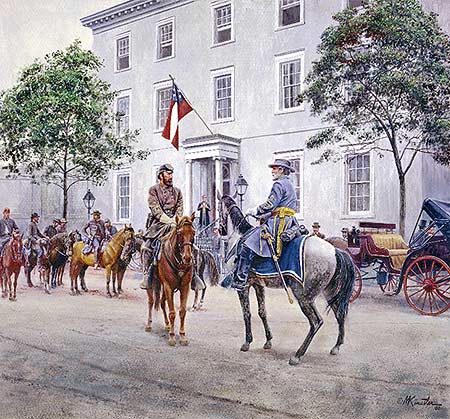
I had a friend buy me a copy of The Killer Angels on a recent visit to the States. As someone who is trying to write her own novel about the Civil War, I wanted to reread this book and study the choices Michael Shaara makes in describing the characters, landscape, and military actions.
The Killer Angels was the first Civil War book I read after I watched the movie made from its pages. It is a fantastic book, deserving of its Pulitzer Prize. As most know, its Southern narrative comes from Longstreet's memoirs and was responsible for the revival of the forgotten general, who was victimized by Lee's aides and some generals of the ANV in their attempt to shield Lee from any culpability for the loss at Gettysburg. A loss that Lee did not hesitate in accepting responsibility for. He tried to resign afterwards, citing his health as a major cause for the loss.
I was ignorant of any of Civil War history when I read this book. Well, except for what I remembered from high school and gleaned from my many readings of Gone With the Wind. I saw the movie and read the book and knew that I wanted to learn more about this time in our history. That is a debt I owe to Michael Shaara's stunning prose.
But, Michael Shaara, whether intended or not has done some of the men he writes about a grave injustice. But I wonder if that is his fault or ours as Civil War enthusiasts.
In the pages of The Killer Angels, Longstreet is advanced at the expense of Lee. Longstreet is credited with understanding that Pickett's Charge was foolish and suicidal. It is not his fault that the attack failed. No that falls on Lee, who stubbornly refused to listen to Longstreet's sage advice. That conversation never happened because Pickett didn't charge across the field as the movie portrays. Instead, Pickett's advance was a huge flanking movement "up the Emmitsburg Road" designed to push Hancock's Second Corps into Ewell and Hill. Hancock acknowledges this in his testimony before Congress, when he says that he thought Lee was intending to go through him... that Lee was looking to roll up his line. If one has walked the Southern position at Gettysburg, one finds that Pickett's brigades were not in front of the Second Corps but to the right of Hancock's position.
But the absolute thing that Shaara's book did was ruin Stuart. The Stuart presented in those pages and in the film is one that bares little resemblance to the Stuart of history. Shaara's Stuart was an irresponsible publicity hound, who on purpose, disobeyed his orders and went riding around the Union army to avenge his loss at Brandy Station (a battle he did not lose) and restore his good name. This Stuart has to be lectured to by an angry Lee like he was a child. If this Stuart actually existed, he would have been cashiered and sent back to Virginia.
Now all that makes good drama. But in the hands of lazy historians it is a slur that Stuart can never recover from. I have argued with many enthusiasts, who read books and love the history as much, if not more than me. But they can't get past what they saw on their television screens. An angry Martin Sheen berating a contrite Stuart close to tears.
But to all of us who claim to love the history, on both sides, it should matter greatly. It should matter that Stuart's orders never tell him to communicate with Lee, but with Ewell. It should matter that Stuart was ordered to the right of Ewell on the Susquehanna and not to Lee's flank on the Potomac. It should matter greatly that Stuart was told to look for Early at York, where the army would be consolidated. And finally, it should matter that right after Lee's death, his aides and some of the generals of the ANV systematically destroyed both Longstreet's and Stuart's reputation in order to salvage Lee's.
I have to wonder if there is any book I can write that could do for Stuart what The Killer Angels did for Longstreet. Since the movie Gettysburg premiered, isn't it true that Longstreet has become the hero of the battle? Reading online societies, online forums, and participating in debates, I find this to be the case. But we are basing his role during the battle on a myth he created in order to protect himself from the unfounded charges made by Walter Taylor, Charles Marshall, Jubal Early, and W.N. Pendleton after Lee's death that he was responsible for the loss.
The reason I ask these questions is that I recently had a conversation with a Civil War enthusiast, who did not care what Stuart was ordered to do. It simply did not matter. He argued that Stuart was a randy cavalier, sleeping around (don't even get me started) and so upset over the negative publicity he received after Brandy Station that he disobeyed his orders and cost Lee the victory. The only thing that saved him from his mistake was Lee's affection for him. This narrative does exist in the historiography, but just because it exists, does not mean it is correct. We, as Civil War enthusiasts, have access to the Original Records of the War. We can look up the orders ourselves. We can read what Stuart was ordered to do. We can compare those orders with the accusations against Stuart that he disobeyed his orders and see that he did as both Lee and Longstreet ordered him to do.
So, I don't fault Michael Shaara for writing a book based on a forgotten memoir of a disgraced general. I do fault all those who take fiction, no matter how well done, and turn it into history. How bad is it? I argued with a professor during a Civil War class in college over this very issue. He didn't like being challenged. He thundered at me: "Did you not see Gettysburg?" My response was a stunned: "That's a movie, it's not history." No matter. He came in the next week and read from a historian's book that upheld the scape goating of Stuart. The class laughed, but I did not care. Stuart deserves better.
I will close this rant with a quote from Longstreet regarding Stuart's role at Gettysburg. He was writing to Major McClellan, Stuart's adjutant, after McClellan wrote an article quoting Stuart's orders. "Your paper, as it was intended, is a complete vindication of General Stuart. It shows General Lee's authority for the movement of his cavalry, and those movements were well conducted, rapidly and vigorously executed, (This is very disingenuous of Longstreet, who, not only knew what Lee's orders said, but endorsed them in a letter that is included in the Official Records) that Stuart left more cavalry with us than we actually used - a fact not known to me heretofore -, and that therefore it was peculiarly unjust, not to say cruel, in all who assailed Stuart, as the cause of the failure of the Campaign." August 3, 1878.
In his memoirs almost twenty years later, Longstreet writes: “Our plans, adopted after deep study, were suddenly given over to gratify the youthful cavalryman's wish for a romantic ride.”
And thanks to The Killer Angels, Gettysburg, and finally our own lack of curiosity into the actual facts, that is the story that remains. To the utter ruin of James Ewell Brown Stuart.
Showing posts with label Michael Shaara. Show all posts
Showing posts with label Michael Shaara. Show all posts
Sunday, March 23, 2008
Sunday, March 9, 2008
Part Eight- Stuart's Insubordination Becomes Part of the Historiography
Charles Marshall wrote two official reports on the campaign, which were signed by Lee. These reports are the seminal works used by historians when analyzing the ANV’s movements. The first report was written on July 31, 1863, and was released to the press before Stuart’s report was forwarded to headquarters. The report detailed the role of the cavalry. “General Stuart was left to guard the passes of the mountains, and to observe the movement of the enemy, whom he was instructed to harass and impede as much as possible should he attempt to cross the Potomac. In that event, General Stuart was directed to move into Maryland, crossing the Potomac east or west of the Blue Ridge, as, in his judgment, should be best, and take position on the right of our column as it advanced.” (38) Again, “No report had been received that the Federal army had cross the Potomac, and the absence of cavalry rendered it impossible to obtain accurate information.” (39) And again: “By the route he (Stuart) pursued, the Federal army was interposed between his command and our main body, preventing any communication with him until his arrival at Carlisle. The march toward Gettysburg was conducted more slowly than it would have been had the movements of the Federal army been known.” (40)
The second report, written on January 20, 1864, included major revisions of Stuart’s role. Instead of marching to the right of the column (implying Longstreet and Hill as they marched to Chambersburg), Stuart had now been ordered to “place himself on the right of General Ewell.” (41) The statement that censured Stuart for placing himself east of the AOP was also removed. The reason for the slow march into Pennsylvania was corrected. The army now marched at a leisurely pace due to the hot weather and “with a view to the comfort of the troops.” (42)
The most condemning statement in the first report did make its way into the final. “The movements of the army prior to the battle of Gettysburg had been much embarrassed (hindered) by the absence of cavalry. As soon as it was known that the enemy had crossed into Maryland, orders were sent to the brigades of Robertson and Jones which had been left to guard the passes of the Blue Ridge to rejoin the army without delay…” (43) This statement is probably the most quoted portion of Lee’s report when proving Stuart was insubordinate. Yet the next few sentences discuss Robertson and Jones. The report says they were recalled from the Valley to join the army at Gettysburg. Why they did not obey their orders and followed the army into Pennsylvania has never been fully explained.
The first book published about the war was William Swinton’s Campaigns of the Army of the Potomac in 1866. Swinton wrote Lee a letter asking specific questions about Gettysburg. Lee’s short reply directed him to the January 1864 official report. Longstreet, however, answered Swinton’s queries and was very critical of Lee’s leadership. Swinton’s book was the opening salvo in the Gettysburg controversy. The articles that followed became required reading for all those writing about the battle. The memoirs produced by Lee’s staff have also been influential in the historiography. All three members (General Long, Colonel Marshall, and Colonel Walter Taylor, Lee’s chief-of-staff) declared Stuart disobeyed his orders and was responsible for the defeat.
In 1934, Douglas Southall Freeman won the Pulitzer Prize for his four volume series on the life of Lee. A work heavily inspired by the memoirs of Lee’s staff. These volumes consistently appear in future books written about Gettysburg, as do his other two works: Lee’s Lieutenants, a history of the generals who served under Lee’s command and Lee’s Dispatches, letters written to Jefferson Davis. In R.E. Lee, Freeman dedicates eight chapters to the battle. He devotes one of them to prove Stuart was ordered to march on the right of the army as it moved into Pennsylvania. It was Stuart’s failure to do so that caused Lee’s defeat at Gettysburg. These accusations are repeated and expanded upon in the chapter about Stuart in Lee’s Lieutenants.
Freeman begins the chapter by informing his readers how Lee viewed the role of the cavalry in the upcoming campaign. “There was not then, nor was there at any later time, the least doubt in his mind as to the function of the main body of the cavalry in the general plan: it should keep the enemy as far to the east as possible, protect the lines of communication, and supply information as to the movements of the enemy. To do these things the cavalry should of course operate on the right flank of the army as it advanced.” (44) Why was this not done? Freeman writes, “[…]Stuart had a more ambitious plan.” (45)
Freeman observes that when orders were sent to Stuart regarding his ambitious plan, Lee felt “it was necessary, therefore, to make it plain to Stuart that while he could cross the Potomac east of Hooker's army, he must put his major mission first and must not attempt a ride around the Federal army if he were hindered in the attempt.” (46) This, Freeman writes, was “the all important thing” (47) for Lee. Stuart failed it accomplish the major mission because he pushed “on after he had encountered resistance east of the Bull Run Mountains, violated orders, and deprived Lee of his services when most needed. He should have turned back then, as Lee had directed him to do should he find his advance hindered by Federal columns.” (48)
Stuart is placed at an instant disadvantage by Freeman. By putting his own opinions about the cavalry’s role in Lee’s voice, any assessment Freeman makes in intepreting Stuart’s orders or his actions become, by default, Lee’s. The phrase major mission is Freeman’s invention. Yet, he wields it throughout the chapter as if it belongs to Lee in order to make Stuart’s insubordination more egregious. For even while Freeman reprints the orders in the chapter, they are always framed in the context of the major mission, which Stuart failed to accomplish by not turning back when finding resistance on the east side of the Bull Run Mountains. Of course Stuart found resistance there. He was on the flank of the Union army, between it and Washington. According to Freeman, Stuart’s orders dictated he should have battled back west through the mountains, with the AOP now alert to his presence, then on through the Blue Ridge and to Shepherdstown in order to join Lee at Chambersburg. No, his orders, as quoted by Freeman, were if he could pass around the enemy without hindrance he was to do so. Once on the east side of the Bull Run Mountains, he was ordered to march north to Ewell on the Susquehanna, which he did.
In 1965, Clifford Dowdey published his work, Lee, another book referenced in the Gettysburg literature. In his chapter on the battle, Dowdey echoes Taylor’s, Marshall’s, Long’s, and Freeman’s theme that Lee was “like a blindfolded giant.” (49) The reason for the blindfold was Stuart. Dowdey accuses the cavalry leader on being “on a side adventure in Maryland” (50) and “riding his cavalry out of the campaign.” (51)
When writing of the two brigades left to cover the army as it marched north, Dowdey writes that Robertson and Jones “were to follow after the infantry was clear of danger.” (52) To explain why they did not, he writes, “in another confusion of orders, this cavalry remained for days staring at the empty passes in the Blue Ridge long after Lee had cross the Potomac.” (53) There was no confusion. Stuart was precise in his order to Robertson.
In 1975, Michael Shaara published The Killer Angels. Both Northern and Southern perspectives were represented through the individuals who played key roles in the battle. Shaara chose Longstreet as his central character and relied heavily on From Manassas to Appomattox for the Southern narration. Shaara picks up Longstreet’s criticism of Stuart and transfers them to the pages of his novel. In one of the few passages related to Stuart, Shaara writes:
“Lee shook his head slowly. “Am I to move on the word of a paid spy?”
“Can’t afford not to,” Longstreet replied.
“There should have been something from Stuart.”
“There should have been.”
“Stuart would not have let us blind.”
“He’s joyriding again,” Longstreet said. “This time you ought to stomp him. Really stomp him.” (54)
Not only is Stuart joyriding, but he is doing it again, and deserves to be punished. In his entire career with the ANV, Stuart never went on a joyride – authorized or unauthorized.
Even though this work of fiction did not climb to the top of the bestseller’s list until after the release of the movie adapted from its pages, the impact of both novel and movie on the historiography has been immeasurable.
(38)Robert E. Lee, General. “Official Campaign Report, July 31, 1863.” The War of the Rebellion: a Compilation of the Official Records of the Union and Confederate Armies. Volume 27, Part II, pages 293 – 305.
(39)Ibid.
(40)Ibid.
(41)Robert E. Lee, General. “Official Campaign Report, January 20, 1864.” pages 313 – 325.
(42)Ibid.
(43)Ibid.
(44)Freeman. R.E. Lee Volume III, 41.
(45)Ibid.
(46)Ibid., 43
(47)Ibid., 48
(48)Ibid., 147
(49)Clifford Dowdey. Lee. (Boston: Little, Brown, and Company. 1965), 365.
(50)Ibid., 362.
(51)Ibid.
(52)Ibid.
(53)Ibid., 364-365
(54)Michael Shaara. The Killer Angels. (New York: Ballentine Books, 2001), 14
The second report, written on January 20, 1864, included major revisions of Stuart’s role. Instead of marching to the right of the column (implying Longstreet and Hill as they marched to Chambersburg), Stuart had now been ordered to “place himself on the right of General Ewell.” (41) The statement that censured Stuart for placing himself east of the AOP was also removed. The reason for the slow march into Pennsylvania was corrected. The army now marched at a leisurely pace due to the hot weather and “with a view to the comfort of the troops.” (42)
The most condemning statement in the first report did make its way into the final. “The movements of the army prior to the battle of Gettysburg had been much embarrassed (hindered) by the absence of cavalry. As soon as it was known that the enemy had crossed into Maryland, orders were sent to the brigades of Robertson and Jones which had been left to guard the passes of the Blue Ridge to rejoin the army without delay…” (43) This statement is probably the most quoted portion of Lee’s report when proving Stuart was insubordinate. Yet the next few sentences discuss Robertson and Jones. The report says they were recalled from the Valley to join the army at Gettysburg. Why they did not obey their orders and followed the army into Pennsylvania has never been fully explained.
The first book published about the war was William Swinton’s Campaigns of the Army of the Potomac in 1866. Swinton wrote Lee a letter asking specific questions about Gettysburg. Lee’s short reply directed him to the January 1864 official report. Longstreet, however, answered Swinton’s queries and was very critical of Lee’s leadership. Swinton’s book was the opening salvo in the Gettysburg controversy. The articles that followed became required reading for all those writing about the battle. The memoirs produced by Lee’s staff have also been influential in the historiography. All three members (General Long, Colonel Marshall, and Colonel Walter Taylor, Lee’s chief-of-staff) declared Stuart disobeyed his orders and was responsible for the defeat.
In 1934, Douglas Southall Freeman won the Pulitzer Prize for his four volume series on the life of Lee. A work heavily inspired by the memoirs of Lee’s staff. These volumes consistently appear in future books written about Gettysburg, as do his other two works: Lee’s Lieutenants, a history of the generals who served under Lee’s command and Lee’s Dispatches, letters written to Jefferson Davis. In R.E. Lee, Freeman dedicates eight chapters to the battle. He devotes one of them to prove Stuart was ordered to march on the right of the army as it moved into Pennsylvania. It was Stuart’s failure to do so that caused Lee’s defeat at Gettysburg. These accusations are repeated and expanded upon in the chapter about Stuart in Lee’s Lieutenants.
Freeman begins the chapter by informing his readers how Lee viewed the role of the cavalry in the upcoming campaign. “There was not then, nor was there at any later time, the least doubt in his mind as to the function of the main body of the cavalry in the general plan: it should keep the enemy as far to the east as possible, protect the lines of communication, and supply information as to the movements of the enemy. To do these things the cavalry should of course operate on the right flank of the army as it advanced.” (44) Why was this not done? Freeman writes, “[…]Stuart had a more ambitious plan.” (45)
Freeman observes that when orders were sent to Stuart regarding his ambitious plan, Lee felt “it was necessary, therefore, to make it plain to Stuart that while he could cross the Potomac east of Hooker's army, he must put his major mission first and must not attempt a ride around the Federal army if he were hindered in the attempt.” (46) This, Freeman writes, was “the all important thing” (47) for Lee. Stuart failed it accomplish the major mission because he pushed “on after he had encountered resistance east of the Bull Run Mountains, violated orders, and deprived Lee of his services when most needed. He should have turned back then, as Lee had directed him to do should he find his advance hindered by Federal columns.” (48)
Stuart is placed at an instant disadvantage by Freeman. By putting his own opinions about the cavalry’s role in Lee’s voice, any assessment Freeman makes in intepreting Stuart’s orders or his actions become, by default, Lee’s. The phrase major mission is Freeman’s invention. Yet, he wields it throughout the chapter as if it belongs to Lee in order to make Stuart’s insubordination more egregious. For even while Freeman reprints the orders in the chapter, they are always framed in the context of the major mission, which Stuart failed to accomplish by not turning back when finding resistance on the east side of the Bull Run Mountains. Of course Stuart found resistance there. He was on the flank of the Union army, between it and Washington. According to Freeman, Stuart’s orders dictated he should have battled back west through the mountains, with the AOP now alert to his presence, then on through the Blue Ridge and to Shepherdstown in order to join Lee at Chambersburg. No, his orders, as quoted by Freeman, were if he could pass around the enemy without hindrance he was to do so. Once on the east side of the Bull Run Mountains, he was ordered to march north to Ewell on the Susquehanna, which he did.
In 1965, Clifford Dowdey published his work, Lee, another book referenced in the Gettysburg literature. In his chapter on the battle, Dowdey echoes Taylor’s, Marshall’s, Long’s, and Freeman’s theme that Lee was “like a blindfolded giant.” (49) The reason for the blindfold was Stuart. Dowdey accuses the cavalry leader on being “on a side adventure in Maryland” (50) and “riding his cavalry out of the campaign.” (51)
When writing of the two brigades left to cover the army as it marched north, Dowdey writes that Robertson and Jones “were to follow after the infantry was clear of danger.” (52) To explain why they did not, he writes, “in another confusion of orders, this cavalry remained for days staring at the empty passes in the Blue Ridge long after Lee had cross the Potomac.” (53) There was no confusion. Stuart was precise in his order to Robertson.
In 1975, Michael Shaara published The Killer Angels. Both Northern and Southern perspectives were represented through the individuals who played key roles in the battle. Shaara chose Longstreet as his central character and relied heavily on From Manassas to Appomattox for the Southern narration. Shaara picks up Longstreet’s criticism of Stuart and transfers them to the pages of his novel. In one of the few passages related to Stuart, Shaara writes:
“Lee shook his head slowly. “Am I to move on the word of a paid spy?”
“Can’t afford not to,” Longstreet replied.
“There should have been something from Stuart.”
“There should have been.”
“Stuart would not have let us blind.”
“He’s joyriding again,” Longstreet said. “This time you ought to stomp him. Really stomp him.” (54)
Not only is Stuart joyriding, but he is doing it again, and deserves to be punished. In his entire career with the ANV, Stuart never went on a joyride – authorized or unauthorized.
Even though this work of fiction did not climb to the top of the bestseller’s list until after the release of the movie adapted from its pages, the impact of both novel and movie on the historiography has been immeasurable.
(38)Robert E. Lee, General. “Official Campaign Report, July 31, 1863.” The War of the Rebellion: a Compilation of the Official Records of the Union and Confederate Armies. Volume 27, Part II, pages 293 – 305.
(39)Ibid.
(40)Ibid.
(41)Robert E. Lee, General. “Official Campaign Report, January 20, 1864.” pages 313 – 325.
(42)Ibid.
(43)Ibid.
(44)Freeman. R.E. Lee Volume III, 41.
(45)Ibid.
(46)Ibid., 43
(47)Ibid., 48
(48)Ibid., 147
(49)Clifford Dowdey. Lee. (Boston: Little, Brown, and Company. 1965), 365.
(50)Ibid., 362.
(51)Ibid.
(52)Ibid.
(53)Ibid., 364-365
(54)Michael Shaara. The Killer Angels. (New York: Ballentine Books, 2001), 14

Subscribe to:
Posts (Atom)