I found this jewel at http://www.fredericksburgpc.org/documents/CaptainJamesPowerSmith.pdf
STONEWALL JACKSON’S AIDE DE CAMP
Captain James Power Smith
In the spring of 1861, James Power Smith was a theological student at Virginia’s Hampden-Sydney College. He enlisted in the Rockbridge Artillery, a Confederate battery comprised of college and seminary students. The battery fought at the First Battle of Manassas (Bull Run) where Smith received his baptism of fire. It was there that General Barney Bee saw Jackson’s men holding steady while other Confederates were giving ground, and made the historic comment, “There stands Jackson like a stone wall!” From then on the name “Stonewall” Jackson became a legend in the South.
On September 7, 1862, Smith rode into Frederick,Maryland, to visit the Presbyterian Church where his father had preached when James was a boy. When he left the church, he discovered that his horse had been stolen. Then he received another surprise. He was told to report to General Thomas J. Jackson, the war’s most famous commander. He thought someone was playing a trick on him, but he went. The general had met Smith three years earlier at a wedding, and surprised the young corporal by inviting him to be the aide-de-camp on his staff.
Smith hustled to get a new uniform and a horse, and on September 20 he returned to the Army of Northern Virginia. The next day he met General Lee, who gave him a fresh peach. Later Smith traveled with Jackson from Winchester to Lee’s headquarters in Fredericksburg. On the way they passed the refugees fleeing from Fredericksburg before the battle, including many huddled in Salem Church.
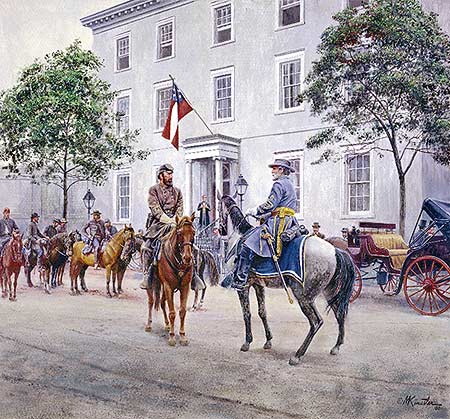
On Sunday morning, November 30, 1862, Jackson and Smith rode into deserted Fredericksburg. They sat in their saddles at the eastern corner of the Presbyterian Church, and surveyed the scene of the coming battle. Smith asked if he could ride down to the river to water his horse, and “Old Jack” warned him that he would probably be shot by the Yankees on the other side of the river. But he did ride down to water his horse, and when he returned, Jackson was still in the same place. After the war, Smith identified the spot where Jackson planned strategy for the Battle of Fredericksburg, and in 1924 a marker was imbedded in the brick wall by the Presbyterian Church, commemorating it.
That night they stayed in the home of the French family—the family that gave the French Memorial Chapel and for whom the education building is named. Jackson led evening prayers, using the big family bible,and kneeling to pray with the family. Then Smith and Jackson established their headquarters south of town near Guiney’s Station.
On the morning of December 11, 1862, General Burnside’s Union guns began the bombardment of Fredericksburg. Smith spent most of the day carrying messages between the Southern commanders. Early next morning he rode with Jackson to the present Lee’s Hill, where Lee and Jackson conferred and observed the battle. They watched the Yankees “coming handsomely” across the river. However, by the end of the day the whole landscape was covered with the bodies of many men in union blue.
During the battle, a part of the Confederate line was the spot south of town commanded with one cannon by the “The Gallant Pelham.” Finally, General Lee had to send word to Pelham to pull back. Who took the message from Lee to Pelham? It was James Power Smith.
Smith also reported that a “fine handsome blooded mare” was shot out from under him that day, and many of his former comrades in the Rockbridge Artillery were killed. That night, Jackson and Smith were at Moss Neck Manor, south of town. Jackson said, “If the men sleep on the ground, I will too.” (This was in December.) They had two overcoats and two blankets. They each put on an overcoat. They put one blanket under them, one over them, and they huddled together to keep from freezing that night.
The next day they moved into Moss Neck manor, the home of the Corbins. On Christmas Day Jackson entertained General Lee, General J. E. B. Stuart and Sandie Pendleton at the manor with turkeys, oysters, a ham, cake, a bottle of wine, biscuits, and pickles. And who obtained all those fixings for the dinner? James Power Smith.
Jackson was appalled by the suffering in Fredericksburg, and led the officers and men in his command in raising $30,000 for their relief—a lot of money for that time.
On April 23, 1863, Smith was present at the baptism of Jackson’s daughter, Julia. Tucker Lacy conducted the service.
On April 29, 1863, hundreds of Federal soldiers crossed the Rappahannock River under the cover of heavy fog in the attack which led to the crucial battle of Chancellorsville. When he received the news, General Jackson sent Smith to inform General Lee of the attack. The next night Smith was sent on an errand by Lee. When he returned, Lee was sleeping at the foot of a tree and covered with his army cloak. He pulled Smith under his cloak and asked him to give his report. Smith then made his own bed, and “with my head in my saddle, near my horse’s feet, I was soon wrapped in the heavy slumber of a weary soldier.”
Smith then became the only eye-witness to a great moment in American history: “Sometime after midnight I was awakened by the chill of the early morning hours, and turning over, caught a glimpse of a little flame on the slope above me, and sitting up to see what it meant, I saw, bending over a scant fire of twigs, two men seated on old cracker boxes and warming their hands over a little fire. I had to rub my eyes and collect my wits to recognize the figures of Robert E. Lee and Stonewall Jackson. Who can tell the story of that quiet council of war between two
sleeping armies.”
As a result of Smith’s report of this scene, the event was immortalized. The famous “Cracker Barrel Conference” not only depicted the South’s two best known generals planning Jackson’s famous flank march that led to their greatest victory at the Battle of Chancellorsville, it was also the last time that the two great men ever saw each other alive. The image of the two men sitting on the cracker boxes by the fire isnow the logo which symbolizes the famous battle at the Chancellorsville Military Park, and elsewhere.
At 8 P.M. that night Smith gathered his couriers to find Jackson, and about a mile west of Chancellorsville was told that Jackson was just ahead. He rode a hundred yards further on, and heard shouting. He was told that Jackson had been wounded, and others around him killed by the fire of their own men. Smith spurred his horse forward.
On arriving at the scene he was told that “He (Jackson) was struck by three balls at the same time. One went through the palm of his right hand; a second passed through the wrist of the left arm and out of the hand; the third one was more severe. It passed through the left arm halfway from the shoulder to the elbow. The large bone of the upper arm was splintered to the elbow joint, and the wound bled freely.”
Jackson’s horse bolted, and he reeled from his saddle, but he was caught and placed gently on the ground. General A. P. Hill had come to his aid as Smith rode up. Smith cut Jackson’s sleeve open from the wrist to the shoulder, and used his handkerchief to stem the flow of blood. Couriers were sent to find a doctor and an ambulance.
Smith was one of the four litter-bearers who started to move Jackson to a safer place on a stretcher. But one of the bearers was shot, and he fell. The fire became heavier, so the litter was placed in the middle of the road, and Smith shielded Jackson’s body with his own. When the firing slackened, Smith helped Jackson up, put his arms around him, and started to drag him to safety. More litter bearers arrived. Again they started to carry him to safety. Another bearer fell, dropping his corner of the litter. This time Jackson fell and hit the ground, causing him great pain. Finally they reached comparative safety and Jackson was placed in an ambulance.
In a tent near the Wilderness Store, Jackson’s left arm was amputated near the shoulder, and a ball was taken from his right hand. Smith held the light for the operation, and “all night long it was mine to watch the sufferer and keep him warmly wrapped and undisturbed in his sleep.” All the other staff officers had to return to their duties, so only Smith remained and continued to talk with Jackson. Though he had been hit three times, fallen from a litter once, was dragged for a distance by Smith, endured a miserable ride in an army ambulance, went through shock, and then had his arm amputated, he still was very alert.
In the afternoon a courier arrived from Lee’s headquarters, and Smith gave his message to Jackson. Lee said, “Could I have directed events, I should have chosen for the good of the country to be disabled in your stead…”
Early on May 4, Jackson was placed in an army ambulance for the twenty-five mile trip to Guiney’s Station, where he would be safer. In the ambulance with Jackson were Chaplain Tucker Lacy, Smith and Doctor Hunter McGuire. McGuire, whose statue stands in front of the state Capitol and who had a Richmond hospital named after him, was a Presbyterian, too. Saddened Virginians watched the ambulance pass by. Smith remained at Guiney’s Station with Tucker Lacy and Doctor McGuire. Smith kept watch with Jackson during the night of May 5th. At dawn he called for the doctor, who recognized the early symptoms of pneumonia. While the doctor was dressing Jackson’s wounds, Anna Jackson and their daughter Julia arrived. Anna sang spiritual songs for him. He told her that he wanted to be buried in Lexington, and that he always wanted to die on Sunday.
On Sunday, May 10, 1862, Lieutenant General Thomas J. Jackson “crossed over the river to rest under the shade of the trees.” Just two weeks after the Jacksons had gone to church together and had their daughter baptized, Anna was a widow. The Confederacy was filled with grief. Smith rode in the railway car to Richmond with the Jackson family and the general’s body. General Longstreet headed the pallbearers who carried the casket up the steps of the Capitol, where over 2,000 people came to show their respects. After the burial in Lexington, Smith accompanied Anna Jackson and little Julia to their home in North Carolina.
On June 13, Smith returned to report to Lee before the battle of Gettysburg. At Lee’s request, Smith remained with him that night, and he was with the general when the battle began on July 1. Lee sent him with a message to General Ewell, and he was with Ewell when the request arrived from General Jubal Early to advance up the slope to capture Cemetery Ridge. Ewell told Smith to take the request to General Lee. He found Lee and Longstreet and conveyed the request.
After the war, Smith returned to Union Seminary, was ordained as a Presbyterian minister, and on May 24, 1869, he was called to be the minister of the Presbyterian Church of Fredericksburg,
where he served for 23 years. He shared in dedicating the Jackson Monument in Richmond and the Memorial Hall in Lexington. He dedicated the place on the Lacy farm at “Ellwood” where Tucker Lacy had buried Jackson’s arm, and also indicated the place by the brick wall in front of the Presbyterian Church where Jackson had stood to “plan the Battle of Fredericksburg.”
In 1871 he married Agnes, the daughter of Tucker Lacy’s younger brother, Major Horace J. Lacy, who lived at “Chatham” (called the “Lacy House” during the war – when it was the Federal headquarters, and then a hospital.) He wrote extensively about his war experiences including “The Religious Character of Stonewall Jackson,” “Jackson at Chancellorsville,” and “Lee at Gettysburg.”
James Power Smith returned to Gettysburg in 1917 to pronounce the invocation at the dedication of the Virginia State Monument at Seminary Ridge. He died in 1923 at 86, and was the last surviving member of Stonewall Jackson’s staff.
Wednesday, February 11, 2009
Sandie Pendleton
Confederate (CSA)
Colonel Alexander Swift Pendleton
"Sandie"
(1840 - 1864)
Home State: Virginia
Command Billet: Staff
Branch of Service: Infantry
Unit: Jackson's Command
Before the Antietam Campaign:
Rank history:
Lt., July 19, 1861;
Aide-de-Camp (A D C), Feb. 1862;
Assistant Adjutant-General (AAG), April 19, 1862;
Capt.and AAG., June 18, 1862;
Major, Dec. 4, 1862
Alexander (Sandie) Swift Pendleton was born near Alexandria, Virginia on September 28, 1840. He was the only son of William Nelson Pendleton. The Pendleton family moved to Lexington, Virginia in October 1853, where William became rector at Grace Episcopal Church. Sandie Pendleton graduated from Washington College (now Washington & Lee University) in 1857, and subsequently enrolled at the University of Virginia, where he was pursuing a Master of Arts degree when the Civil War began in April 1861. He received a commission as 2nd Lieutenant in Provisional Army of Virginia and reported to Harper's Ferry on June 14, 1861. Within weeks, he was asked by General Stonewall Jackson to join his staff as an ordnance officer --- Jackson had known Pendleton from their days together in Lexington, where Jackson was a Professor at the Virginia Military Institute. Pendleton subsequently served as Jackson's Assistant Adjutant General (Second Corps), and the relationship between Pendleton and Jackson was a close one-- it was said that Jackson "loved him like a son."
In the Antietam Campaign:
Capt Pendleton was AAG on Gen Jackson's staff. At one point during the battle, he describes the scene - "Such a storm of balls I never conceived it possible for men to live through. Shot and shell shrieking and crashing, canister and bullets whistling and hissing most fiend-like through the air until you could almost see them. In that mile's ride I never expected to come back alive." {quoted on the NPS Antietam site)
The remainder of the War:
He served on General "Stonewall" Jackson's staff until the Generals death at Chancellorsville in May 1863, and subsequently as adjutant-general to General Jubal A. Early and General Richard S. Ewell. He was killed at Fisher's Hill, Virginia, 22 September, 1864.
References, Sources, and other notes:
The authoritive biography is - Bean, W. G. Stonewall's Man: Sandie Pendleton, University of North Carolina Press, 1959.
More on the Web:
See a brief bio and collection of papers at VMI - the source of the picture and much of the text above, and a memorial site (with a picture of Pendleton's gravesite) on the Stonewall Jackson Cemetery in Lexington.
Birth Date: 9/28/1840
Place of Birth: Alexandria, VA
College: Washington College (VA), UVa
Death Date: 9/22/1864
Death Place: Fisher's Hill, VA
Burial Place: Stonewall Jackson Cemetery, Lexington, VA

Joseph G. Morrison
In my novel, Joe Morrison plays a very important role. While researching his life, I found this article on the internet. I hope you enjoy learning more about Jackson's brother-in-law and aide-de-camp.
J.G. Morrison
Confederate (CSV)
Lieutenant J.G. Morrison (CSV)
Joseph Graham Morrison (1842 - 1906)Home State: North Carolina Command Billet: Aide-de-camp Branch of Service: Staff Unit: Jackson's Command.
Before the Antietam Campaign:
He was named for his maternal grandfather, Revolutionary War figure and later General Joseph Graham. As the Civil War began he was a student at the Virginia Military Academy (Class of 1865), but he left school and was commissioned Lieutenant and ADC on his brother-in-law Thomas "Stonewall" Jackson’s staff in June 1862. Jackson had married Morrison's sister Mary Anna in 1857.
Cedar Mountain in August …
"... was his first experience on the battlefield. His bearing was fearless and chivalric. He was riding one of the General’s horses, which, shot in the jaw, was rearing and plunging, sprinkling both his rider and himself with blood. It was suggested to the General that he had better call that youth in or his career would be a short one, but he replied that his example would not be lost upon the troops and he would learn more discretion after a battle or two. He would not permit him to be recalled. Morrison escaped that day but after the General’s death he was badly wounded twice and came out of the army with the loss of a foot."(from Douglas 1)
In the Antietam Campaign: He was aide-de-camp (ADC) to General Jackson on the Maryland Campaign.
The remainder of the War: Lieutenant Morrison was with General Jackson when he was mortally wounded by his own troops at Chancellorsville in May 1863. After Chancellorsville, in July 1863, rather than transfer to General Ewell with the rest of Jackson’s staff, he joined General Ramseur.
In September 1863 he transferred to the 57th North Carolina Infantry as Adjutant. By 1865 he was Captain of Company F, and lost a foot shortly after at Petersburg, while away from his regiment visiting General Hoke.
After the War: Also suffering from tuberculosis, Joseph spent the four years following the War in California recuperating. In 1869 he came home to North Carolina where he was a planter and ran the Mariposa Cotton Mills. He returned to claim the family home on his father’s death in 1889, and himself passed at Charlotte on 11 April 1906.
References, Sources, and other notes:Special thanks to Bill Torrens, who pointed me to Krick2 and the Douglas anecdote used here.
More on the Web:See more about the Morrison family and their famous relations on the 'behind AotW' blog.
Birth Date: 01/06/1842
Place of Birth: Lincoln County, NC
Death Date: 04/11/1906
Death Place: Charlotte, NC
Burial Place: Machpelah Presbyterian Church Cemetery, Lincoln Co
Notes
1 Douglas, Henry Kyd, I Rode With Stonewall, Chapel Hill: University of North Carolina Press, 1940, pp. 127-128 [AotW citation 600]
2 Krick, Robert E.L., Staff Officers in Gray; A Biographical Register of the Staff Officers in the Army of Northern Virginia, Chapel Hill: University of North Carolina Press, 2003, pg. 226 [AotW citation 601]
© 1996 - 2009 by Brian Downey and AotW Members
Wednesday, October 29, 2008
The Funeral of Stonewall Jackson - The Lexington Gazette, May 20, 1863
All that was mortal of our great and good chief, Lieut. Gen. T.J. Jackson was consigned to the tomb on Friday last.
The body having reached Lexington by the Packet boat on Thursday afternoon, accompanied by his personal staff, Maj. A.S. Pendleton, Surgeon H. McGuire, Lieut. Morrison, and Lieut. Smith, by his Excellency Gov. Letcher, and a delegation of the citizens of Lynchburg, it was received by the Corps of Cadets and escorted to the Institute, and deposited in his late Lecture Room, which had been appropriately draped in mourning.
There was the table used by the late Professor--the same chair in which he sat--the cases with the Philosophical apparatus he had used--all told of his quiet and unobtrusive labors in his Professional life--and placed just as he left them, when he received the order of the Governor of Virginia to march the Corps of Cadets to Richmond, on the 21st of April 1861. He left the Va. Military Institute in command of the Cadets. He has been brought back to sleep among us--a world renowned Christian Hero.
The procession moved from the Institute on Friday morning at 10 A.M. The Funeral escort was commanded by Maj. S. Ship, Commandant of Cadets, a former pupil of Gen. Jackson and a gallant officer who had served with him in his Valley Campaign, as Major of the 21st Va. Regt.
The Escort was composed as follows:
1. Cadet Battalion
2. Battery of Artillery of 4 pieces, the same battery he had for ten years commanded as Instructor of Artillery and which had also served with him at 1st Manassas, in [the] Stonewall Brigade.
3. A company of the original Stonewall Brigade, composed of members of different companies of the Brigade, and commanded by Capt. A. Hamilton, bearing the flag of the "Liberty Hall Volunteers."
4. A company of convalescent officers and soldiers of the army.
5. A Squadron of cavalry was all that was needed to complete the escort prescribed by the Army Regulations. This squadron opportunely made its appearance before the procession moved from the church. The Squadron was a part of Sweeny's battalion of Jenkin's command, and many of its members were from the General's native North-western Virginia.
6. The Clergy.
7. The Body enveloped in the Confederate Flag and covered with flowers, was borne on a caisson of the Cadet Battery, draped in mourning.The pall bearers were as follows:Wm. White ; Professor J.L. Campbell--representing the Elders of the Lexington Presbyterian Church.Wm. C. Lewis; Col. S. McD. Reid--County Magistrates.Prof. J.J. White; Prof. C.J. Harris--Washington College.S. McD. Moore; John W. Fuller--Franklin Society.George W. Adams; Robt. I. White--Town Council.Judge J. W. Brockenbrough; Joseph G. Steel--Confederate District CourtDr. H.H. McGuire; Capt. F.W. Henderson--C.S. Army.Rev. W. McElwee; John Hamilton--Bible Society of Rockbridge
8. The Family and Personal Staff of the deceased.
9. The Governor of Va., Confederate States Senator Henry of Tenn. The Sergeant-at-Arms of C.S. Senate, and a member of the City of Richmond Council.
10. Faculty and Officers of Va. Mil. Institute.
11. Elders and Deacons of Lexington Presbyterian Church of which church Gen. Jackson was a Deacon.
12. Professors and Students of Washington College.
13. Franklin Society.
14. Citizens.
Article Regarding Auction of Flora's handmade Battle Flag
“My darling One--My battlefield flag, the beautiful one you made fell from the tent-front the other day into the fire,” said Jeb Stuart, Confederate Civil War General, in a note to his wife Flora. “It has proudly waved over many battlefields and if ever I need a motive for braving danger and trials I found it by looking upon that symbol placed in my hands by my cherished wife,” Stuart added.
The same red-wool bunting flag, showing the Confederate “Southern Cross” with its 13 stars and burn marks was retuned to Stuart’s wife in 1862. Most likely, it was the same flag at Stuart’s side during his battles. Little could Flora know, in two years, her husband, one of the most famous and colorful cavaliers in the Army of Northern Virginia, would also be snuffed out.
The flags soldiers carried in battle were fragile. Some were silk, others wool. Subjected to sun, rain, snow, bullets and bayonets, they were lovingly birthed from wedding dresses and Sunday best garments. Soldiers died for them. Prized trophies, flags were the most sought after objects on the battlefield. Waving proudly in front of regiments, at wars end all that remained of some flags were shreds of cloth nailed to a staff. Faced with ultimate surrender, hundreds were buried, burned and otherwise destroyed by Johnny Rebs themselves. Still others were cut up into dozens of tiny pieces. Each surviving warrior would carry one home as a souvenir.
After Gen. Jeb Stuart’s death, a number of items were found in his pockets: a letter to his wife, a poem about the death of a child, a copy of the New Testament, a handkerchief, a lock of his daughter’s hair, a commendation congratulating the infantry he commanded, and a thin round pin cushion embroidered with a Confederate flag. When Gen. Robert E. Lee learned Stuart was dying at the age of 31, he said in a shaken voice, “I can scarcely think about him without weeping.”
Because of the fighting, a disruption in railroad service and a rainstorm, Stuart’s wife was late in reaching her husband’s bedside. After a 10 hour journey, she entered the house where he lay. A certain quiet all around her revealed the inevitable. Words were unnecessary. Flora went and sat alone in a candlelit room beside her dead husband. Stuart’s funeral was held at St. James Church in Richmond, Va. Battles were raging nearby so his troops were absent. Because of the fighting, there was no military escort. As the choir sang, Flora sat in the front of the church weeping. Afterwards, a hearse drawn by four white horses escorted Stuart to Hollywood Cemetery. For the rest of her life, Flora wore black to mourn Stuart’s death and displayed the bullet-riddled, burnt battle flag on her wall. She died on May 10, 1923.
On Dec. 1 and 2, Heritage Galleries & Auctioneers, Dallas, Texas, featured a selection of items belonging to Gen. Jeb Stuart in its Civil War History auction. Among them was the flag discussed. Here are some current values for Stuart’s personal belongings.
Gen Jeb Stuart Portrait and Autograph; matted and framed; 10 inches by 15 inches; $3,884.
Gold Mechanical Pencil and Cuff Links; $19,120.
Field Compass and Lock of Hair; hair removed by wife on night of his death; $44,813.
West Point Class Ring; gold with green stone; given to Stuart by his parents when he graduated in 1854; $113,525.
Gold Pocket Watch; key-wind; 52mm pocket watch; inscribed with his initials; case by E. Maurice and Co., movement by John Cragg of London; $131,450.
Personal Battle Flag; most recognized banner of the Confederacy; 13-star design; $956,000.
****
It is while I read articles like this I wish I were rich enough to buy some of these items.
Link: http://www.liveauctiontalk.com/free_article_detail.php?article_id=710
Civil War Minute - The Death of J.E.B. Stuart
I am posting a link to a youtube video about the death of Jeb Stuart. The narrative is from Private McCormack.
http://www.youtube.com/watch?v=XkK4qXkWqGM
http://www.youtube.com/watch?v=XkK4qXkWqGM
Tuesday, October 28, 2008
Lee's Reflections on the Death of Stuart
These reflections come from Rob Lee's book on his father.
Captain W. Gordon McCabe writes me:"I was sitting on my horse very near to General Lee, who was talking to my colonel, William Johnson Pegram, when a courier galloped upwith the despatch announcing that Stuart had been mortally wounded and was dying. General Lee was evidently greatly affected, and saidslowly, as he folded up the despatch, 'General Stuart has been mortallywounded: a most valuable and able officer.' Then, after a moment, he added in a voice of deep feeling 'HE NEVER BROUGHT ME A PIECE OF FALSE INFORMATION'--turned and looked away.
What praise dearer to asoldier's heart could fall from the lips of the commanding generaltouching his Chief of Cavalry! These simple words of Lee constitute,I think, the fittest inscription for the monument that is soon to be erected to the memory of the great cavalry leader of the 'Army of Northern Virginia.'
"In a letter from my father to my mother, dated Spottsylvania CourtHouse, May 16th, he says:"...As I write I am expecting the sound of the guns every moment. I grieve over the loss of our gallant officers and men, and miss their aid and sympathy. A more zealous, ardent, brave, and devoted soldiert han Stuart the Confederacy cannot have. Praise be to God for having sustained us so far. I have thought of you very often in these eventful days. God bless and preserve you.
"General Lee, in his order announcing the death of Stuart, thus speaks of him:"...Among the gallant soldiers who have fallen in this war, General Stuart was second to none in valour, in zeal, and in unflinching devotion to his country. His achievements form a conspicuous part of the history of this army, with which his name and services will beforever associated. To military capacity of a high order and to thenoble virtues of the soldier he added the brighter graces of a purelife, guided and sustained by the Christian's faith and hope. The mysterious hand of an all-wise God has removed him from the scene of his usefulness and fame. His grateful countrymen will mourn his loss and cherish his memory. To his comrades in arms he has left the proud recollections of his deeds and the inspiring influence of his example."
Subscribe to:
Posts (Atom)