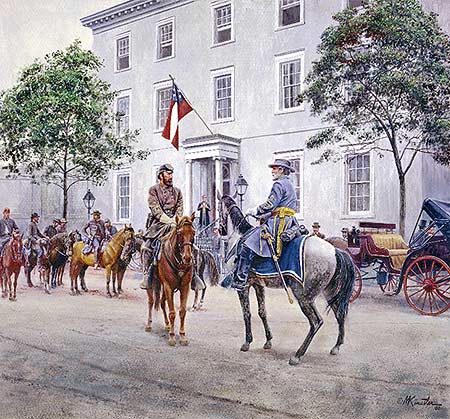
The following is an account of Stuart’s death and funeral from the Southern Historical Society Papers, Vol. VII. Richmond, Virginia, February, 1879. No. 2. There are some very flagrant errors within the text. I have left the text intact, but put the correct information in parenthesis.
The circumstances attending the wounding and death of the "Flower of Cavaliers" ought to be put in permanent form for the use of the future historian, for no history of the Army of Northern Virginia would be complete which did not give large space to the chivalric deeds of this great soldier.
Among our most precious memories of those stirring times are those which cluster around the person and character of Stuart. We remember him as he led an infantry charge on the outpost in the autumn of 1861-- as he appeared at his headquarters on his red blanket on Munson's hill, with a kindly word and a cordial grasp for even the private soldier -- as all through the campaigns which followed he appeared at the head of his column or in the heat of battle always gay, quick and daring -- and especially do we love to recall him amid the sweets of social intercourse or sitting a deeply interested listener in the meetings of our Chaplains' Association at Orange Courthouse. We were present when he took leave of his devoted wife at the opening of the campaign of 1864, saw him several times amid those bloody scenes in the Wilderness, and wept with the whole army when the sad news came that the great cavalryman had fallen -- that the "Chevalier Bayard" of the Confederacy had yielded up his noble life in defending our capital from imminent danger.
We would be glad to have from some competent hand a sketch of that last campaign of Stuart's, and a detailed account of the circumstances immediately connected with his fall. Meantime we give below the very interesting account of his last moments, which appeared at the time of his death in the Richmond Examiner:
No incident of mortality, since the fall of the great Jackson, has occasioned more painful regret than this. Major General J.E.B. Stuart, the model of Virginian cavaliers and dashing chieftain, whose name was a terror to the enemy, and familiar as a household word in two continents, is dead - - struck down by a bullet from the foe, and the whole Confederacy mourns him. He breathed out his gallant spirit resignedly, and in the full possession of all his remarkable faculties of mind and body, at twenty two minutes to eight o'clock Thursday night, at the residence of Dr. Brewer, a relative, (Dr. Brewer was his brother-in-law) on Grace street, in the presence of Drs. Brewer, Garnett, Gibson, and Fontaine, of the General's staff, Rev. Messrs. Peterkin and Keller and a circle of sorrow stricken comrades and friends. We learn from the physicians in attendance upon the General that his condition during the day was very changeable, with occasional delirium and other unmistakable symptoms of speedy dissolution. In the moments of delirium the General's mind wandered and, like the immortal Jackson (whose spirit, we trust, his has joined), in the lapse of reason his faculties were busied with the details of his command. He reviewed, in broken sentences, all his glorious campaigns around McClellan's rear on the Peninsula beyond the Potomac, and upon the Rapidan, quoting from his orders and issuing new ones to his couriers, with a last injunction to "make haste."
About noon, Thursday, President Davis visited his bedside, and spent some fifteen minutes in the dying chamber of his favorite chieftain. The President, taking his hand, said, "General, how do you feel?" He replied, "Easy, but willing to die, if God and my country think I have fulfilled my destiny and done my duty." As evening approached the General's delirium increased, and his mind again wandered to the battlefields over which he had fought, then off to wife and children, and off again to the front. A telegraphic message had been sent for his wife, who was in the country, with the injunction to make all haste, as the General was dangerously wounded. Some thoughtless but unauthorized person, thinking probably to spare his wife pain, altered the dispatch to "slightly wounded," and it was thus she received it, and did not make that haste which she otherwise would have done to reach his side.
As the evening wore on, the paroxysms of pain increased, and mortification set in rapidly. Though suffering the greatest agony at times, the General was calm, and applied to the wound with his own hand the ice intended to relieve the pain. During the evening he asked Dr. Brewer how long he thought he could live, and whether it was possible for him to survive through the night. The Doctor, knowing he did not desire to be buoyed by false hopes, told him frankly that death, that last enemy, was rapidly approaching. The General nodded and said, "I am resigned if it be God's will; but I would like to see my wife. But God's will be done." Several times he roused up and asked if she had come.
To the Doctor, who sat holding his wrist and counting the fleeting, weakening pulse, he remarked, "Doctor, I suppose I am going fast now. It will soon be over. But God's will be done. I hope I have fulfilled my destiny to my country and my duty to God."
At half past seven o'clock it was evident to the physicians that death was setting its clammy seal upon the brave, open brow of the General, and told him so; asked if he had any last messages to give. The General, with a mind perfectly clear and possessed, then made dispositions of his staff and personal effects. To Mrs. General R.E. Lee he directed that his golden spurs be given as a dying memento of his love and esteem of her husband. (Correction: The spurs were sent to Mrs. Lilly Lee of Shepherdstown) To his staff officers he gave his horses. So particular was he in small things, even in the dying hour, that he emphatically exhibited and illustrated the ruling passion strong in death. To one of his staff, who was a heavy built man, he said, "You had better take the larger horse; he will carry you better." Other mementoes he disposed of in a similar manner. To his young son he left his glorious sword.
His worldly matters closed, the eternal interest of his soul engaged his mind. Turning to the Rev. Mr. Peterkin, of the Episcopal Church, and of which he was an exemplary member, he asked him to sing the hymn commencing --
"Rock of ages cleft for me,
Let me hide myself in thee,"
he joining in with all the voice his strength would permit. He then joined in prayer with the ministers. To the Doctor he again said, "I am going fast now; I am resigned; God's will done."
Thus died General J.E.B. Stuart.
His wife reached the house of death and mourning about ten o'clock on Thursday night, one hour and a half after dissolution, and was of course plunged into the greatest grief by the announcement that death had intervened between the announcement of the wounding of the General and her arrival.
The funeral services, preliminary to the consignment to the grave of the remains of General Stuart, were conducted yesterday after noon in Saint James' Episcopal Church, corner of Marshall and Fifth streets -- Rev. Dr. Peterkin, rector. The cortege reached the church about five o'clock, without music or military escort, the Public Guard being absent on duty. The church was already crowded with citizens. The metallic case containing the corpse was borne into the church and up in the centre aisle to the altar the organ pealing a solemn funeral dirge and anthem by the choir.
Among the pall bearers we noticed Brigadier General John H. Winder, General George W. Randolph, General Joseph R. Anderson, Brigadier General Lawton and Commodore Forrest.
Among the congregation appeared President Davis, General Bragg, General Ransom, and other civic and military officials in Richmond. A portion of the funeral services according to the Episcopal church was read by Rev. Dr. Peterkin, assisted by other ministers, concluding with singing and prayer.
The body was then borne forth to the hearse in waiting, decorated with black plumes and drawn by four white horses. The organ pealed its slow, solemn music as the body was borne to the entrance, and whilst the cortege was forming -- the congregation standing by with heads uncovered. Several carriages in the line were occupied by the members of the deceased General's staff and relatives. From the church the cortege moved to Hollywood Cemetery, where the remains were deposited in a vault, the concluding portion of the affecting service read by Rev. Dr. Minnigerode, of Saint Paul's Church, and all that was mortal of the dead hero was shut in from the gaze of men.
Doctor Brewer, the brother in law of General Stuart, has furnished us with some particulars obtained from the General's own lips of the manner in which he came by his wound. He had formed a line of skirmishers near the Yellow Tavern, when, seeing a brigade preparing to charge on his left, General Stuart, with his staff and a few men, dashed down the line to form troops to repel the charge. About this time the Yankees came thundering down upon the General and his small escort. Twelve shots were fired at the General at short range, the Yankees evidently recognizing his well known person. The General wheeled upon them with the natural bravery which had always characterized him, and discharged six shots from his revolver at his assailants. The last of the twelve shots fired at him struck the General in the left side of the stomach. He did not fall, knowing he would be captured if he did, and nerving himself in his seat, wheeled his horse's head and rode for the protection of his lines. Before he reached them his wound overcame him, and he fell, or was helped from his saddle by one of his ever faithful troopers, and carried to a place of security. Subsequently, he was brought to Richmond in an ambulance. The immediate cause of death was mortification of the stomach, induced by the flow of blood from the kidneys and intestines into the cavity of the stomach.
General Stuart was about thirty five years of age. (Correction: He was thirty-one years old) He leaves a widow and two children. His oldest offspring, a sprightly boy, died a year ago while he was battling for his country on the Rappahannock. (Correction: It was his daughter, Flora, who had died in November, 1862) When telegraphed that his child was dying, he sent the reply, "I must leave my child in the hands of God; my country needs me here; I cannot come."
Thus has passed away, amid the exciting scenes of this revolution, one of the bravest and most dashing cavaliers that the "Old Dominion" has ever given birth to. Long will her sons recount the story of his achievements and mourn his untimely departure.
Saturday, May 10, 2008
Lee's Reaction to the Death of Stonewall Jackson
The following narrative comes from Douglas Freeman Southall's R.E. Lee. Southall's volumes are invaluable to the Lee literature and, in fact, serves as the seminal and definitive work on Lee's life. I have a problem with the volumes though. Southall puts his opinion in Lee's voice, therefore making it appear as if Lee is voicing these concerns, ideas, etc. Unfortunately, these opinions have worked their way into the current Civil War historiography as Lee's opinion and, therefore, as fact. As discerning historians, scholars, or even enthusiasts, it is our responsibility to separate the author's opinion from fact.
"One of Jackson's chaplains, Reverend B. T. Lacy, came to headquarters during the morning of the 7th on his way to find Doctor S. B. Morrison, Early's chief surgeon, whom Doctor McGuire desired in consultation. Jackson was worse, Mr. Lacy said. He had done very well on the 6th except for slight nausea, but at dawn Doctor McGuire had found unmistakable symptoms of pneumonia. There was fear, for the first time, that his illness might be fatal. Lee would not admit the possibility of such an outcome. His own faith in God was so complete that he did not believe Heaven would deprive the South of a man whose services were essential to victory. He said to Lacy: "Give [Jackson] my affectionate regards, and tell him to make haste and get well, and come back to me as soon as he can. He has lost his left arm, but I have lost my right."
What would become of the army if Jackson died? Where, among all his lieutenants, could Lee look for another man to execute with swift certainty the flank marches he so much employed in his strategy? Longstreet was a fine fighter, once the issue was drawn, but Longstreet was slow and contentious, always arguing for his own plan, even to the last minute, whereas Jackson, after advancing his own proposals, would execute Lee's orders as readily as if they were his own. In the Army of Northern Virginia, he had no peer. For him to die would be in very truth for Lee to lose his "right arm."
That evening Jackson was reported better. The pneumonia did not seem to be filling the lung. But the next morning, Friday, May 8, as Lee went about the routine duties of the day, gloom settled again. Jackson was weaker, the pneumonia was advancing, he was in mild delirium at intervals, babbling orders and, with his old concern for the welfare of his men, repeatedly calling, "Tell Major Hawks to send forward provisions for the troops." Despite these ominous symptoms, Lee would not give him up. Jackson could not die, he kept telling himself! He was unable to go to Jackson, both because he could not trust his emotions and because there was no one in whose hands he would feel safe in leaving the army. He had even been compelled to ask the President to come to headquarters for the discussion of important military questions, inasmuch as he felt that his own presence there was essential. There was one thing, only one, that he could do for Jackson. That was to pray for him. On Saturday night, as the doctors shook their heads and expressed the fear that the outlook was hopeless, Lee went down spiritually to the brook Jabbok and, like Jacob, wrestled with the angel. Never in his life had he prayed with so much agony of spirit. While the army slept and Jackson in his stupor fought his battles over, Lee on his knees implored Heaven to grant to his country the mercy of the deliverance of Jackson from death.
When the troops began to gather for worship during the forenoon of the next day — a beautiful Sabbath that the commanding general had recommended as a day of thanksgiving for the victory — Lee was still unconvinced that Jackson would be taken. Eagerly he met the chaplain who came from Guiney's at Jackson's request to preach at headquarters. The face of the clergyman told his story: The doctors ahead given Jackson up and did not believe he could survive, except by a miracle. He was in virtual coma, breathing very badly, and muttering still of his warring. "A. P. Hill," he was saying, "prepare for action." And again: "I must find out whether there is high ground between Chancellorsville and the river . . . push up the columns, hasten the columns. . . ." Even in the face of this, Lee refused to believe it could happen. "Surely, General Jackson must recover," he said, in a shaken voice. "God will not take him from us, now that we need him so much. Surely he will be spared to us, in answer to the many prayers which are offered for him!"
The minister preached to a large company of officers and to a multitude of men who had escaped the fangs of death in the Wilderness, but it is doubtful if Lee heard much that the earnest and eloquent Mr. Lacy had to say. His mind was at Guiney's, with Jackson, and so were his prayers. When the service was over, Lee spoke again to the chaplain: "When you return, I trust you will find him better. When a suitable occasion offers, give him my love, and tell him that I wrestled in prayer for him last night, as I never prayed, I believe, for myself." And he had to turn abruptly away to conceal his emotion."
But it was not to be so. At 3:15, on a beautiful spring day, Jackson’s delirium stopped. With a smile, he said, “Let us cross over the river and rest under the shade of the trees.” And then he closed his eyes, and died.
"One of Jackson's chaplains, Reverend B. T. Lacy, came to headquarters during the morning of the 7th on his way to find Doctor S. B. Morrison, Early's chief surgeon, whom Doctor McGuire desired in consultation. Jackson was worse, Mr. Lacy said. He had done very well on the 6th except for slight nausea, but at dawn Doctor McGuire had found unmistakable symptoms of pneumonia. There was fear, for the first time, that his illness might be fatal. Lee would not admit the possibility of such an outcome. His own faith in God was so complete that he did not believe Heaven would deprive the South of a man whose services were essential to victory. He said to Lacy: "Give [Jackson] my affectionate regards, and tell him to make haste and get well, and come back to me as soon as he can. He has lost his left arm, but I have lost my right."
What would become of the army if Jackson died? Where, among all his lieutenants, could Lee look for another man to execute with swift certainty the flank marches he so much employed in his strategy? Longstreet was a fine fighter, once the issue was drawn, but Longstreet was slow and contentious, always arguing for his own plan, even to the last minute, whereas Jackson, after advancing his own proposals, would execute Lee's orders as readily as if they were his own. In the Army of Northern Virginia, he had no peer. For him to die would be in very truth for Lee to lose his "right arm."
That evening Jackson was reported better. The pneumonia did not seem to be filling the lung. But the next morning, Friday, May 8, as Lee went about the routine duties of the day, gloom settled again. Jackson was weaker, the pneumonia was advancing, he was in mild delirium at intervals, babbling orders and, with his old concern for the welfare of his men, repeatedly calling, "Tell Major Hawks to send forward provisions for the troops." Despite these ominous symptoms, Lee would not give him up. Jackson could not die, he kept telling himself! He was unable to go to Jackson, both because he could not trust his emotions and because there was no one in whose hands he would feel safe in leaving the army. He had even been compelled to ask the President to come to headquarters for the discussion of important military questions, inasmuch as he felt that his own presence there was essential. There was one thing, only one, that he could do for Jackson. That was to pray for him. On Saturday night, as the doctors shook their heads and expressed the fear that the outlook was hopeless, Lee went down spiritually to the brook Jabbok and, like Jacob, wrestled with the angel. Never in his life had he prayed with so much agony of spirit. While the army slept and Jackson in his stupor fought his battles over, Lee on his knees implored Heaven to grant to his country the mercy of the deliverance of Jackson from death.
When the troops began to gather for worship during the forenoon of the next day — a beautiful Sabbath that the commanding general had recommended as a day of thanksgiving for the victory — Lee was still unconvinced that Jackson would be taken. Eagerly he met the chaplain who came from Guiney's at Jackson's request to preach at headquarters. The face of the clergyman told his story: The doctors ahead given Jackson up and did not believe he could survive, except by a miracle. He was in virtual coma, breathing very badly, and muttering still of his warring. "A. P. Hill," he was saying, "prepare for action." And again: "I must find out whether there is high ground between Chancellorsville and the river . . . push up the columns, hasten the columns. . . ." Even in the face of this, Lee refused to believe it could happen. "Surely, General Jackson must recover," he said, in a shaken voice. "God will not take him from us, now that we need him so much. Surely he will be spared to us, in answer to the many prayers which are offered for him!"
The minister preached to a large company of officers and to a multitude of men who had escaped the fangs of death in the Wilderness, but it is doubtful if Lee heard much that the earnest and eloquent Mr. Lacy had to say. His mind was at Guiney's, with Jackson, and so were his prayers. When the service was over, Lee spoke again to the chaplain: "When you return, I trust you will find him better. When a suitable occasion offers, give him my love, and tell him that I wrestled in prayer for him last night, as I never prayed, I believe, for myself." And he had to turn abruptly away to conceal his emotion."
But it was not to be so. At 3:15, on a beautiful spring day, Jackson’s delirium stopped. With a smile, he said, “Let us cross over the river and rest under the shade of the trees.” And then he closed his eyes, and died.

Friday, May 9, 2008
An Account of Jackson’s Death and Funeral – Part Two
The following narrative of Jackson’s death and funeral comes from the book Stonewall’s Man: Sandie Pendleton, written by W.G. Bean.
The final tribute paid to Jackson in Richmond occurred in the early morning of May 13. His body was again taken to the Governor’s Mansion for a brief service and then to a train which carried it by way of Gordonsville to Lynchburg. From here it was transported on the James River and Kanawha Canal to Lexington. The editor of the Daily Dispatch regretted that the remains of Jackson could not be interred in Hollywood Cemetery in Richmond, “so near the theatre of his glory, where every breeze wafts his renown, and the murmuring waters, as they role solemnly by, seem to attune themselves to sweet, yet mournful melodies of the grave.” But Jackson had expressed a wish to be buried in Lexington where, as “an unknown, subordinate professor,” had been called “by Providence” to enact an important role in the affairs of mankind. The editor was prophetic in the statement that the fame of Jackson would be as enduring as the eternal mountains “at whose feet he was cradled.” Their long shadows, like those of “some majestic cathedral,” would consecrate his grave, and their loftiest pinnacles would be derive new sublimity from their association with the name of “JACKSON.”
The funeral train wended its way on May 13 from Richmond to Lynchburg amidst the homage of tearful people. In addition to the immediate family of General Jackson, the funeral party consisted of the servant Jim Lewis, Sandie Pendleton, James Power Smith, Hunter McGuire, Governor Letcher, and Confederate Senator G.A. Henry of Tennessee. Upon its arrival in Lynchburg at half past six in the afternoon, it was met by a delegation headed by Mayor W.B. Branch, R.H. Glass, Charles Dimmock, John S. Langhorne, John H. Flood, and W.M. Blackford. Minute guns were fired, and the church bells tolled their anguish. A procession was formed and marched through several streets to the wharf where the casket was placed on the packet boat, The Marshall, commanded by Captain J.B. Keffer. As the Lexington boat was very crowded, it was ten o’clock before the berths were hung.
The packet boat reached Lexington in the afternoon of May 14 (Thursday). General F.H. Smith came on board three miles from Lexington with his program for the ceremonies in Lexington. He had previously announced that the funeral would take place on Saturday, May 16, but yielded to Mrs. Jackson’s insistence that it be on May 15. A corps of cadets received the remains at the canal terminus, escorted it to the Institute, and placed it in the lecture room formerly used by Jackson. The next day, the body of Jackson was borne to its final resting place amidst the solemn pageantry of a military funeral – a novelty for the college community of Lexington.
On Friday morning at 10 o’clock, the funeral procession moved from the Institute to the Presbyterian Church. The escort was headed by Major Scott Schipp, commandant of the corps of cadets, former student of Jackson at the Institute, and an officer who had served in the Valley campaign of 1862. The military escort was composed of the cadets, a battery of First Manassas, a company of veterans of the Stonewall Brigade who happened to be in the county at that time and who bore the flag of the Liberty Hall Volunteers, a company of convalescent soldiers, a squadron of cavalry, and the clergy.
The casket which followed the escort was wrapped in the first Confederate flag ever made, which had been presented by President Davis to Mrs. Jackson. It was borne on a caisson of the cadet battery draped in black. Behind the caisson were the honorary pallbearers representing the Presbyterian Church of Lexington, the county magistrates, the Confederate district court, Washington College, the Virginia Military Institute, the Franklin Society, the town council, the Confederate Navy, and the Bible Society of Rockbridge County.
Then came in the following order: the family in a carriage followed on foot by Sandie Pendleton, Hunter McGuire, and J.P. Smith; Governor John Letcher, Senator Henry, and other representatives of the Confederate government; the faculty and officers of the Virginia Military Institute; the elders and deacons of the Presbyterian Church of Lexington; the professors and students of Washington College; members of the Franklin Society; and citizens of the community.
A simple service was conducted at the church by the pastor, the Reverend Dr. W.S. White, and other visiting ministers. The Reverend Dr. Ramsay of Lynchburg offered a prayer “of wonderful pathos.” The hymn “How Blest the Righteous, When He Dies” was sung and the Reverend Dr. White read the fifteenth chapter of First Corinthians after which another prayer was said by the Reverend Mr. W.F. Junkin, brother of Jackson’s first wife. The remains were then carried to the cemetery and with military honors committed to the grave.
The final tribute paid to Jackson in Richmond occurred in the early morning of May 13. His body was again taken to the Governor’s Mansion for a brief service and then to a train which carried it by way of Gordonsville to Lynchburg. From here it was transported on the James River and Kanawha Canal to Lexington. The editor of the Daily Dispatch regretted that the remains of Jackson could not be interred in Hollywood Cemetery in Richmond, “so near the theatre of his glory, where every breeze wafts his renown, and the murmuring waters, as they role solemnly by, seem to attune themselves to sweet, yet mournful melodies of the grave.” But Jackson had expressed a wish to be buried in Lexington where, as “an unknown, subordinate professor,” had been called “by Providence” to enact an important role in the affairs of mankind. The editor was prophetic in the statement that the fame of Jackson would be as enduring as the eternal mountains “at whose feet he was cradled.” Their long shadows, like those of “some majestic cathedral,” would consecrate his grave, and their loftiest pinnacles would be derive new sublimity from their association with the name of “JACKSON.”
The funeral train wended its way on May 13 from Richmond to Lynchburg amidst the homage of tearful people. In addition to the immediate family of General Jackson, the funeral party consisted of the servant Jim Lewis, Sandie Pendleton, James Power Smith, Hunter McGuire, Governor Letcher, and Confederate Senator G.A. Henry of Tennessee. Upon its arrival in Lynchburg at half past six in the afternoon, it was met by a delegation headed by Mayor W.B. Branch, R.H. Glass, Charles Dimmock, John S. Langhorne, John H. Flood, and W.M. Blackford. Minute guns were fired, and the church bells tolled their anguish. A procession was formed and marched through several streets to the wharf where the casket was placed on the packet boat, The Marshall, commanded by Captain J.B. Keffer. As the Lexington boat was very crowded, it was ten o’clock before the berths were hung.
The packet boat reached Lexington in the afternoon of May 14 (Thursday). General F.H. Smith came on board three miles from Lexington with his program for the ceremonies in Lexington. He had previously announced that the funeral would take place on Saturday, May 16, but yielded to Mrs. Jackson’s insistence that it be on May 15. A corps of cadets received the remains at the canal terminus, escorted it to the Institute, and placed it in the lecture room formerly used by Jackson. The next day, the body of Jackson was borne to its final resting place amidst the solemn pageantry of a military funeral – a novelty for the college community of Lexington.
On Friday morning at 10 o’clock, the funeral procession moved from the Institute to the Presbyterian Church. The escort was headed by Major Scott Schipp, commandant of the corps of cadets, former student of Jackson at the Institute, and an officer who had served in the Valley campaign of 1862. The military escort was composed of the cadets, a battery of First Manassas, a company of veterans of the Stonewall Brigade who happened to be in the county at that time and who bore the flag of the Liberty Hall Volunteers, a company of convalescent soldiers, a squadron of cavalry, and the clergy.
The casket which followed the escort was wrapped in the first Confederate flag ever made, which had been presented by President Davis to Mrs. Jackson. It was borne on a caisson of the cadet battery draped in black. Behind the caisson were the honorary pallbearers representing the Presbyterian Church of Lexington, the county magistrates, the Confederate district court, Washington College, the Virginia Military Institute, the Franklin Society, the town council, the Confederate Navy, and the Bible Society of Rockbridge County.
Then came in the following order: the family in a carriage followed on foot by Sandie Pendleton, Hunter McGuire, and J.P. Smith; Governor John Letcher, Senator Henry, and other representatives of the Confederate government; the faculty and officers of the Virginia Military Institute; the elders and deacons of the Presbyterian Church of Lexington; the professors and students of Washington College; members of the Franklin Society; and citizens of the community.
A simple service was conducted at the church by the pastor, the Reverend Dr. W.S. White, and other visiting ministers. The Reverend Dr. Ramsay of Lynchburg offered a prayer “of wonderful pathos.” The hymn “How Blest the Righteous, When He Dies” was sung and the Reverend Dr. White read the fifteenth chapter of First Corinthians after which another prayer was said by the Reverend Mr. W.F. Junkin, brother of Jackson’s first wife. The remains were then carried to the cemetery and with military honors committed to the grave.
Thursday, May 8, 2008
An Account of Jackson’s Death and Funeral – Part One
The following narrative of Jackson’s death and funeral comes from the book Stonewall’s Man: Sandie Pendleton, written by W.G. Bean
The additional work which devolved upon Sandie during the week following the wounding of Jackson prevented him from visiting the wounded chieftain until Sunday, May 10, the day Jackson died. As Sandie entered the sick chamber, Jackson recognized him and asked, “Who is preaching today at headquarters?” Sandie replied the Dr. Lacy was, and Jackson expressed his pleasure at the news. When told by Sandie that the entire army was praying for his recovery, Jackson murmured, “Thank God, they are very kind.” Presently he added, “It’s the Lord’s Day; my wish is fulfilled. I have always wanted to die on a Sunday.” So affected was Sandie by the scene that he went to the porch and wept. His intense feeling was revealed in a remark, the day after Jackson’s death, to Mrs. Jackson, “God knows I would have died for him.”
As his condition rapidly deteriorated, Jackson’s mind wandered back to the bloody night of May 2 on the Old Turnpike. In one of his early deliriums, he exclaimed, “I must find out if there is high ground between Chancellorsville and the river. Push up the columns! Hasten the columns! Pendleton, you take charge of that. Where’s Pendleton? Tell him to push up the column.”
The events of Sunday, May 10, were vividly recalled later by William Allan. “It was a beautiful day. We were terribly anxious. [Sandie] Pendleton rode down to see the General; the rest of us staid at Headquarters, where Dr. Lacy preached… The whole army was sad and anxious. The news brought to us during the forenoon was bad and I went to my tent after the preaching, feeling very gloomy. The afternoon was wearing on when Pendleton rode rapidly to my quarters and told me that the General had died an hour before.” Sandie dashing to the telegraph office at Hamilton’s Crossing and wired Governor John Letcher: “General Jackson died at fifteen minutes past 3 o’clock this afternoon. His remains will go to Richmond tomorrow.”
Sandie then return to Guiney Station to carry out the instructions of General Lee – who was doubtless aware of the close relationship existing between Jackson and Sandie – to take charge of the remains, to make all arrangements for the funeral, and to accompany the body to Lexington, where Jackson had expressed a desire during his last days to be buried.
The body, dressed by Sandie and J.P. Smith, was temporarily placed in a crude coffin constructed by the soldiers and moved to the front room of the Chandler office. It remained there until its departure for Richmond, where it was later embalmed in the reception room of the Governor’s Mansion and transferred to a metallic casket presented by the citizens of Fredericksburg.
The funeral cortege left Guiney Station on a special train on May 11 (Monday) and arrived in Richmond at 4 o’clock in the afternoon. It addition to Mrs. Jackson and her infant, Mrs. Moses Hoge, and Mrs. Chandler, the remains were accompanied by Sandie Pendleton, Hunter McGuire, J.P. Smith, J.G. Morrison, and the Reverend Dr. B.T. Lacy – all members of Jackson’s staff. Captain Henry Kyd Douglas, formerly of the staff but now of the Second Virginia Regiment, Dr. W.H. Mayo of the governor’s staff and Dr. David Tucker of Richmond, who had been summoned to Guiney Station during the last days of Jackson’s illness, were also in the party. Throngs of people awaited the train as it passed the stations, and at Ashland the ladies placed wreathes and flowers on the casket.
All activities were suspended in Richmond at 12 o’clock, the announced hour of the arrival of the train. A tremendous concourse of citizens had assembled at the depot, but when it was announced that the train would not arrive until 4 o’clock, the crowd slowly dispersed and reassembled at that hour.
Upon reaching Richmond, the train stopped at the corner of Fourth and Broad Street in order to spare Mrs. Jackson the ordeal of facing the multitude of mourners. She was met by Mrs. Letcher and other ladies to Richmond and was taken in a carriage to the Governor’s Mansion. The casket was enveloped in a Confederate flag and covered with wreathes of evergreen and rare flowers. The hearse, flanked by Sandie Pendleton, Hunter McGuire, J.P. Smith, and Henry Kyd Douglas moved amidst the tolling bells down Broad Street to the corner of Ninth; turned toward Main Street, and was taken past the classic porch of St. Paul’s Episcopal Church to the Governor’s Mansion in the Capitol Square. After its arrival there, Sandie and Douglas stood guard until darkness and the body remained in the Mansion during the night. The bells continued to toll until sundown, and thousands of people stayed in the Square until dark. Never before, the Richmond Daily Dispatch declared, had there been such an exhibition, “of heartfelt and general sorrow” in Richmond.
Tuesday, May 12, was a beautiful and warm day in Richmond. The military pageant was one never to be forgotten by those who witnessed it. Promptly at 10 o’clock in the morning, under the direction of George W. Randolph, master of ceremonies, the procession formed on the Capitol Grounds, stretching from the Governor’s Mansion to Grace Street. The band of the Thirtieth Virginia Infantry, hurriedly transported from Hamilton’s Crossing for the occasion, headed the procession. Then came the military escort followed by the hearse which was draped and drawn by four white horses appropriately caparisoned. Grouped around the hearse were the pallbearers: Sandie Pendleton, J.P. Smith, Hunter McGuire, Henry Kyd Douglas, and Generals James Longstreet, R.S. Ewell, J.H. Winder, Arnold Elzey, George E. Pickett, Richard Brooke Garnett, W.M. Kemper, M.D. Corse, and Commodore Bassett French. The carriages, conveying President Davis, who looked “think and frail in health,” and Jackson’s family, were next in line. Behind the carriage came on foot the various chiefs of department, state and Confederate, and distinguished citizens of the city. Little Sorrel, Jackson’s horse, was led by his servant, Jim Lewis.
An immense throng had gathered to move along with the procession. The flags were draped with crepe, and the swords of the military officials were draped at the hilt. The cannons of the artillery wore the sad insignia of mourning, the drums were muffled, and at a given hour a gun stationed beneath the Washington monument boomed the signal for the procession to move.
The bells pealed out their sorrow, and the melancholy dirge of the musicians of the band of the Thirtieth Virginia Infantry swelled forth in moving tones. The director of the band, A.J. Bowering, subsequently said that he had no instructions “as to what I should play but I had in mind that it must be something historical.” As he had only one copy of the “Dead March” from Saul with him upon leaving Hamilton’s Crossing, he transcribed and arranged, on the journey to Richmond, the music of this dirge for twenty different instruments. The band broke into the “Psalm of David” when George W. Randolph raised his sword for the procession to start. “I have played, [Bowering wrote] to men standing against the wall awaiting the command that would send them into eternity and in hospitals I have done my best to soothe the dying hours of the men of Virginias, but never was I so impressed. The tears rolled down the faces of my men and I knew that I was weeping.
“We played as we never played before and in that march around the city there was in line a musician, the brother of Adelina Patti. My soul, how he could play the E flat on a cornet! He played beside me in the parade.”
Emerging from the Capitol Square, the procession moved down Governor’s Street to Main, turned up Main to Second Street, through which it passed to Grace Street, and return to Capitol Square. The casket was borne by the generals of the army to the Senate chamber where, wrapped in the flag made immortal by Jackson, it lay in state until midnight.
The scene on Main Street, during the funeral procession beggared description, said the Richmond Daily Enquirer – “so impressive, so beautiful, so full of stirring associations, blending with the martial dirges of the bands, the gleam of muskets, rifles, and sabers drawn, the sheen of the cannon, the thousands of throbbing hearts, and the sorrow that mantled over all” J.B. Jones, the rebel diarist, recorded that the funeral was “very solemn and imposing because the mourning was sincere and heartfelt. There was no vain ostentation.”
The mixed scene of woe and honor in the Senate chamber was equally moving. As “shattered and emaciated veterans, noble-bowed matrons, and pale, delicate maidens gathered around that sacred bier, in the awed hush of a common sorrow, too deep for words.” T.C. DeLeon lamented, “tears rose from the hearts that had lost their dearest and nearest without a murmur, save – Thy will be done. And little children were lifted up to look upon what was left of him.” On another occasion, as the concourse of mourners passed by the bier, “an elderly and respectable-looking gentleman” addressed them in tones of confidence: Weep not; all is for the best. Though Jackson has been taken from the head of his corps, his spirit is now pleading our cause at the bar of God.”
The additional work which devolved upon Sandie during the week following the wounding of Jackson prevented him from visiting the wounded chieftain until Sunday, May 10, the day Jackson died. As Sandie entered the sick chamber, Jackson recognized him and asked, “Who is preaching today at headquarters?” Sandie replied the Dr. Lacy was, and Jackson expressed his pleasure at the news. When told by Sandie that the entire army was praying for his recovery, Jackson murmured, “Thank God, they are very kind.” Presently he added, “It’s the Lord’s Day; my wish is fulfilled. I have always wanted to die on a Sunday.” So affected was Sandie by the scene that he went to the porch and wept. His intense feeling was revealed in a remark, the day after Jackson’s death, to Mrs. Jackson, “God knows I would have died for him.”
As his condition rapidly deteriorated, Jackson’s mind wandered back to the bloody night of May 2 on the Old Turnpike. In one of his early deliriums, he exclaimed, “I must find out if there is high ground between Chancellorsville and the river. Push up the columns! Hasten the columns! Pendleton, you take charge of that. Where’s Pendleton? Tell him to push up the column.”
The events of Sunday, May 10, were vividly recalled later by William Allan. “It was a beautiful day. We were terribly anxious. [Sandie] Pendleton rode down to see the General; the rest of us staid at Headquarters, where Dr. Lacy preached… The whole army was sad and anxious. The news brought to us during the forenoon was bad and I went to my tent after the preaching, feeling very gloomy. The afternoon was wearing on when Pendleton rode rapidly to my quarters and told me that the General had died an hour before.” Sandie dashing to the telegraph office at Hamilton’s Crossing and wired Governor John Letcher: “General Jackson died at fifteen minutes past 3 o’clock this afternoon. His remains will go to Richmond tomorrow.”
Sandie then return to Guiney Station to carry out the instructions of General Lee – who was doubtless aware of the close relationship existing between Jackson and Sandie – to take charge of the remains, to make all arrangements for the funeral, and to accompany the body to Lexington, where Jackson had expressed a desire during his last days to be buried.
The body, dressed by Sandie and J.P. Smith, was temporarily placed in a crude coffin constructed by the soldiers and moved to the front room of the Chandler office. It remained there until its departure for Richmond, where it was later embalmed in the reception room of the Governor’s Mansion and transferred to a metallic casket presented by the citizens of Fredericksburg.
The funeral cortege left Guiney Station on a special train on May 11 (Monday) and arrived in Richmond at 4 o’clock in the afternoon. It addition to Mrs. Jackson and her infant, Mrs. Moses Hoge, and Mrs. Chandler, the remains were accompanied by Sandie Pendleton, Hunter McGuire, J.P. Smith, J.G. Morrison, and the Reverend Dr. B.T. Lacy – all members of Jackson’s staff. Captain Henry Kyd Douglas, formerly of the staff but now of the Second Virginia Regiment, Dr. W.H. Mayo of the governor’s staff and Dr. David Tucker of Richmond, who had been summoned to Guiney Station during the last days of Jackson’s illness, were also in the party. Throngs of people awaited the train as it passed the stations, and at Ashland the ladies placed wreathes and flowers on the casket.
All activities were suspended in Richmond at 12 o’clock, the announced hour of the arrival of the train. A tremendous concourse of citizens had assembled at the depot, but when it was announced that the train would not arrive until 4 o’clock, the crowd slowly dispersed and reassembled at that hour.
Upon reaching Richmond, the train stopped at the corner of Fourth and Broad Street in order to spare Mrs. Jackson the ordeal of facing the multitude of mourners. She was met by Mrs. Letcher and other ladies to Richmond and was taken in a carriage to the Governor’s Mansion. The casket was enveloped in a Confederate flag and covered with wreathes of evergreen and rare flowers. The hearse, flanked by Sandie Pendleton, Hunter McGuire, J.P. Smith, and Henry Kyd Douglas moved amidst the tolling bells down Broad Street to the corner of Ninth; turned toward Main Street, and was taken past the classic porch of St. Paul’s Episcopal Church to the Governor’s Mansion in the Capitol Square. After its arrival there, Sandie and Douglas stood guard until darkness and the body remained in the Mansion during the night. The bells continued to toll until sundown, and thousands of people stayed in the Square until dark. Never before, the Richmond Daily Dispatch declared, had there been such an exhibition, “of heartfelt and general sorrow” in Richmond.
Tuesday, May 12, was a beautiful and warm day in Richmond. The military pageant was one never to be forgotten by those who witnessed it. Promptly at 10 o’clock in the morning, under the direction of George W. Randolph, master of ceremonies, the procession formed on the Capitol Grounds, stretching from the Governor’s Mansion to Grace Street. The band of the Thirtieth Virginia Infantry, hurriedly transported from Hamilton’s Crossing for the occasion, headed the procession. Then came the military escort followed by the hearse which was draped and drawn by four white horses appropriately caparisoned. Grouped around the hearse were the pallbearers: Sandie Pendleton, J.P. Smith, Hunter McGuire, Henry Kyd Douglas, and Generals James Longstreet, R.S. Ewell, J.H. Winder, Arnold Elzey, George E. Pickett, Richard Brooke Garnett, W.M. Kemper, M.D. Corse, and Commodore Bassett French. The carriages, conveying President Davis, who looked “think and frail in health,” and Jackson’s family, were next in line. Behind the carriage came on foot the various chiefs of department, state and Confederate, and distinguished citizens of the city. Little Sorrel, Jackson’s horse, was led by his servant, Jim Lewis.
An immense throng had gathered to move along with the procession. The flags were draped with crepe, and the swords of the military officials were draped at the hilt. The cannons of the artillery wore the sad insignia of mourning, the drums were muffled, and at a given hour a gun stationed beneath the Washington monument boomed the signal for the procession to move.
The bells pealed out their sorrow, and the melancholy dirge of the musicians of the band of the Thirtieth Virginia Infantry swelled forth in moving tones. The director of the band, A.J. Bowering, subsequently said that he had no instructions “as to what I should play but I had in mind that it must be something historical.” As he had only one copy of the “Dead March” from Saul with him upon leaving Hamilton’s Crossing, he transcribed and arranged, on the journey to Richmond, the music of this dirge for twenty different instruments. The band broke into the “Psalm of David” when George W. Randolph raised his sword for the procession to start. “I have played, [Bowering wrote] to men standing against the wall awaiting the command that would send them into eternity and in hospitals I have done my best to soothe the dying hours of the men of Virginias, but never was I so impressed. The tears rolled down the faces of my men and I knew that I was weeping.
“We played as we never played before and in that march around the city there was in line a musician, the brother of Adelina Patti. My soul, how he could play the E flat on a cornet! He played beside me in the parade.”
Emerging from the Capitol Square, the procession moved down Governor’s Street to Main, turned up Main to Second Street, through which it passed to Grace Street, and return to Capitol Square. The casket was borne by the generals of the army to the Senate chamber where, wrapped in the flag made immortal by Jackson, it lay in state until midnight.
The scene on Main Street, during the funeral procession beggared description, said the Richmond Daily Enquirer – “so impressive, so beautiful, so full of stirring associations, blending with the martial dirges of the bands, the gleam of muskets, rifles, and sabers drawn, the sheen of the cannon, the thousands of throbbing hearts, and the sorrow that mantled over all” J.B. Jones, the rebel diarist, recorded that the funeral was “very solemn and imposing because the mourning was sincere and heartfelt. There was no vain ostentation.”
The mixed scene of woe and honor in the Senate chamber was equally moving. As “shattered and emaciated veterans, noble-bowed matrons, and pale, delicate maidens gathered around that sacred bier, in the awed hush of a common sorrow, too deep for words.” T.C. DeLeon lamented, “tears rose from the hearts that had lost their dearest and nearest without a murmur, save – Thy will be done. And little children were lifted up to look upon what was left of him.” On another occasion, as the concourse of mourners passed by the bier, “an elderly and respectable-looking gentleman” addressed them in tones of confidence: Weep not; all is for the best. Though Jackson has been taken from the head of his corps, his spirit is now pleading our cause at the bar of God.”
Tuesday, May 6, 2008
Henry McClellan's Account of Jeb Stuart's Wounding and Death
This account of the gallant and noble Stuart’s death comes from a letter Major Henry McClellan (Stuart’s adjutant) wrote to Flora Stuart after the general’s death. It was also printed in the Southern Historical Society Papers and in McClellan’s book on Stuart. The rest of the narrative comes from McClellan’s book.
“About four o’clock the enemy suddenly threw a brigade of cavalry, mounted upon our extreme left, attacking our whole line at the same time. As he always did, the general hastened to the point where the greatest danger threatened, -- and the point against which the enemy directed the mounted charge. My horse was so much exhausted by my severe ride of the morning that I could not keep pace with him, but Captain G.W. Dorsey, of company K, 1st Virginia Cavalry, gave me the particulars that follow.
The enemy’s charge captured our battery on the left of our line, and drove back almost the entire left. Where Captain Dorsey was stationed – immediately on the Telegraph Road – about eighty men had collected, his personal example held them steady while the enemy charged entirely past their position. With his men he fired into their flank and rear as they passed him, in advancing and retreating, for they were met by a mounted charge of the 1st Virginia Cavalry and driven back some distance. As they retired, one man who had been dismounted in the charge, and was running out on foot, turned as he passed the general, and discharging his pistol inflicted the fatal wound. When Captain Dorsey discovered that he was wounded he came at one to his assistance, and endeavored to lead him to the rear; but the general’s horse had become so restive and unmanageable that he insisted upon being taken down, and allowed to rest against a tree. When this was done Captain Dorsey sent for another horse. While waiting the general ordered him to leave him, and return to his men and drive back the enemy. He said he feared that he was mortally wounded, and could be of no more service. Captain Dorsey told him that he could not obey that order; that he would rather sacrifice his life than leave him until he had placed him out of all danger. The situation was an exposed one. Our men were sadly scattered, and there was hardly a handful of men between that little group and the advancing enemy. But the horse arrived in time; the general was lifted on to him, and was led by Captain Dorsey to a safer place. There, by the general’s order, he gave him into the charge of private Wheatly, of his company, and returned to rally his scattered men. Wheatly procured an ambulance, placed the general in it with the greatest of care, and supporting him in his arms, was driving toward the rear. I was hastening toward that part of the field where I had heard that he was wounded when I met the ambulance. The general had so often told me that if he were wounded I must not leave the field, but report to the officer next to him in rank, that I did not now presume to disregard his order, and the more so because I saw that Dr. Fontaine, Venable, Garnett, Hullihen, and several of his couriers were attending him. I remained with Fitz Lee until the next morning, when he sent me to the city to see General Bragg, and I thus had an opportunity to spend an hour with my general.”
As he was being driven back from the field he noticed the disorganized ranks of his retreating men, and called out to them: ----
“Go back! Go back! And do your duty, as I have done mine, and our country will be safe. Go back! Go back! I had rather die than be whipped.”
There were his last words on the battle-field, -- words not of idle egotism, but of soldierly entreaty. The shadow that for days had hung over his joyous, earnest life was deepening with the mist from out the dark valley, and ere the chill night closed in he would once again urge to effort, once again cheer to the charge, the comrades he had loved and led so well. But a few months later came the answering echo from the lips of his great commander, who would have gladly shared with him a soldier’s grave, “My men, I have done my best for you.”
While yet in the ambulance Dr. Fontaine and Lieutenant Hullihen turned the general over on his side, in order that an examination of the wound might be made While this was in progress he spoke to Hullihen, addressing him by the pet name which he usually employed: --
“Honey-bun, how do I look in the face?”
“General,” replied Hullihen, “you are looking right well. You will be all right.”
“Well,” said he, “I don’t know how this will turn out; but if it is God’s will that I shall die I am ready.”
In order to avoid the enemy, who how held full possession of the Brook turnpike, it was necessary for the ambulance to make a wide detour to reach Richmond, and it was some time after dark when the general arrived at the residence of his brother-in-law, Dr. Charles Brewer. The long ride gave him great suffering. On the morning of the 12th, after delivering General Fitz Lee’s message to General Bragg, I repaired to the bedside of my dying chief. He was calm and composed, in the full possession of his mind. Our conversation was, however, interrupted by paroxysms of suffering. He directed me to make the proper disposal of his official papers and to send his personal effects to his wife. He then said: ---
“I wish you to take one of my horses and Venable the other. Which is the heavier rider?”
I replied that I thought Venable was.
“Then,” said he, “let Venable have the gray horse, and you take the bay.”
Soon he spoke again:---
“You will find in my hat a small Confederate flag, which a lady of Columbia, South Carolina, sent me, with the request that I wear it upon my horse in a battle and return to her. Send it to her.”
I was at a loss how to interpret these instructions; for I had never seen any such decoration upon his hat. But upon examining it the flag was found within its lining, stained with the sweat of his brow; and among his papers I found the letter which had conveyed the request.
Again he said: “My spurs which I have always word in battle I promised to give to Mrs. Lilly Lee, of Shepherdstown, Virginia. My sword I leave to my son.”
While I sat by his side the sound of cannon outside the city was heard. He turned to me eagerly and inquired what it meant. I explained that Gracy’s brigade and other troops had moved out against the enemy’s rear on the Brook turnpike and that Fitz Lee would endeavor to oppose their advance at Meadow Bridge. He turned his eyes upward, and exclaimed earnestly, “God grant that they may be successful.” Then he turned his head aside, he said with a sigh, ---
“But I must be prepared for another world.”
The thought of duty was always uppermost in his mind; and after listening to the distant cannonading for a few moments, he said: “Major, Fitz Lee may need you.” I understood his meaning, and pressed his hand in a last farewell.
As I left his chamber President Davis entered. Taking the general’s hand, he asked: “General, how do you feel?”
He replied: “Easy, but willing to die, if God and my country think I have fulfilled my destiny and done my duty.”
The Reverend Mr. Peterkin visited him, and prayed with him. He requested Mr. Peterkin to sing “Rock of Ages,” and joined in the singing of the hymn.
During the afternoon he asked Dr. Brewer whether it were not possible for him to survive the night. The doctor frankly told him that death was close at hand.
He the said: “I am resigned if it be God’s will; but I would like to see my wife. But God’s will be done.”
Again he said to Dr. Brewer: “I am going fast now; I am resigned. God’s will be done.”
And thus he passed away.
“About four o’clock the enemy suddenly threw a brigade of cavalry, mounted upon our extreme left, attacking our whole line at the same time. As he always did, the general hastened to the point where the greatest danger threatened, -- and the point against which the enemy directed the mounted charge. My horse was so much exhausted by my severe ride of the morning that I could not keep pace with him, but Captain G.W. Dorsey, of company K, 1st Virginia Cavalry, gave me the particulars that follow.
The enemy’s charge captured our battery on the left of our line, and drove back almost the entire left. Where Captain Dorsey was stationed – immediately on the Telegraph Road – about eighty men had collected, his personal example held them steady while the enemy charged entirely past their position. With his men he fired into their flank and rear as they passed him, in advancing and retreating, for they were met by a mounted charge of the 1st Virginia Cavalry and driven back some distance. As they retired, one man who had been dismounted in the charge, and was running out on foot, turned as he passed the general, and discharging his pistol inflicted the fatal wound. When Captain Dorsey discovered that he was wounded he came at one to his assistance, and endeavored to lead him to the rear; but the general’s horse had become so restive and unmanageable that he insisted upon being taken down, and allowed to rest against a tree. When this was done Captain Dorsey sent for another horse. While waiting the general ordered him to leave him, and return to his men and drive back the enemy. He said he feared that he was mortally wounded, and could be of no more service. Captain Dorsey told him that he could not obey that order; that he would rather sacrifice his life than leave him until he had placed him out of all danger. The situation was an exposed one. Our men were sadly scattered, and there was hardly a handful of men between that little group and the advancing enemy. But the horse arrived in time; the general was lifted on to him, and was led by Captain Dorsey to a safer place. There, by the general’s order, he gave him into the charge of private Wheatly, of his company, and returned to rally his scattered men. Wheatly procured an ambulance, placed the general in it with the greatest of care, and supporting him in his arms, was driving toward the rear. I was hastening toward that part of the field where I had heard that he was wounded when I met the ambulance. The general had so often told me that if he were wounded I must not leave the field, but report to the officer next to him in rank, that I did not now presume to disregard his order, and the more so because I saw that Dr. Fontaine, Venable, Garnett, Hullihen, and several of his couriers were attending him. I remained with Fitz Lee until the next morning, when he sent me to the city to see General Bragg, and I thus had an opportunity to spend an hour with my general.”
As he was being driven back from the field he noticed the disorganized ranks of his retreating men, and called out to them: ----
“Go back! Go back! And do your duty, as I have done mine, and our country will be safe. Go back! Go back! I had rather die than be whipped.”
There were his last words on the battle-field, -- words not of idle egotism, but of soldierly entreaty. The shadow that for days had hung over his joyous, earnest life was deepening with the mist from out the dark valley, and ere the chill night closed in he would once again urge to effort, once again cheer to the charge, the comrades he had loved and led so well. But a few months later came the answering echo from the lips of his great commander, who would have gladly shared with him a soldier’s grave, “My men, I have done my best for you.”
While yet in the ambulance Dr. Fontaine and Lieutenant Hullihen turned the general over on his side, in order that an examination of the wound might be made While this was in progress he spoke to Hullihen, addressing him by the pet name which he usually employed: --
“Honey-bun, how do I look in the face?”
“General,” replied Hullihen, “you are looking right well. You will be all right.”
“Well,” said he, “I don’t know how this will turn out; but if it is God’s will that I shall die I am ready.”
In order to avoid the enemy, who how held full possession of the Brook turnpike, it was necessary for the ambulance to make a wide detour to reach Richmond, and it was some time after dark when the general arrived at the residence of his brother-in-law, Dr. Charles Brewer. The long ride gave him great suffering. On the morning of the 12th, after delivering General Fitz Lee’s message to General Bragg, I repaired to the bedside of my dying chief. He was calm and composed, in the full possession of his mind. Our conversation was, however, interrupted by paroxysms of suffering. He directed me to make the proper disposal of his official papers and to send his personal effects to his wife. He then said: ---
“I wish you to take one of my horses and Venable the other. Which is the heavier rider?”
I replied that I thought Venable was.
“Then,” said he, “let Venable have the gray horse, and you take the bay.”
Soon he spoke again:---
“You will find in my hat a small Confederate flag, which a lady of Columbia, South Carolina, sent me, with the request that I wear it upon my horse in a battle and return to her. Send it to her.”
I was at a loss how to interpret these instructions; for I had never seen any such decoration upon his hat. But upon examining it the flag was found within its lining, stained with the sweat of his brow; and among his papers I found the letter which had conveyed the request.
Again he said: “My spurs which I have always word in battle I promised to give to Mrs. Lilly Lee, of Shepherdstown, Virginia. My sword I leave to my son.”
While I sat by his side the sound of cannon outside the city was heard. He turned to me eagerly and inquired what it meant. I explained that Gracy’s brigade and other troops had moved out against the enemy’s rear on the Brook turnpike and that Fitz Lee would endeavor to oppose their advance at Meadow Bridge. He turned his eyes upward, and exclaimed earnestly, “God grant that they may be successful.” Then he turned his head aside, he said with a sigh, ---
“But I must be prepared for another world.”
The thought of duty was always uppermost in his mind; and after listening to the distant cannonading for a few moments, he said: “Major, Fitz Lee may need you.” I understood his meaning, and pressed his hand in a last farewell.
As I left his chamber President Davis entered. Taking the general’s hand, he asked: “General, how do you feel?”
He replied: “Easy, but willing to die, if God and my country think I have fulfilled my destiny and done my duty.”
The Reverend Mr. Peterkin visited him, and prayed with him. He requested Mr. Peterkin to sing “Rock of Ages,” and joined in the singing of the hymn.
During the afternoon he asked Dr. Brewer whether it were not possible for him to survive the night. The doctor frankly told him that death was close at hand.
He the said: “I am resigned if it be God’s will; but I would like to see my wife. But God’s will be done.”
Again he said to Dr. Brewer: “I am going fast now; I am resigned. God’s will be done.”
And thus he passed away.
Sunday, May 4, 2008
Dr. Hunter McGuire's Account of Jackson's Wounding- Part Two
At this time the battle was raging fearfully, and the sound of the cannon and musketry could be distinctly heard at the hospital. The General’s attention was attracted to it from the first and when the noise was at its height, and indicated how fiercely the conflict was being carried on, he directed all his attendants, except Captain Smith, to return to the battlefield and attend to their different duties. By 8 o’clock Sunday night the pain in his side had disappeared, and in all respects he seemed to be doing well. He inquired minutely about the battle and the different troops engaged, and his face would light up with enthusiasm and interest when told how this brigade acted, or that officer displayed conspicuous courage, and his head gave the peculiar shake from side to side, and he uttered his usual, “Good, good,” with unwonted energy when the gallant behavior of the “Stonewall brigade” was alluded to. He said, “the men of the brigade will be someday proud to say to their children, I was one of the ‘Stonewall brigade.’” He disclaimed any right of his own to the name Stonewall. “It belongs to the brigade and not to me.” This night he slept well, and was free from pain.
A message was received from General Lee the next morning directing me to remove the General to Guinea’s station as soon as his condition would justify it, as there was some danger of capture by the Federals, who were threatening to cross at Ely’s Ford. In the meantime to protect the hospital, some troops were sent to this point. The General objected to being moved, if, in my opinion, it would do him any injury. He said he had no objection to staying in a tent, and would prefer it if his wife, when she came, could find lodging in a neighboring house, “and if the enemy does come,” he added, “I am not afraid of them; I have always been kind to their wounded, and I am sure they will be kind to me.” General Lee sent word again late that evening that he must be moved if possible, and preparations were made to leave the next morning. I was directed to accompany him and remain with him, and my duties with the corps as medical direction were turned over to the surgeon next in rank. General Jackson had previously declined to permit me to go with him to Guinea’s, because complaints had been so frequently made of general officers, when wounded, carrying off with them the surgeons belonging to their command. When informed of this order of the commanding general, he said, “General Lee has always been very kind to me, and I thank him.” Very early Tuesday morning he was placed in an ambulance and started for Guinea’s station, and at 8 o’clock that evening he arrived at the Chandler house, where he remained until he died. Captain Hotchkiss, with a party of engineers, was sent in front to clear the road of wood, stone, etc., and to order the wagons out of the track to let the ambulance pass.
The rough teamsters sometimes refused to move their loaded wagons out of the way for an ambulance until told that it was Jackson, and then, with all possible speed, they gave the way and stood with hats off and sweeping as he went by. At Spotsylvania Court House and along the whole route men and women rushed to the ambulance, bringing all the poor delicacies they had and with tearful eyes the blessed him and prayed for his recovery. He bore the journey well, and was cheerful throughout the day. He talked freely about the late battle, and among other things said that he had intended to endeavor to cut the Federals off from the United States ford, and taking a position between them and the river, oblige them to attack him, and he added, with a smile, “My men sometimes fail to drive the enemy from a position, but they always fail to drive us away.” He spoke of Rodes, and alluded in high terms to his magnificent behavior on the field Saturday evening. He hoped he would be promoted. He thought promotion for gallantry should be made at one, upon the field and not delayed. Made very early, or upon the field, they would be the greatest incentives to gallantry in others. He spoke of Colonel Willis (subsequently killed in battle),who commanded the skirmishers of Rodes’s division, and praised him very highly, and referred to the deaths of Paxton and Boswell very feelingly. He alluded to them as officers of great merit and promise. The day was quite warm, and at one time he suffered from slight nausea. At his suggestion, I placed over his stomach a wet towel; and he expressed great relief from it. After he arrived at Chandler’s house he ate some bread and tea with evident relish, and slept well throughout the entire night. Wednesday he thought to be doing remarkably well. He ate heartily for one in his condition, and was uniformly cheerful.
I found his wounds to be very well to-day. Union by the first intention had taken place to some extent in the stump, and the rest of the surface of the wound exposed was covered with healthy granulations. The wound in his hand gave him little pain, and the discharge was healthy. Simple line and water dressings were used, both for the stump and hand, and upon the palm of the latter a light, short splint was applied to assist in keeping at rest the fragments of the second and third metacarpal bones. He expressed great satisfaction when told that his wounds were healing and asked if I could tell from their appearance how long he would probably be kept from the field. Conversing with Captain Smith a few moments afterwards, he alluded to his injuries and said, “Many would regard them as a great misfortune. I regard them as one of the blessings of my life.” Captain Smith replied: “All things work together for good to those that love God.” “Yes,” he answered, “that’s it, that’s it.”
At my request Dr. Morrison came to-day and remained with him. About 1 o’clock Thursday morning, while I was asleep upon a lounge in his room, he directed his servant (Jim) to apply a wet towel to his stomach to relieve an attack of nausea, with which he was again troubled. The servant asked permission to first consult me, but the General knowing that I had slept none for nearly three nights, refused to allow the servant to disturb me, and demanded the towel. About daylight I was aroused, and found him suffering great pain. An examination disclosed pleuro-pneumonia of the right side. I believed, and the consulting physicians concurred in their opinion, that it was attributable to the fall from the litter the night he was wounded. The General himself referred to this accident. I think the disease came on too soon after the application of the wet cloths to admit the supposition, once believed, that it was induced by them. The nausea, for which the cloths were applied that night, may have been a result of inflammation already begun. Contusion of the lung, with extravasation of blood prevented any ill effects until reaction had been well established, and then inflammation ensured. Cups were applied and mercury, with antimony and opium administered.
Towards the evening he became better, and hopes were again entertained of his recovery. Mrs Jackson arrived to-day and nursed him faithfully to the end. She was a devoted wife and earnest Christian, and endeared us all by her great kindness and gentleness. The General’s joy at the presence of his wife and child was very great; and for him unusually demonstrative. Noting the sadness of his wife, he said to her tenderly: “I know you would gladly give your life for me, but I am perfectly resigned. Do not be sad. I hope I may recover. Pray for me, but always remember in your prayers to use the petition, ‘Thy will be done.’”
Friday his wounds were again dressed and although the quantity of discharge from them had diminished, the process of healing was still going on. The pain in his side had disappeared, but he breath with difficulty, and complained of a feeling of great exhaustion. When Dr. Breckenridge (who, with Dr. Smith, had been sent for in consultation) said he hoped that the blister which had been applied would afford him great relief, he expressed his own confidence in it, and in his final recovery.
Dr. Tucker, from Richmond, arrived on Saturday, and all that human skill could devise was done to stay the hand of death. He suffered n pain today, and his breathing was less difficult, but he was evidently hourly growing weaker.
When his child was brought to him to-day he played with her for sometime, frequently caressing her and calling her his “little comforter.” At one time he raised his wounded hand above his head and closing his eye, was for some moments silently engaged in prayer. He said to me, “I see from the number of physicians that you think my condition dangerous, but I think God, if it is His will, than I am ready to go.”
About daylight on Sunday morning Mrs. Jackson informed him that his recovered way very doubtful, and that it was better that he should be prepared for the worse. He was silent for a moment and then said: “It will be infinite gain to be translated to Heaven.” He advised his wife, in the event of his death, to return to her father’s house, and added: “You have a good and kind father, but there is no one so kind and good as your Heavenly Father.” He still expressed a hope of his recovery, but requested her, if he should die, to have him buried in Lexington, in the Valley of Virginia. His exhaustion increased so rapidly that at 11 o’clock Mrs. Jackson knelt by his bed and told him before the sun went down he would be with his Savior. He replied: “Oh, no, you are frightened, my child, death is not so near; I may yet get well.” She fell upon the bed weeping bitterly and told him again that the physicians said there was no hope. After a moment’s pause he asked her to call me. “Doctor, Anna informs me that you have told her that I am to die to-day, is it so?” When he was answered, he turned his eyes toward the ceiling and gazed for a moment or two as if in intense thought, he replied, “Very good, very good, it is all right.” He then tried to comfort his almost broken-hearted wife, and told her that he had a great deal to say to her, but he was too weak.
Colonel Pendleton came into the room about 1 o’clock, and he asked him, “Who was preaching at headquarters today?” When told that the whole army was praying for him, he replied, “Thank God, they are very kind.” He said: “It is the Lord’s Day, my wish is fulfilled. I have always desired to die on Sunday.”
His mind now began to fail and wander, and he frequently talked as if in command upon the field, giving orders in his own way; then the scene shifted and he was at the mess-table, in conversation with members of his staff; now with his wife and child; now at prayers with his military family. Occasional intervals of return of his mind would appear, and during one of them I offered him some brandy and water, but he declined it, saying, “It will only delay my departure, and do no good; I want to preserve my mind if possible, to the last.” About half-past one he was told that he had but two hours to live, and he answered again, feebly, but firmly, “Very good, it is alright.”
A few moments before he died he cried out in his delirium, “Order A.P. Hill to prepare for action!” Pass the infantry to the front rapidly. Tell Major Hawkes,” then he stopped leaving the sentence unfinished. Presently a smile of ineffable sweetness spread itself over his pale face, and he cried quietly and with an expression of relief. “Let us cross over the river and rest under the shades of the tree.” And without pain or the least struggle, his spirit passed from earth to the God who gave it.
A message was received from General Lee the next morning directing me to remove the General to Guinea’s station as soon as his condition would justify it, as there was some danger of capture by the Federals, who were threatening to cross at Ely’s Ford. In the meantime to protect the hospital, some troops were sent to this point. The General objected to being moved, if, in my opinion, it would do him any injury. He said he had no objection to staying in a tent, and would prefer it if his wife, when she came, could find lodging in a neighboring house, “and if the enemy does come,” he added, “I am not afraid of them; I have always been kind to their wounded, and I am sure they will be kind to me.” General Lee sent word again late that evening that he must be moved if possible, and preparations were made to leave the next morning. I was directed to accompany him and remain with him, and my duties with the corps as medical direction were turned over to the surgeon next in rank. General Jackson had previously declined to permit me to go with him to Guinea’s, because complaints had been so frequently made of general officers, when wounded, carrying off with them the surgeons belonging to their command. When informed of this order of the commanding general, he said, “General Lee has always been very kind to me, and I thank him.” Very early Tuesday morning he was placed in an ambulance and started for Guinea’s station, and at 8 o’clock that evening he arrived at the Chandler house, where he remained until he died. Captain Hotchkiss, with a party of engineers, was sent in front to clear the road of wood, stone, etc., and to order the wagons out of the track to let the ambulance pass.
The rough teamsters sometimes refused to move their loaded wagons out of the way for an ambulance until told that it was Jackson, and then, with all possible speed, they gave the way and stood with hats off and sweeping as he went by. At Spotsylvania Court House and along the whole route men and women rushed to the ambulance, bringing all the poor delicacies they had and with tearful eyes the blessed him and prayed for his recovery. He bore the journey well, and was cheerful throughout the day. He talked freely about the late battle, and among other things said that he had intended to endeavor to cut the Federals off from the United States ford, and taking a position between them and the river, oblige them to attack him, and he added, with a smile, “My men sometimes fail to drive the enemy from a position, but they always fail to drive us away.” He spoke of Rodes, and alluded in high terms to his magnificent behavior on the field Saturday evening. He hoped he would be promoted. He thought promotion for gallantry should be made at one, upon the field and not delayed. Made very early, or upon the field, they would be the greatest incentives to gallantry in others. He spoke of Colonel Willis (subsequently killed in battle),who commanded the skirmishers of Rodes’s division, and praised him very highly, and referred to the deaths of Paxton and Boswell very feelingly. He alluded to them as officers of great merit and promise. The day was quite warm, and at one time he suffered from slight nausea. At his suggestion, I placed over his stomach a wet towel; and he expressed great relief from it. After he arrived at Chandler’s house he ate some bread and tea with evident relish, and slept well throughout the entire night. Wednesday he thought to be doing remarkably well. He ate heartily for one in his condition, and was uniformly cheerful.
I found his wounds to be very well to-day. Union by the first intention had taken place to some extent in the stump, and the rest of the surface of the wound exposed was covered with healthy granulations. The wound in his hand gave him little pain, and the discharge was healthy. Simple line and water dressings were used, both for the stump and hand, and upon the palm of the latter a light, short splint was applied to assist in keeping at rest the fragments of the second and third metacarpal bones. He expressed great satisfaction when told that his wounds were healing and asked if I could tell from their appearance how long he would probably be kept from the field. Conversing with Captain Smith a few moments afterwards, he alluded to his injuries and said, “Many would regard them as a great misfortune. I regard them as one of the blessings of my life.” Captain Smith replied: “All things work together for good to those that love God.” “Yes,” he answered, “that’s it, that’s it.”
At my request Dr. Morrison came to-day and remained with him. About 1 o’clock Thursday morning, while I was asleep upon a lounge in his room, he directed his servant (Jim) to apply a wet towel to his stomach to relieve an attack of nausea, with which he was again troubled. The servant asked permission to first consult me, but the General knowing that I had slept none for nearly three nights, refused to allow the servant to disturb me, and demanded the towel. About daylight I was aroused, and found him suffering great pain. An examination disclosed pleuro-pneumonia of the right side. I believed, and the consulting physicians concurred in their opinion, that it was attributable to the fall from the litter the night he was wounded. The General himself referred to this accident. I think the disease came on too soon after the application of the wet cloths to admit the supposition, once believed, that it was induced by them. The nausea, for which the cloths were applied that night, may have been a result of inflammation already begun. Contusion of the lung, with extravasation of blood prevented any ill effects until reaction had been well established, and then inflammation ensured. Cups were applied and mercury, with antimony and opium administered.
Towards the evening he became better, and hopes were again entertained of his recovery. Mrs Jackson arrived to-day and nursed him faithfully to the end. She was a devoted wife and earnest Christian, and endeared us all by her great kindness and gentleness. The General’s joy at the presence of his wife and child was very great; and for him unusually demonstrative. Noting the sadness of his wife, he said to her tenderly: “I know you would gladly give your life for me, but I am perfectly resigned. Do not be sad. I hope I may recover. Pray for me, but always remember in your prayers to use the petition, ‘Thy will be done.’”
Friday his wounds were again dressed and although the quantity of discharge from them had diminished, the process of healing was still going on. The pain in his side had disappeared, but he breath with difficulty, and complained of a feeling of great exhaustion. When Dr. Breckenridge (who, with Dr. Smith, had been sent for in consultation) said he hoped that the blister which had been applied would afford him great relief, he expressed his own confidence in it, and in his final recovery.
Dr. Tucker, from Richmond, arrived on Saturday, and all that human skill could devise was done to stay the hand of death. He suffered n pain today, and his breathing was less difficult, but he was evidently hourly growing weaker.
When his child was brought to him to-day he played with her for sometime, frequently caressing her and calling her his “little comforter.” At one time he raised his wounded hand above his head and closing his eye, was for some moments silently engaged in prayer. He said to me, “I see from the number of physicians that you think my condition dangerous, but I think God, if it is His will, than I am ready to go.”
About daylight on Sunday morning Mrs. Jackson informed him that his recovered way very doubtful, and that it was better that he should be prepared for the worse. He was silent for a moment and then said: “It will be infinite gain to be translated to Heaven.” He advised his wife, in the event of his death, to return to her father’s house, and added: “You have a good and kind father, but there is no one so kind and good as your Heavenly Father.” He still expressed a hope of his recovery, but requested her, if he should die, to have him buried in Lexington, in the Valley of Virginia. His exhaustion increased so rapidly that at 11 o’clock Mrs. Jackson knelt by his bed and told him before the sun went down he would be with his Savior. He replied: “Oh, no, you are frightened, my child, death is not so near; I may yet get well.” She fell upon the bed weeping bitterly and told him again that the physicians said there was no hope. After a moment’s pause he asked her to call me. “Doctor, Anna informs me that you have told her that I am to die to-day, is it so?” When he was answered, he turned his eyes toward the ceiling and gazed for a moment or two as if in intense thought, he replied, “Very good, very good, it is all right.” He then tried to comfort his almost broken-hearted wife, and told her that he had a great deal to say to her, but he was too weak.
Colonel Pendleton came into the room about 1 o’clock, and he asked him, “Who was preaching at headquarters today?” When told that the whole army was praying for him, he replied, “Thank God, they are very kind.” He said: “It is the Lord’s Day, my wish is fulfilled. I have always desired to die on Sunday.”
His mind now began to fail and wander, and he frequently talked as if in command upon the field, giving orders in his own way; then the scene shifted and he was at the mess-table, in conversation with members of his staff; now with his wife and child; now at prayers with his military family. Occasional intervals of return of his mind would appear, and during one of them I offered him some brandy and water, but he declined it, saying, “It will only delay my departure, and do no good; I want to preserve my mind if possible, to the last.” About half-past one he was told that he had but two hours to live, and he answered again, feebly, but firmly, “Very good, it is alright.”
A few moments before he died he cried out in his delirium, “Order A.P. Hill to prepare for action!” Pass the infantry to the front rapidly. Tell Major Hawkes,” then he stopped leaving the sentence unfinished. Presently a smile of ineffable sweetness spread itself over his pale face, and he cried quietly and with an expression of relief. “Let us cross over the river and rest under the shades of the tree.” And without pain or the least struggle, his spirit passed from earth to the God who gave it.
Friday, May 2, 2008
Dr. Hunter McGuire's Account of Jackson's Wounding - Part One
The following article is from the Southern Historical Society Papers, Volume XIV, January 1886.
The Death of Stonewall Jackson
By Doctor Hunter McGuire, Medical Director of Jackson's Corps
Supported upon either side by his aides -- Captain James Power Smith and Joseph Morrison -- the General moved slowly and painfully towards the rear. Occasionally resting for a moment to shake off the exhaustion which pain and the loss of blood produced, he at last reached the line of battle, where most of the men were lying down to escape the shell and canister with which the Federals raked the road. General Pender rode up here to the little party and asked who was wounded and Captain Smith, who had been instructed by General Jackson to tell no one of his injury, simply answered, "A Confederate officer;" but Pender recognized the General, and, springing from his horse, hurriedly expressed his regret, and added that his lines were so broken he feared it would be necessary to fall back. At this moment the scene was a fearful one. The air seemed to be alive with the shrieks of shells and the whistling of bullets; horses, riderless and mad with fright, dashed in every direction; hundreds left the ranks and fled to the rear, and the groans of the wounded and dying mingled with the shouts of others being led again to the assault. Almost fainting as he was, from loss of blood, fearfully wounded, and as he thought, dying, Jackson was undismayed by this terrible scene. The words of Pender seemed to rouse him to life. Pushing aside the men who supported him, he stretched himself to his full height and answered feebly, but distinctly enough to be heard above the din of battle: "General Pender, you must hold on to the field; you must hold out to the last."
It was Jackson's last order upon the field of battle. Still more exhausted by his effort, he asked to be permitted to lie down for a few minutes, but the danger from the fire, and capture by the Federal advance, was too imminent, and his aides hurried him on. A litter having been obtained, he was placed upon it, and the bearers passed on as rapidly as the thick woods and rough ground permitted. Unfortunately, another one of the bearers was struck down, and the litter having been supported at each of the four corners by a man, fell and threw the General to the ground. The fall was a serious one, and as he touched the earth, he gave, for the first time, expression to his suffering, and groaned piteously.
Captain Smith sprang to his side, and as he raised his head, a bright beam of moonlight made its way through the thick foliage and rested upon the pale face of the sufferer. The captain was startled by its great pallor and stillness, and cried out: "Oh! General, are you seriously hurt?" "No," he answered, "don't trouble yourself, my friend, about me;" and presently added something about winning the battle first and attending to the wounded afterwards. He was placed upon the litter again, and carried a few hundred yards, when I met him with the ambulance. I knelt down by him and said, "I hope you are not badly hurt, General?" He replied very calmly but feebly, "I am badly injured, Doctor; I fear I am dying." After a paused he continued, "I am glad you have come. I think the wound in my shoulder is still bleeding." His clothes were saturated with blood, and hemorrhage was still going on from the wound. Compression to the artery with the finger arrested it until, light being procured from the ambulance, the handkerchief, which had slipped a little, was readjusted.
His calmness amid the dangers which surrounded him and at the supposed presence of death, and his uniform politeness, which did not forsake him, even under these, the most trying circumstances, were remarkable. His complete control, too, over his mind enfeebled as it was by loss of blood, pain &c., was wonderful. His suffering as this time was intense; his hands were cold, his skin clammy, his face pale, and his lips compressed and bloodless; not a groan escaped him -- not a sign of suffering except the slight corrugation of his brow; the fixed rigid face, and the thin lips too tightly compressed that the impression of the teeth could be seen through them. Except these, he controlled by his iron will all evidence of emotion, and more difficult than this even, he controlled that disposition to restlessness, which many of us have observed upon the field of battle, attending great loss of blood. Some whiskey and morphine were procured from Dr. Straith and administered to him, and placing him in the ambulance it was started for the corps field infirmary at Wilderness Tavern. Colonel Crutchfield, his chief of artillery, was also in the ambulance wagon. He had been wounded very seriously in the leg, and was suffering intensely.
The General expressed, very feelingly his sympathy for Crutchfield, and once, when the latter groaned aloud, he directed the ambulance to stop, and requested me to see if something could not be done for his relief. Torches had been provided, and every means to carry them to the hospital as safely and easily as possible. I sat in the front part of the ambulance, with my finger resting upon the artery above the wound, to arrest bleeding if it should occur. When I was recognized by acquaintances and asked who was wounded, the General would tell me to say, "A Confederate officer." At one time he put his right hand upon my head, and pulling me down to him, asked if Crutchfield was dangerously injured. When answered, "No, only painfully hurt," he replied. "I am glad it is no worse." In a few moments after Crutchfield did the same thing, and when he was told that the General was seriously wounded, he groaned and cried out, "Oh, my God!" It was for this that the General directed the ambulance to be halted, and requested that something should be done for Crutchfield's relief.
After reaching the hospital he was placed in a bed, covered with blankets, and another drink of whiskey and water given to him. Two hours and a half elapsed before sufficient reaction took place to warrant an examination. At 2 o'clock, Sunday morning, Surgeons Black, Walls, and Coleman being present, I informed him that chloroform would be given him, and his wounds examined. I told him that amputation would probably be required, and asked it was found necessary whether it should be done at once. He replied promptly, "Yes, certainly. Dr. McGuire, do for me whatever you think best." Chloroform was then administered, and as he began to feel its effects, and its relief to the pain he was suffering, he exclaimed: "What an infinite blessing," and continued to repeat the word "blessing," until he became insensible. The round ball (such as is used for the smooth-bore Springfield musket), which had lodged under the skin upon the back of his right hand, was extracted first. It had entered the palm about the middle of the hand, and had fractured two of the bones. The left arm was then amputated about two inches below the shoulder, very rapidly and with slight loss of blood, the ordinary circular operation having been made. There were two wounds in his arm. The first and most serious was about three inches below the shoulder-joint, the ball dividing the main artery and fracturing the bone. The second was several inches in length, a ball having entered the outside of the forearm, an inch below the elbow, came out upon the opposite side just above the wrist. Throughout the whole of the operation, and until all the dressings were applied, he continued insensible. Two or three slight wounds of the skin of his face, received from the branches of trees when his horse dashed through the woods, were dressed simply with isinglass plaster.
About half-past 3 o'clock, Colonel (then Major) Pendleton, the assistant adjutant-general, arrived at the hospital and asked to see the General. He stated that General Hill had been wounded, and that the troops were in great disorder. General Stuart was in command, and had sent him to see the General. At first I declined to permit an interview, but the colonel urged the safety of the army and success of the cause depended upon his seeing him. When he entered the tent, the General said: "Well, major, I am glad to see you. I thought you were killed." Pendleton briefly explained the condition of affairs, gave Stuart's message, and asked what should be done. General Jackson at once was interested, and asked in his quick, rapid way several questions. When they were answered, he remained silent for a moment, evidently trying to think; he contracted his brow, set his mouth, and for some moments was obviously endeavoring to concentrate his thoughts. For a moment it was believed he had succeeded, for his nostrils dilated, and his eye flashed its old fire, but it was only for a moment; his face relaxed again, and presently he answered very feebly and sadly, "I don't know. I can't tell, say to General Stuart he must do what he thinks best." Soon after this he slept hours and seemed to be doing well. The next morning he was free from pain, and expressed himself sanguine of recovery. He sent his aide-de-camp, Morrison, to inform his wife of his injuries, and to bring her at once to see him. The following note from General Lee was read to him that morning by Captain Smith. "I have just received your note, informing me that you were wounded. I cannot express my regret at that occurence. Could I have directed events, I should have chosen, for the good of the country to have been disabled in your stead. I congratulate you upon the victory, which is due to your skill and energy." He replied: "General Lee should give praise to God."
About 10 o'clock his right side began to pain him so much that he asked me to examine it. He said he had injured it in falling from the litter the night before, and believed that he had struck it against a stone or the stump of a sapling. No evidence of injury could be discovered by examination. The skin was not broken or bruised, and the long performed, as far as I could tell, its proper function. Some simple application was recommended, in the belief that the pain would soon disappear.
The Death of Stonewall Jackson
By Doctor Hunter McGuire, Medical Director of Jackson's Corps
Supported upon either side by his aides -- Captain James Power Smith and Joseph Morrison -- the General moved slowly and painfully towards the rear. Occasionally resting for a moment to shake off the exhaustion which pain and the loss of blood produced, he at last reached the line of battle, where most of the men were lying down to escape the shell and canister with which the Federals raked the road. General Pender rode up here to the little party and asked who was wounded and Captain Smith, who had been instructed by General Jackson to tell no one of his injury, simply answered, "A Confederate officer;" but Pender recognized the General, and, springing from his horse, hurriedly expressed his regret, and added that his lines were so broken he feared it would be necessary to fall back. At this moment the scene was a fearful one. The air seemed to be alive with the shrieks of shells and the whistling of bullets; horses, riderless and mad with fright, dashed in every direction; hundreds left the ranks and fled to the rear, and the groans of the wounded and dying mingled with the shouts of others being led again to the assault. Almost fainting as he was, from loss of blood, fearfully wounded, and as he thought, dying, Jackson was undismayed by this terrible scene. The words of Pender seemed to rouse him to life. Pushing aside the men who supported him, he stretched himself to his full height and answered feebly, but distinctly enough to be heard above the din of battle: "General Pender, you must hold on to the field; you must hold out to the last."
It was Jackson's last order upon the field of battle. Still more exhausted by his effort, he asked to be permitted to lie down for a few minutes, but the danger from the fire, and capture by the Federal advance, was too imminent, and his aides hurried him on. A litter having been obtained, he was placed upon it, and the bearers passed on as rapidly as the thick woods and rough ground permitted. Unfortunately, another one of the bearers was struck down, and the litter having been supported at each of the four corners by a man, fell and threw the General to the ground. The fall was a serious one, and as he touched the earth, he gave, for the first time, expression to his suffering, and groaned piteously.
Captain Smith sprang to his side, and as he raised his head, a bright beam of moonlight made its way through the thick foliage and rested upon the pale face of the sufferer. The captain was startled by its great pallor and stillness, and cried out: "Oh! General, are you seriously hurt?" "No," he answered, "don't trouble yourself, my friend, about me;" and presently added something about winning the battle first and attending to the wounded afterwards. He was placed upon the litter again, and carried a few hundred yards, when I met him with the ambulance. I knelt down by him and said, "I hope you are not badly hurt, General?" He replied very calmly but feebly, "I am badly injured, Doctor; I fear I am dying." After a paused he continued, "I am glad you have come. I think the wound in my shoulder is still bleeding." His clothes were saturated with blood, and hemorrhage was still going on from the wound. Compression to the artery with the finger arrested it until, light being procured from the ambulance, the handkerchief, which had slipped a little, was readjusted.
His calmness amid the dangers which surrounded him and at the supposed presence of death, and his uniform politeness, which did not forsake him, even under these, the most trying circumstances, were remarkable. His complete control, too, over his mind enfeebled as it was by loss of blood, pain &c., was wonderful. His suffering as this time was intense; his hands were cold, his skin clammy, his face pale, and his lips compressed and bloodless; not a groan escaped him -- not a sign of suffering except the slight corrugation of his brow; the fixed rigid face, and the thin lips too tightly compressed that the impression of the teeth could be seen through them. Except these, he controlled by his iron will all evidence of emotion, and more difficult than this even, he controlled that disposition to restlessness, which many of us have observed upon the field of battle, attending great loss of blood. Some whiskey and morphine were procured from Dr. Straith and administered to him, and placing him in the ambulance it was started for the corps field infirmary at Wilderness Tavern. Colonel Crutchfield, his chief of artillery, was also in the ambulance wagon. He had been wounded very seriously in the leg, and was suffering intensely.
The General expressed, very feelingly his sympathy for Crutchfield, and once, when the latter groaned aloud, he directed the ambulance to stop, and requested me to see if something could not be done for his relief. Torches had been provided, and every means to carry them to the hospital as safely and easily as possible. I sat in the front part of the ambulance, with my finger resting upon the artery above the wound, to arrest bleeding if it should occur. When I was recognized by acquaintances and asked who was wounded, the General would tell me to say, "A Confederate officer." At one time he put his right hand upon my head, and pulling me down to him, asked if Crutchfield was dangerously injured. When answered, "No, only painfully hurt," he replied. "I am glad it is no worse." In a few moments after Crutchfield did the same thing, and when he was told that the General was seriously wounded, he groaned and cried out, "Oh, my God!" It was for this that the General directed the ambulance to be halted, and requested that something should be done for Crutchfield's relief.
After reaching the hospital he was placed in a bed, covered with blankets, and another drink of whiskey and water given to him. Two hours and a half elapsed before sufficient reaction took place to warrant an examination. At 2 o'clock, Sunday morning, Surgeons Black, Walls, and Coleman being present, I informed him that chloroform would be given him, and his wounds examined. I told him that amputation would probably be required, and asked it was found necessary whether it should be done at once. He replied promptly, "Yes, certainly. Dr. McGuire, do for me whatever you think best." Chloroform was then administered, and as he began to feel its effects, and its relief to the pain he was suffering, he exclaimed: "What an infinite blessing," and continued to repeat the word "blessing," until he became insensible. The round ball (such as is used for the smooth-bore Springfield musket), which had lodged under the skin upon the back of his right hand, was extracted first. It had entered the palm about the middle of the hand, and had fractured two of the bones. The left arm was then amputated about two inches below the shoulder, very rapidly and with slight loss of blood, the ordinary circular operation having been made. There were two wounds in his arm. The first and most serious was about three inches below the shoulder-joint, the ball dividing the main artery and fracturing the bone. The second was several inches in length, a ball having entered the outside of the forearm, an inch below the elbow, came out upon the opposite side just above the wrist. Throughout the whole of the operation, and until all the dressings were applied, he continued insensible. Two or three slight wounds of the skin of his face, received from the branches of trees when his horse dashed through the woods, were dressed simply with isinglass plaster.
About half-past 3 o'clock, Colonel (then Major) Pendleton, the assistant adjutant-general, arrived at the hospital and asked to see the General. He stated that General Hill had been wounded, and that the troops were in great disorder. General Stuart was in command, and had sent him to see the General. At first I declined to permit an interview, but the colonel urged the safety of the army and success of the cause depended upon his seeing him. When he entered the tent, the General said: "Well, major, I am glad to see you. I thought you were killed." Pendleton briefly explained the condition of affairs, gave Stuart's message, and asked what should be done. General Jackson at once was interested, and asked in his quick, rapid way several questions. When they were answered, he remained silent for a moment, evidently trying to think; he contracted his brow, set his mouth, and for some moments was obviously endeavoring to concentrate his thoughts. For a moment it was believed he had succeeded, for his nostrils dilated, and his eye flashed its old fire, but it was only for a moment; his face relaxed again, and presently he answered very feebly and sadly, "I don't know. I can't tell, say to General Stuart he must do what he thinks best." Soon after this he slept hours and seemed to be doing well. The next morning he was free from pain, and expressed himself sanguine of recovery. He sent his aide-de-camp, Morrison, to inform his wife of his injuries, and to bring her at once to see him. The following note from General Lee was read to him that morning by Captain Smith. "I have just received your note, informing me that you were wounded. I cannot express my regret at that occurence. Could I have directed events, I should have chosen, for the good of the country to have been disabled in your stead. I congratulate you upon the victory, which is due to your skill and energy." He replied: "General Lee should give praise to God."
About 10 o'clock his right side began to pain him so much that he asked me to examine it. He said he had injured it in falling from the litter the night before, and believed that he had struck it against a stone or the stump of a sapling. No evidence of injury could be discovered by examination. The skin was not broken or bruised, and the long performed, as far as I could tell, its proper function. Some simple application was recommended, in the belief that the pain would soon disappear.
Subscribe to:
Posts (Atom)